The first 3D printed sand mold I unpacked looked wrong. The layer lines were visible, the surface felt rougher than a rammed mold, and I spent ten minutes checking the dimensional prints before I trusted it enough to pour. That casting came out cleaner than anything I’d made with the same pattern in wood. 3D printing doesn’t replace foundry work — it fits inside it, at specific points in the workflow where traditional tooling is either too slow, too expensive, or geometrically impossible.
3D Printed Sand Molds
Binder jetting prints sand molds directly from a CAD file — no pattern, no core box, no flask work. A print head deposits a binder (furan, phenolic, or inorganic) onto successive layers of foundry sand, building the cope, drag, and any core geometries as a single digital-to-mold workflow. Once printed, you handle them the same way you’d handle any sand mold: assemble, close, pour.
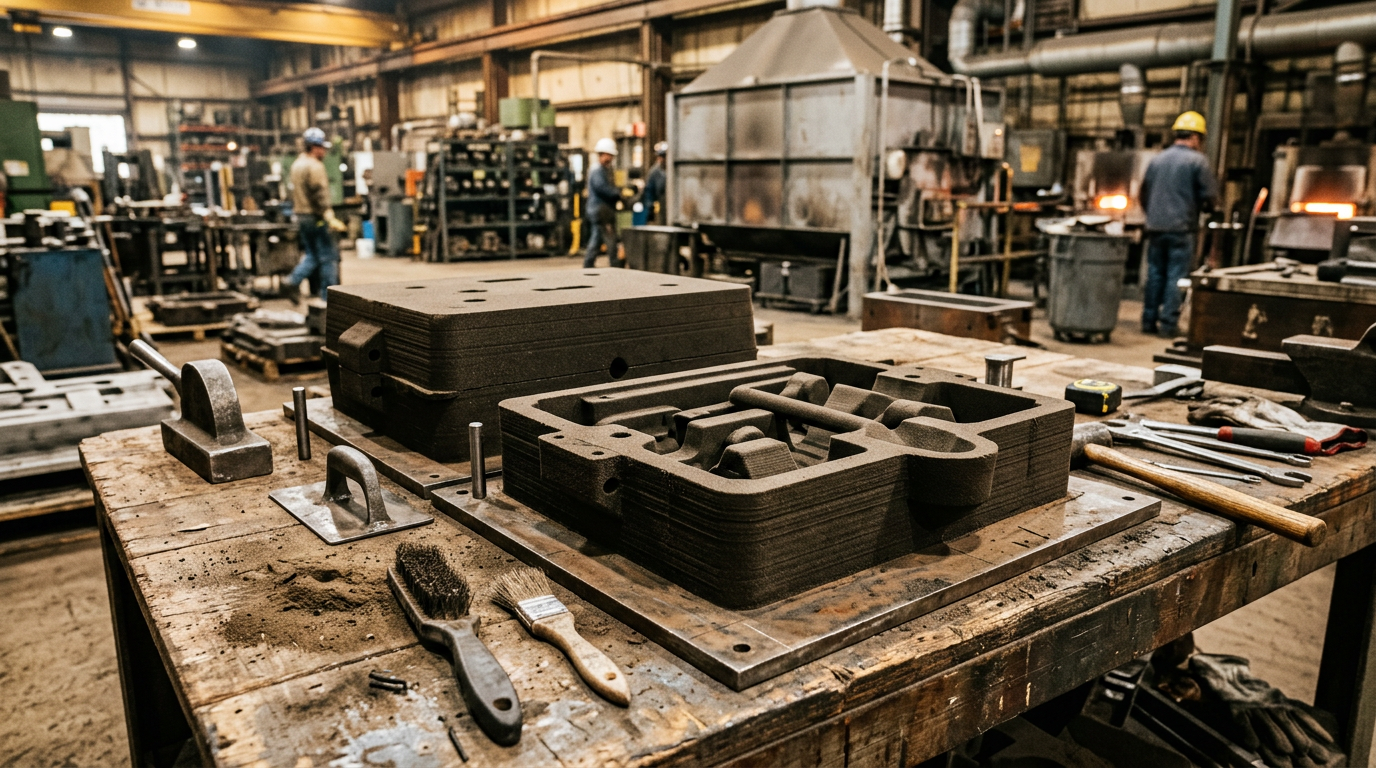
The real advantage shows up in one-off and short-run work. OK Foundry reverse-engineered a 1912 Velie engine block using laser scanning and 3D printed the sand molds and cores. Complex water jacket passages that would have been cost-prohibitive to core traditionally became economically viable for a single casting. They did the same for a historic elevator reel from a Philadelphia building — spiral groove geometry preserved directly in the casting, no machining.
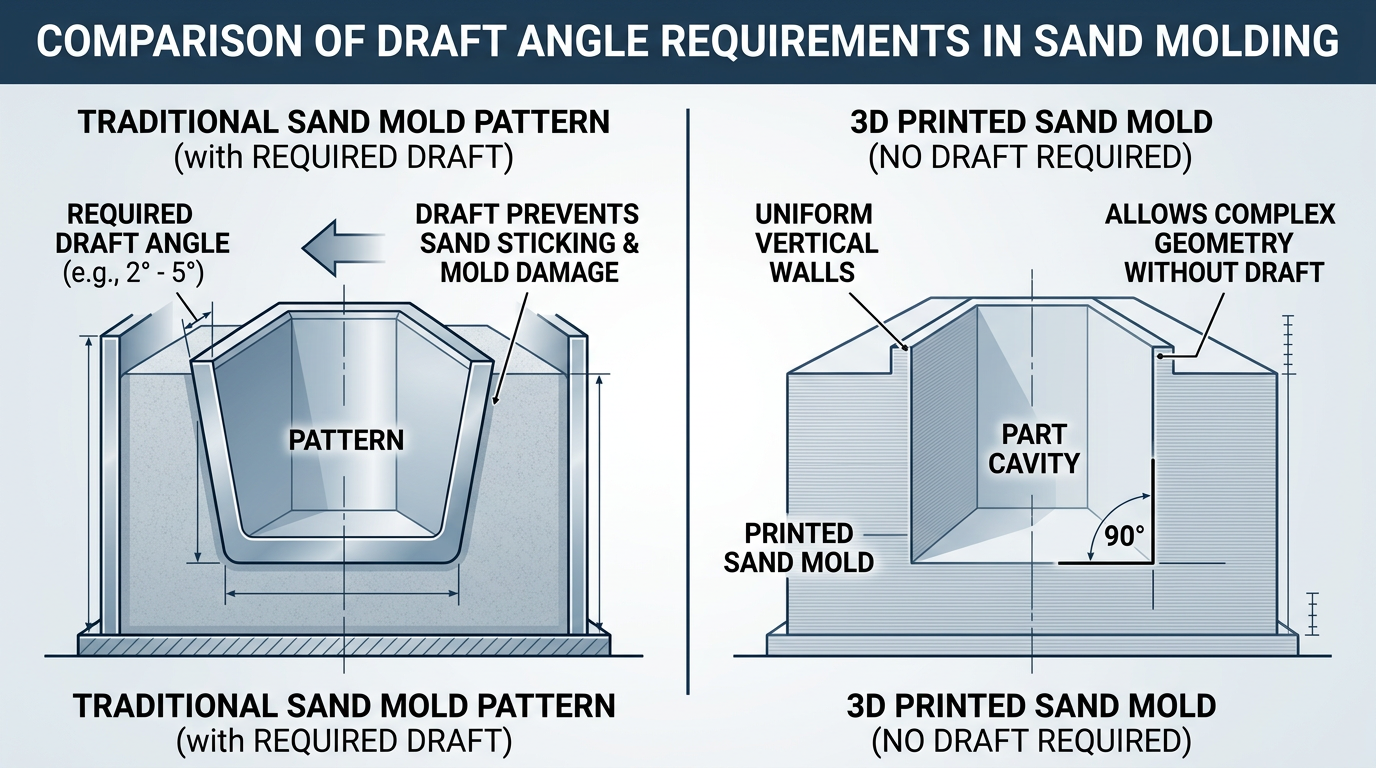
Industrial binder jetting printers hold tolerances of +/-0.3 mm, which is tighter than most hand-rammed molds. The bigger design win is zero draft angle. Traditional patterns need 1-5 degrees of draft for extraction from the sand. Printed molds don’t — the pattern is never physically removed. That means tighter-to-net-shape castings and less machining allowance on finished surfaces.
Before you pour, check the printed mold the same way you’d check any mold. Your binder choice affects the casting as much as the sand — furan binders produce high-strength molds suited for aluminum through steel. Phenolic systems offer better dimensional stability at high temperatures — critical for ferrous pours. Inorganic binders eliminate harmful gas emissions during casting, which is becoming a compliance requirement in more jurisdictions.
3D Printed Cores
Liberty Pattern had an aerospace casting that traditionally required assembling over 20 individual core segments. With binder jetting, they printed the entire core as one piece — eliminating assembly labor and every dimensional error that accumulates at each core joint.
Think about what that means on the shop floor. Every time you glue two core segments together, you introduce a potential shift, a flash line, and a defect interface. Multiply that by 20 joints and you’re managing tolerance stack-up across the entire internal geometry. One printed core has zero joints.
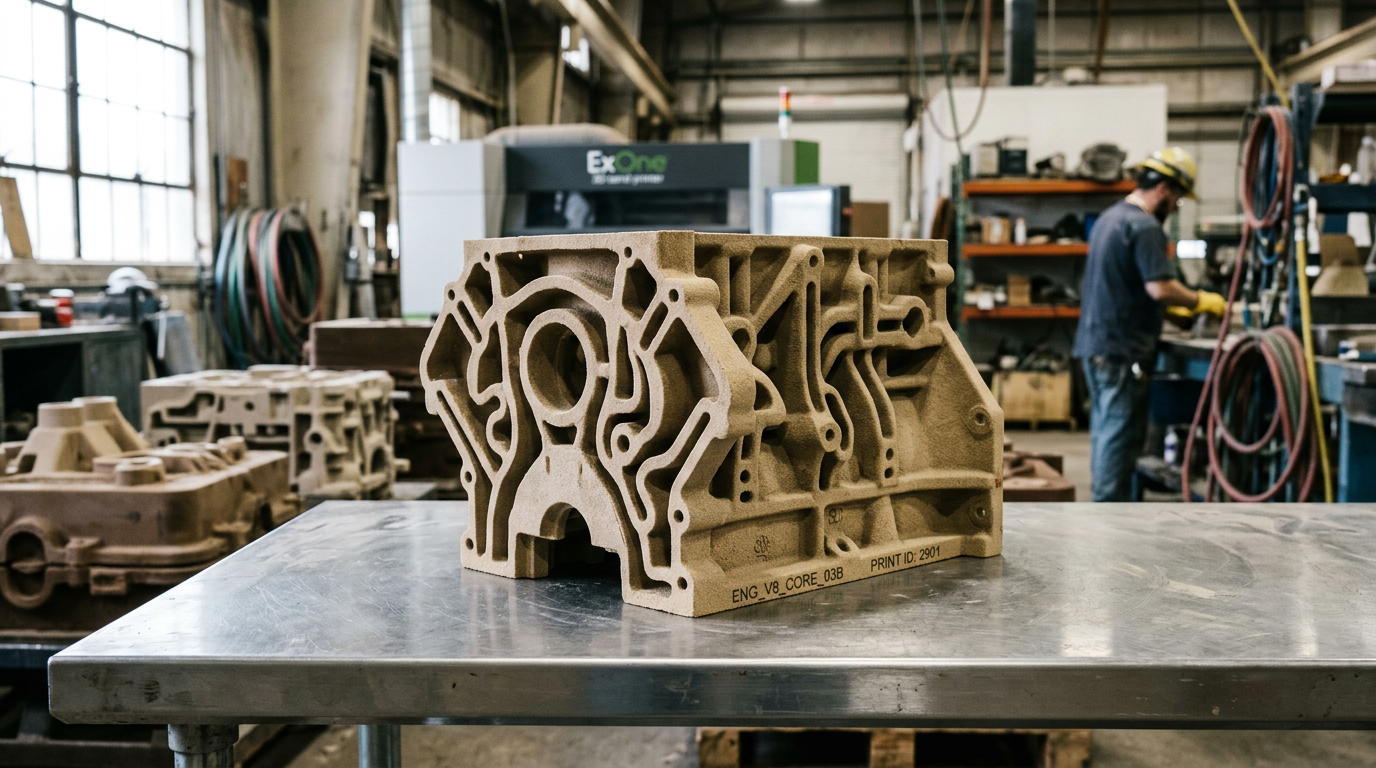
This applies most to castings with complex internal passages — water jackets, oil galleries, manifold runners. If your core design currently requires multi-piece assembly with core prints at each joint, 3D printing can cut your core scrap rate by reducing those joint interfaces to zero. For simple, single-piece cores that you can blow in a core box in 30 seconds, the economics don’t favor printing.
3D Printed Patterns for Investment Casting
3D printing also works upstream of the foundry — printing expendable patterns for investment (lost-wax) casting instead of machining injection molds for wax patterns. Print a resin pattern, invest it in ceramic shell, burn it out, pour metal.
The most common mistake I see is choosing the wrong filament material. PLA — the default filament on most desktop 3D printers — doesn’t vaporize during burnout. It melts out the bottom of the mold or stays partially rigid inside the plaster, making the mold brittle and the casting defective. I’ve seen molds shatter entirely because the PLA expanded during heating before it softened enough to drain.
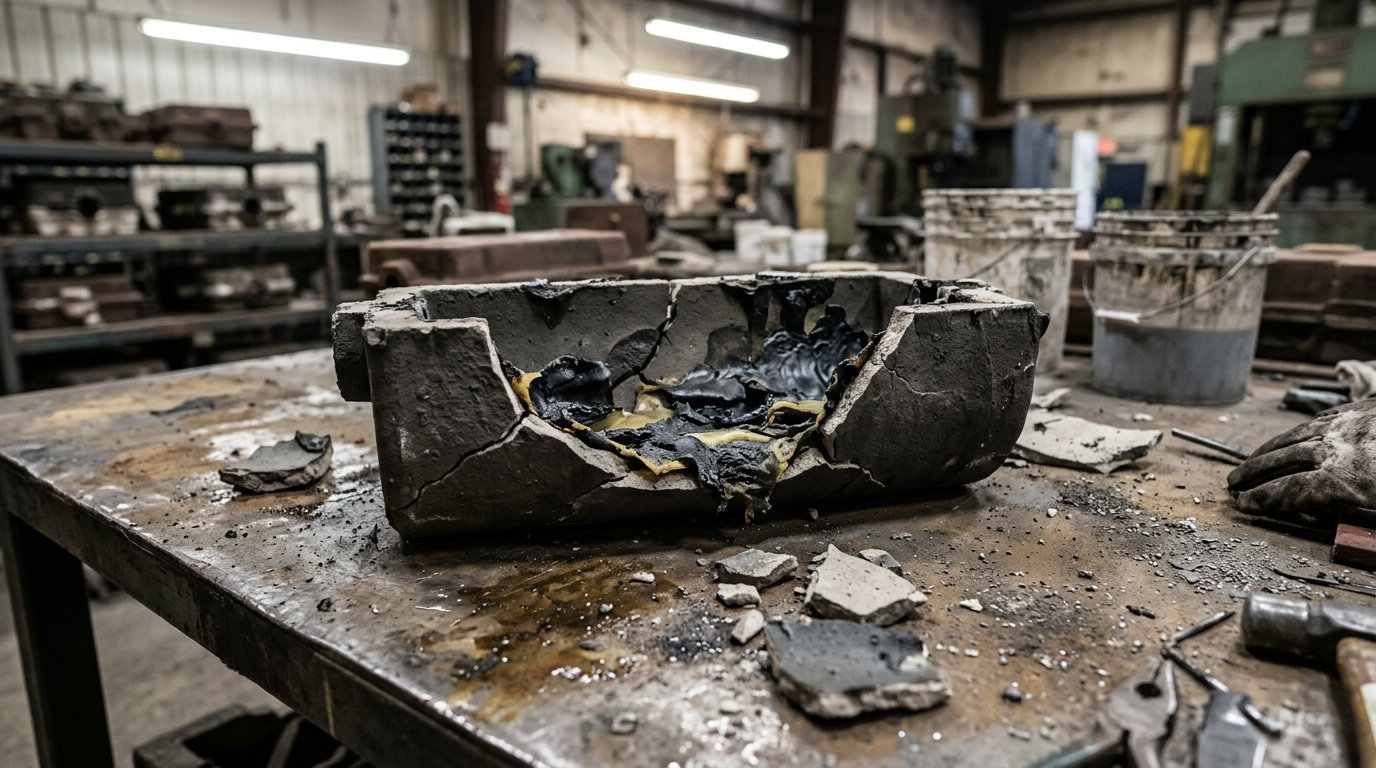
ABS burns out better than PLA, but the cleanest results come from castable resins specifically formulated for burnout. These resins ash out completely at kiln temperatures, leaving a clean cavity. The cost difference between PLA filament and castable resin is negligible compared to the cost of a failed pour.
If you’re printing patterns for investment casting, start with simple geometries with flat backs. Complex designs require understanding where to place gates, sprues, and risers on the printed pattern — the same gating principles apply regardless of how the pattern was made.
Lead Time and Cost Trade-Offs
An automotive supplier needed ZL101A aluminum test parts on a timeline that traditional pattern-making couldn’t meet. With 3D printed sand molds, they had five castings in 25 days versus the 12-16 weeks a conventional approach would have required — over 60% time savings. For complex prototype cylinder heads, the gap is even larger: 3-5 weeks versus 20+ weeks traditional, saving 75-85% of the development timeline.
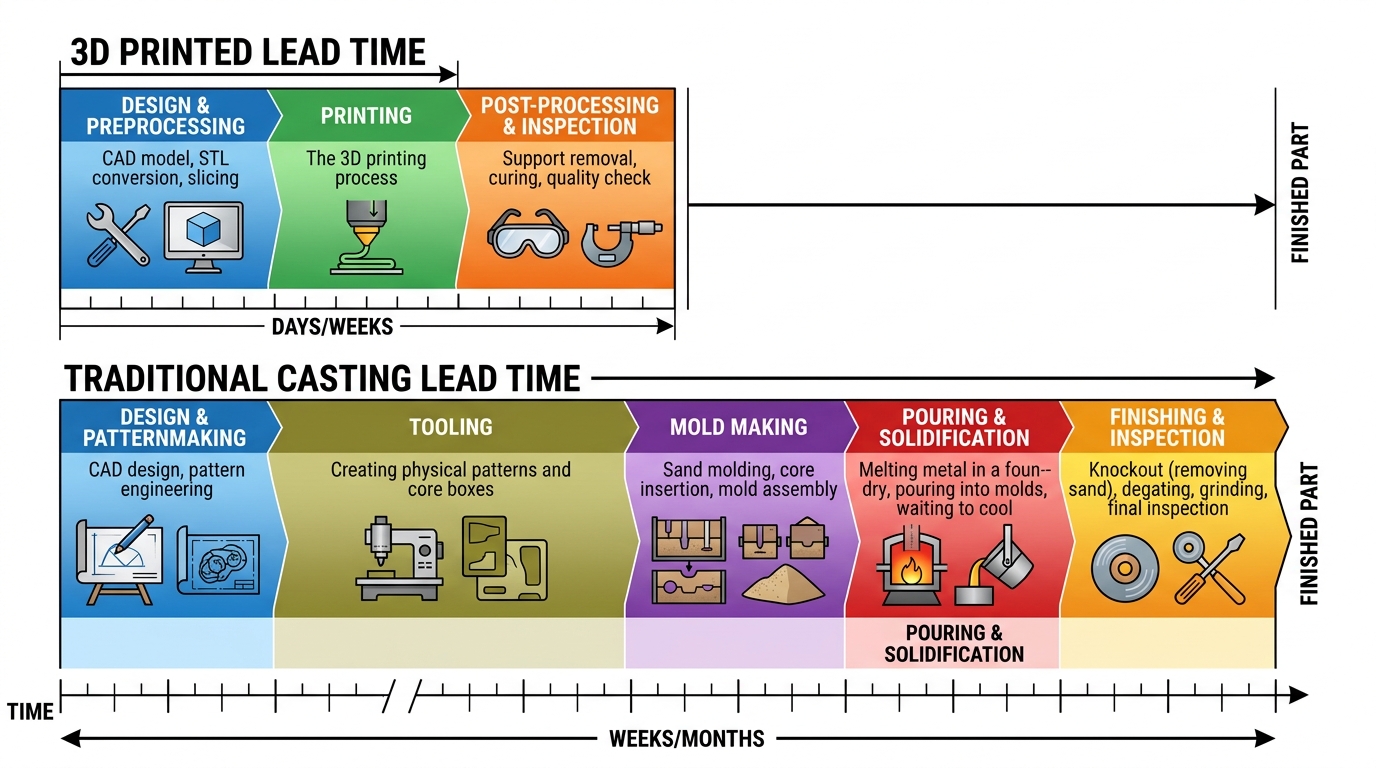
Cost follows a different curve. 3D sand casting has a near-flat cost curve from one to several hundred parts — the per-unit price barely drops with volume because there’s no tooling to amortize. Traditional casting has high upfront tooling cost but far lower per-unit cost at volume. The crossover depends on part complexity and size, but as a general guide, the break-even against traditional tooling happens around six parts for printed sand cores.
The 75% savings figures you see in vendor literature are real, but they apply to prototype and low-volume work. At production volumes above a few hundred parts, traditional tooling costs amortize to pennies per casting while printed mold costs hold steady.
When 3D Printing Doesn’t Make Sense for Casting
High-volume production. If you’re casting 1,000+ identical parts per year, invest in proper patterns and core boxes. The per-unit economics of 3D printing cannot compete with traditional tooling at scale. The cost curve that looks flat at low volumes becomes a ceiling at high volumes, while traditional tooling costs amortize to near zero.
Large castings. Current build volumes on industrial sand printers max out around 31.5 x 15.7 x 19.7 inches. That covers a lot of components, but if you’re pouring machine bases, large valve bodies, or structural frames, you’re back to conventional mold-making. Some printers offer larger build envelopes, but the equipment cost puts them out of reach for most foundries.
Simple geometries. A rectangular housing with no internal passages doesn’t benefit from the geometric freedom of 3D printing. A pattern maker can produce a wood or metal pattern for simple shapes faster and cheaper than the turnaround time on a 3D printing service bureau. The technology pays for itself in complexity — without complexity, you’re paying a premium for convenience.
The right question isn’t whether to use 3D printing for casting. It’s where in your specific workflow the technology removes a bottleneck. For prototypes, complex cores, and legacy part reproduction, it eliminates weeks of lead time and thousands in tooling cost. For production runs of simple parts, your existing patterns and core boxes remain the better tool.
Matching the Method to the Job
Three applications justify 3D printing in a foundry workflow: prototyping where lead time outweighs per-unit cost, complex cores where consolidation eliminates assembly and improves dimensional accuracy, and legacy reproduction where no pattern exists and only one or two castings are needed. Everything else still belongs to traditional tooling. The one shift I didn’t expect — foundries that started with 3D printed prototyping molds are now redesigning production castings to take advantage of zero draft angles and consolidated cores, even when they eventually switch back to traditional tooling for the production run. The printed mold is becoming a design tool, not just a manufacturing shortcut.