What Happens When Casting Sand Has Moisture
Moisture is what holds a green sand mold together, and missing the right amount in either direction causes defects. Too

Moisture is what holds a green sand mold together, and missing the right amount in either direction causes defects. Too
Aero Metals, American Casting Company, AMT, Barron Industries, Eagle Alloy, Fisher Cast Steel, MetalTek International, Milwaukee Precision Casting, Northern Stainless
Draft angle in sand casting is the taper given to every pattern wall that runs perpendicular to the parting line,
Sand casting patterns are made from wood, plastic (polyurethane board or castable epoxy and urethane), metal (aluminum or cast iron),
Subsurface pinholes in ductile iron castings are prevented by limiting the hydrogen and nitrogen that reach the metal at the
The gating system in sand casting is the set of channels molded into the sand that carries molten metal from
Choose a chemical binder by the casting first (the metal you pour, the size of the part, and whether the
Look for a foundry that pours ductile iron as its main metal, controls magnesium treatment and inoculation on every ladle,
Most cast iron parts belong in a sand mold: green sand for long runs of parts under a few hundred
Casting sand is recycled inside the foundry: the same sand is cleaned, cooled, topped up with new sand and binder
The difference is water: a green sand mold is poured moist, and a dry sand mold is the same clay-bonded
Expendable mold casting is any casting process in which the mold is destroyed to get the casting out, so a
At 2025 scrap prices the charge metal in a gray iron green sand casting works out to about $0.49 per
Moulding sand is the refractory granular material a foundry packs around a pattern to form a mould cavity: silica grains
An iron casting is proved on five things: chemical composition, mechanical properties from a test bar, microstructure, internal and surface
Green sand is silica sand bonded with bentonite clay, activated by water, with a carbonaceous additive such as sea coal
Cast iron comes in five types — gray, ductile, compacted graphite, white and malleable — and what separates them is
A spark test, a chisel cut or a fresh fracture places an unmarked part on one side or the other,
There is no single ASTM standard for cast iron. ASTM publishes a family of separate iron-casting specifications under Committee A04,
The cope is the upper section of a sand mold and the drag is the lower one — the two
A match plate pattern is a split pattern whose cope and drag halves are mounted back to back on one
A casting defect is repaired by locating it with an NDT method that can actually see it, excavating all of
Making a mold for metal casting means packing bonded sand around a pattern in two flask halves, cutting the passages
Metal casting shrinkage is the volume a casting loses on its way from the ladle to room temperature, and it
Casting defects sort into a small number of families, and the family tells you what physically went wrong: gas the
Investment casting fills a shape with liquid metal; forging squeezes solid metal into a shape. Every other difference between the
The ten investment casting manufacturers below — Precision Castparts, Howmet Aerospace, CPP, Impro, Doncasters, Hitchiner, Signicast, ZOLLERN, MetalTek and RLM
Alloy settles this comparison before anything else does. Die casting is commercially a non-ferrous process, so a carbon steel, stainless
An investment casting shop runs several waxes side by side — pattern, runner, soluble, sticky, repair and dipping — and
Investment casting works with almost any alloy that can be melted and poured, and in industrial practice the choice narrows
Alloy and annual volume decide this, and for a ferrous part they decide it immediately: permanent mold casting is in
Casting metal means melting an alloy, pouring it into a cavity shaped like the part, and letting it freeze —
Tupy, Waupaca Foundry, MAT Foundry Group, Grede, Impro Precision, MetalTek, Grainger & Worrall, Harrison Castings, Badger Alloys and Benton Foundry
Draft Angle Calculator inmm Offset from angleAngle from offsetDie casting (NADCA) Wall height from parting line, L (in.) Draft angle,
Casting processes divide by the mold and by what drives the metal into it. The mold is either expendable —
Lost foam casting gives you internal passages without cores and a casting without a parting line; green sand gives you

A ferrous investment casting still needs machining, but only on the minority of features whose print callouts exceed what any
Investment casting is a process in which a ceramic shell is built up in layers around a disposable wax pattern,
Sand inclusions are fragments of mold or core sand trapped in the casting, nearly always at or just under the
Nearly every defect on a ferrous sand casting traces to one of five causes: gas the mold could not vent,
Machining allowance is the extra metal left on a casting’s to-be-machined surfaces so the finishing cut can take off the
Ductile iron grades are sets of minimum mechanical properties defined by two standards: ASTM A536 in North America, with five
Heat treatment changes the matrix of a ductile iron casting — to ferrite, pearlite, tempered martensite or ausferrite — and
Choose cast steel when the part must take impact, bending or internal pressure and yield before it breaks; choose cast
The difference between ductile iron and gray iron is the shape of the graphite: ductile iron carries it as spheroids,
Sand castings are inspected with six NDT methods, and the one to call out depends on where the defect you
Sand casting shapes metal as a liquid, poured into a sand mold and solidified in place; forging shapes it as
Choose sand casting for any part that is not a plain body of revolution, and centrifugal casting for tubes, sleeves,
The ten sand casting factories below — Dawang Metals, Dandong Foundry, Shandong Useen, Ninghai Jinma, Taiyuan SIMIS, Haian Aoyu, Cangzhou
Shell mold casting holds tighter tolerances, a smoother as-cast surface and thinner walls than green sand; green sand costs less
Coated sand casting and resin sand casting differ in when the resin meets the sand and how it cures. Coated
Resin sand casting is sand casting in a mold bonded by a synthetic resin that hardens through a chemical reaction,
Casting patterns fall into eleven recognized types, and what separates them is not the shape of the part but how
Investment casting holds tighter tolerances; sand casting tools cheaper and goes heavier. Five numbers from your own print decide which route fits a specific ferrous part.
Die casting is the better process for aluminum, zinc, and magnesium parts made in quantities that pay for a tool-steel
The first 3D printed sand mold I unpacked looked wrong. The layer lines were visible, the surface felt rougher than
Green sand is the cheaper mold for small and medium ferrous castings made in volume; no-bake is the better process
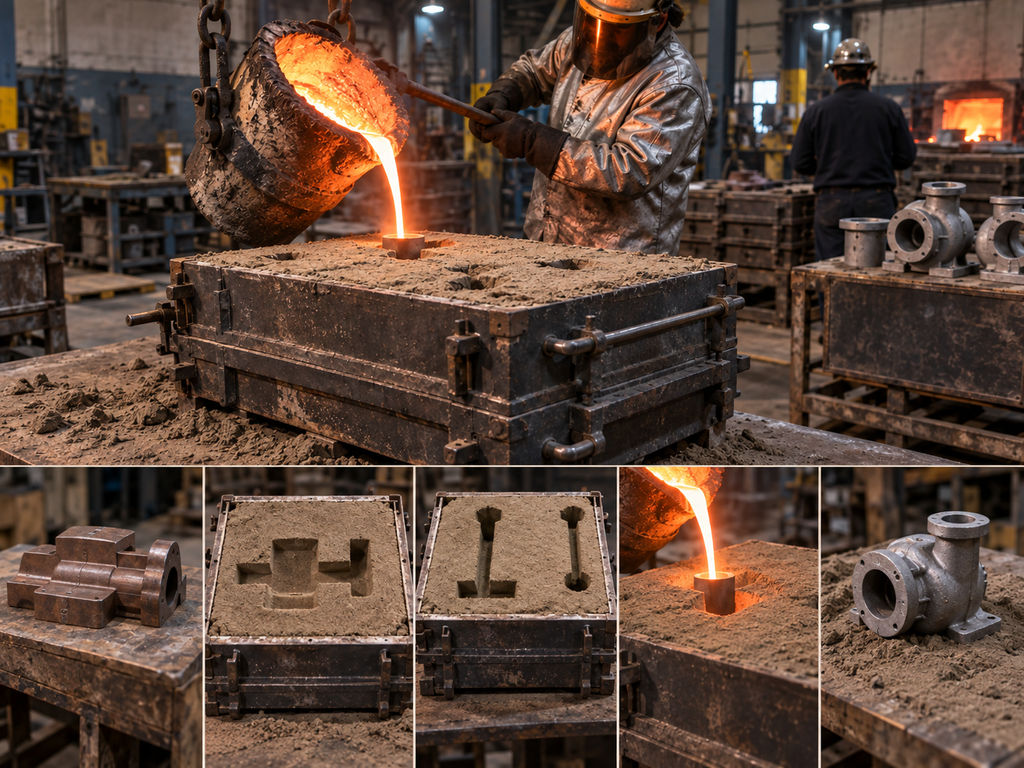
Green sand casting is sand casting in a mold bonded with clay and water instead of a chemical resin. The
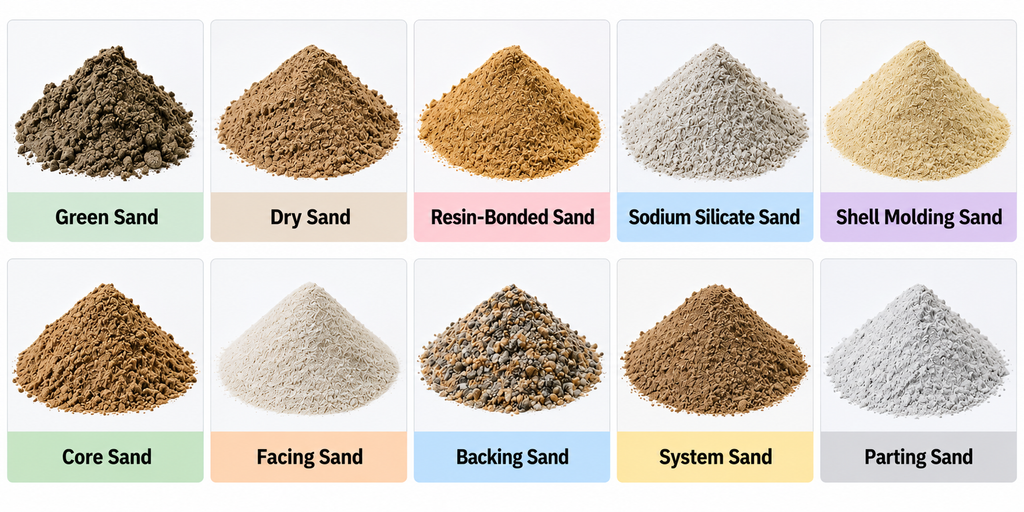
Four base sands and three binder families are two separate specification decisions. The sintering, expansion and acid demand numbers that separate them for ferrous casting.
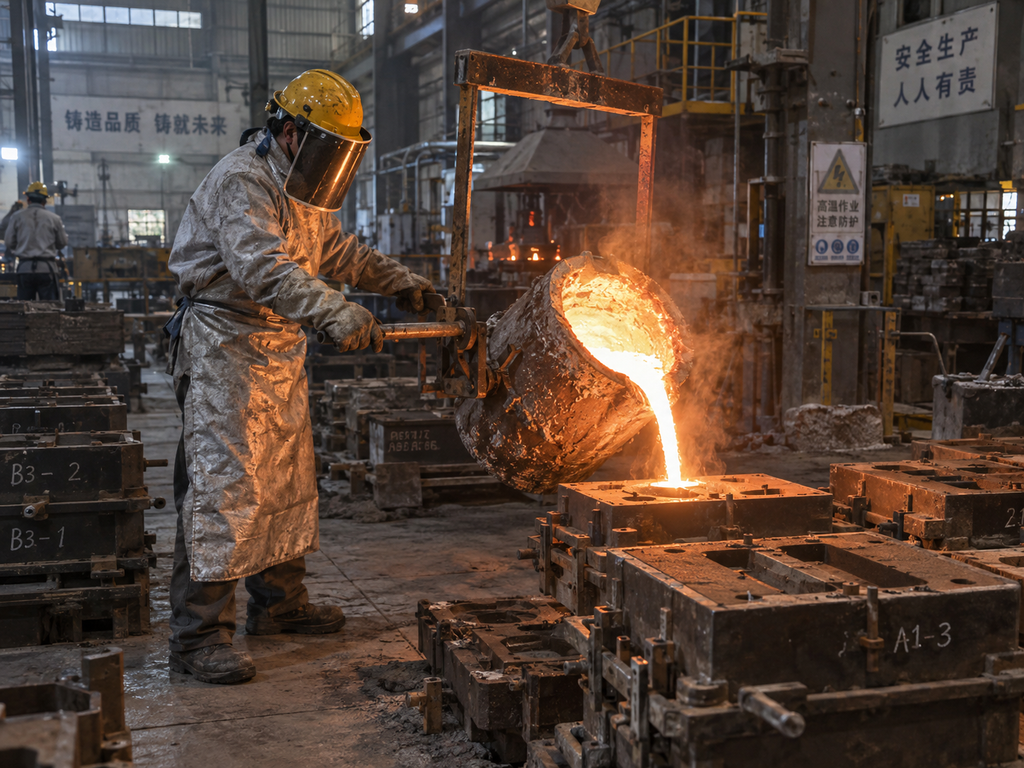
Sand casting is the process of forming a cavity in bonded sand around a pattern, pouring molten metal into that