Automated green sand lines produce over 300 molds per hour — faster than any other sand casting method. That speed, combined with near-total sand reuse and low tooling cost, is why green sand accounts for roughly 40% of all sand castings made in the United States. But speed means nothing if you can’t hit your tolerances. The typical green sand description stops at “economical and versatile” without a single number to work with. Here’s what you actually need to specify green sand casting for your next component.
How Green Sand Casting Works
A green sand mold is held together by moisture, not heat. The “green” refers to the mold’s uncured, wet state — it never goes through an oven or chemical hardening step. A typical mix runs about 85% silica sand (average grain size 220-250 micrometers), 10-11% bentonite clay as the binder, and 3-4% water. Some shops add sea coal or other carbonaceous additives to improve surface finish and reduce metal penetration.
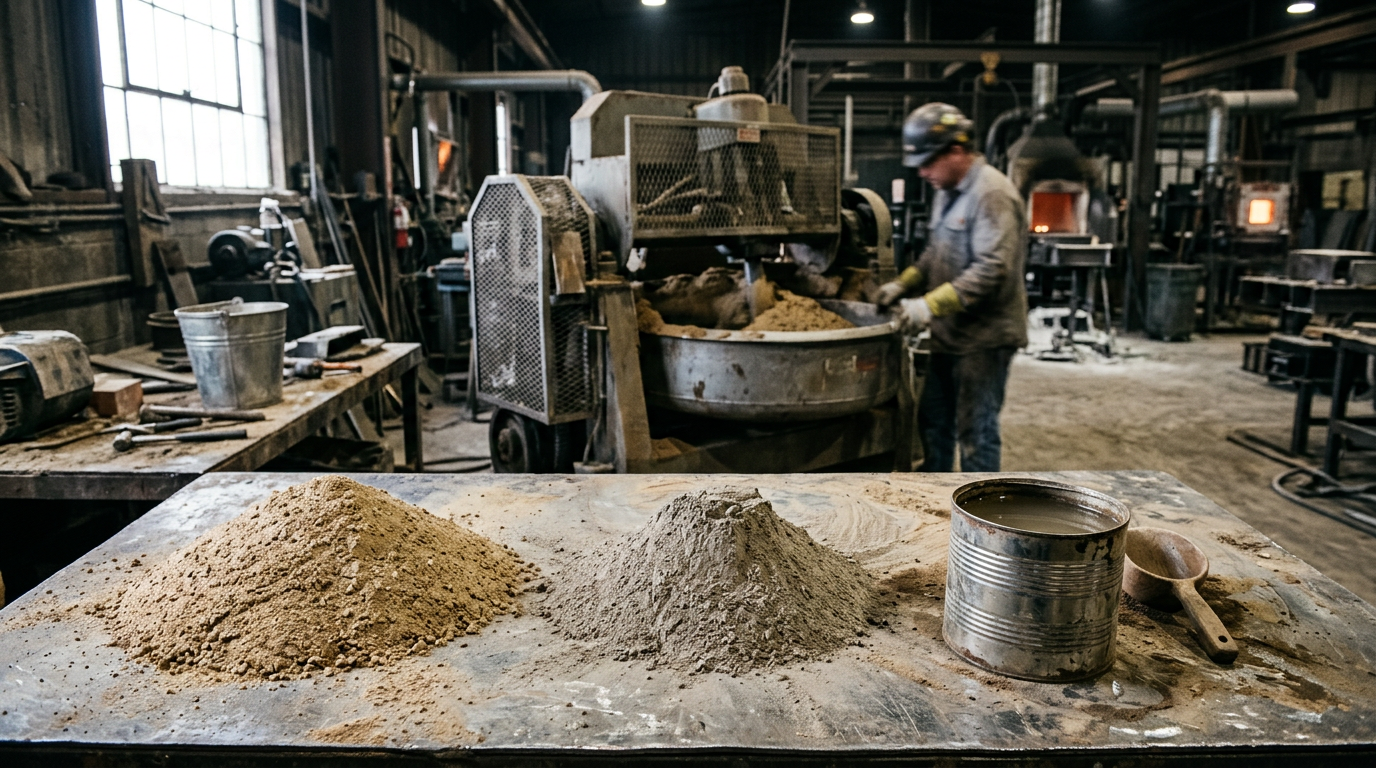
The core sand casting process applies here with one key difference: no curing step. Sand is compacted around a pattern — either by hand ramming in a flask or by high-pressure squeeze on an automated molding machine. The pattern splits the mold into two halves: the cope (top) and drag (bottom). Once compacted, the pattern is withdrawn, cores are set for internal features, and the two halves are closed. Metal is poured, the casting solidifies, and the mold is broken apart. The sand goes straight back to the muller for reconditioning.
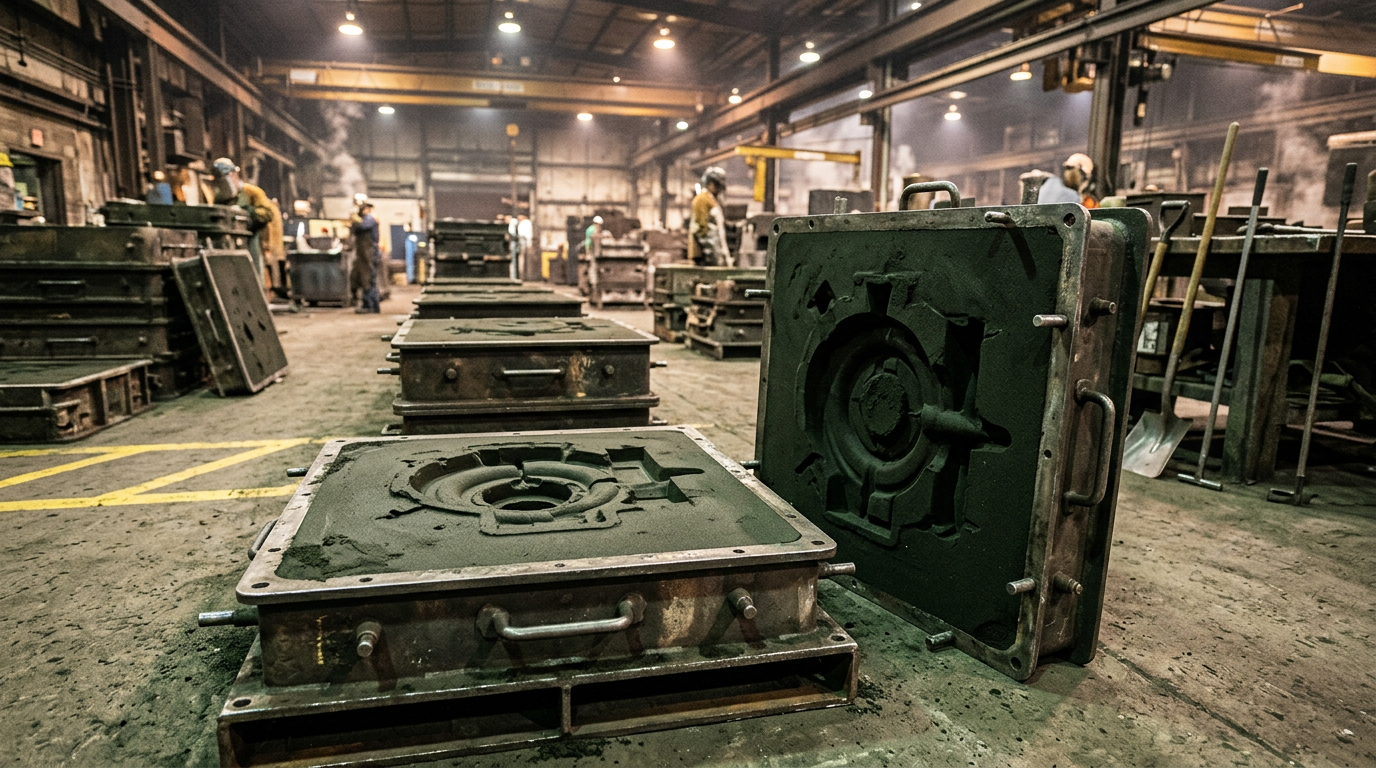
What makes green sand different from resin-bonded sand or no-bake systems is cycle time. Because the sand needs no curing, you can strip and reuse it within minutes. That’s the fundamental advantage — and the fundamental constraint, since an uncured mold is softer and less dimensionally stable than a chemically bonded one.
Tolerances, Surface Finish, and Weight Range
Practical baseline tolerance for small green sand castings is +/-0.060 inches — and that single number answers the question engineers ask most often about this process.
Dimensional Tolerances
Can you push tolerance to +/-0.030 inches? Technically yes, but rejection rates climb and per-piece cost increases. Design to the practical number and machine critical surfaces.
One distinction that changes how you tolerance a drawing: dimensions within a single mold half (cope or drag only) are much tighter than dimensions that cross the parting line. Achievable tolerances reach +/-0.4-0.5 mm within a single mold half, but mold closure adds another 0.2-0.25 mm of variation across the parting line. If your critical dimension spans that joint, either plan for machining or ask your foundry about locating pins.
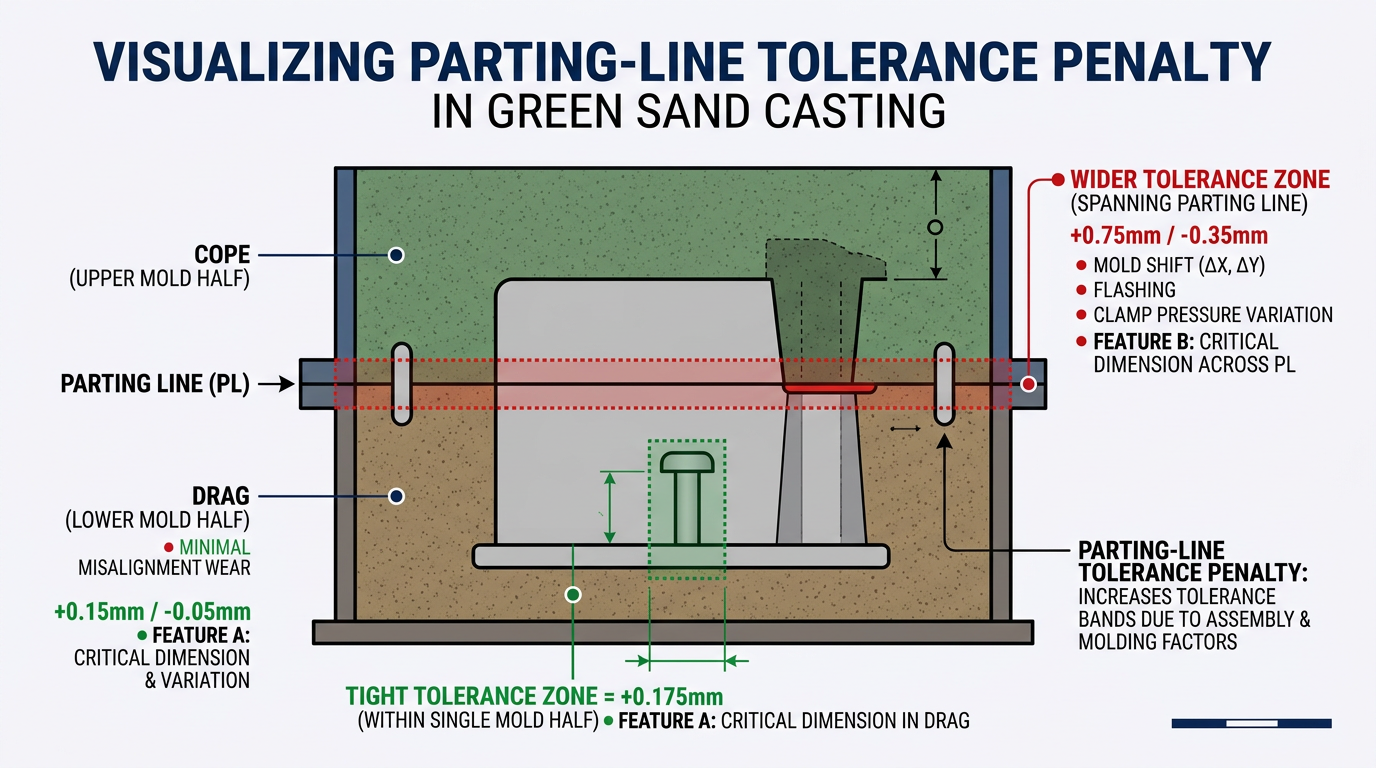
For typical (non-optimized) work, expect +/-1 mm linear tolerance with an additional +/-1 mm across parting lines and core joints.
Surface Finish
Green sand produces 250-900 RMS (micro-inches, root mean square) surface finish depending on sand grain size, compaction density, and alloy. That range determines how much machining you’ll need downstream.
For comparison: shell molding delivers 75-150 RMS, and investment casting achieves 50-125 RMS. Green sand is roughly 2-10 times rougher. If your part needs better than 250 RMS on non-machined surfaces, green sand is not the right process.
Weight and Flatness
Green sand handles castings from a few ounces up to 500 pounds routinely, with some foundries pouring pieces up to 7,000 pounds. Flatness capability runs about 0.1 mm per 25 mm of span, excluding localized pitting. For large flat surfaces, factor in straightening or machining.
Design Rules for Green Sand Castings
Pattern quality determines casting quality. I’ve seen perfectly good metal ruined by a pattern that ignored basic green sand constraints. These numbers keep you out of trouble.
Wall Thickness
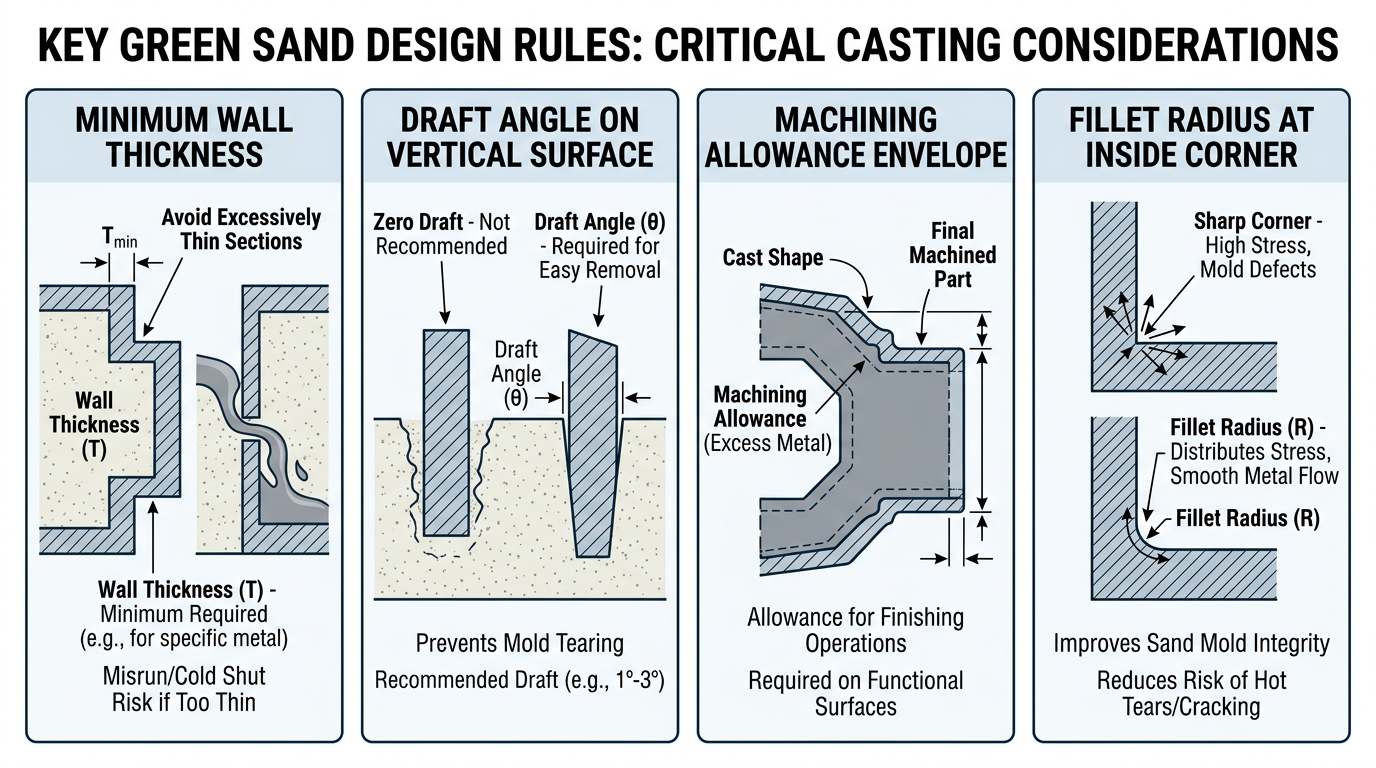
Minimum wall thickness depends on the alloy. Light alloys (aluminum, magnesium) can go as thin as 3 mm. Ferrous alloys — gray iron, ductile iron, steel — need 5-6 mm minimum. Thinner walls are technically possible but demand special attention to venting, gating, and shrinkage allowance in the pattern.
Draft Angles
Plan for 1-3 degrees of draft on all vertical surfaces. Two degrees is a safe default. One degree is achievable on well-maintained patterns with good sand properties, but zero draft will tear the mold every time. Internal surfaces need more draft than external ones because the casting shrinks onto internal features as it cools.
Machining Allowances
Before you pour, check your machining stock. For iron castings, bore machining allowances range from 0.1 inches on small bores up to 0.4 inches on bores over 80 inches in diameter. External surface allowances follow a similar scale: 0.09-0.4 inches depending on the overall dimension. As a general rule, budget 0.5-1.6% of the casting dimension or 1.5-6 mm, whichever is greater.
Shrinkage
Build shrinkage into your pattern dimensions. Gray iron shrinks 3-4% by volume during solidification, steel 4-5%, and aluminum 6-7%. Your pattern maker should apply alloy-specific shrink rules, but as the design engineer, keep these numbers in mind when dimensioning features that interface with machined components.
What Green Sand Does Well and Where It Falls Short
Green sand is the workhorse of the casting industry for reasons that go beyond just being cheap. Automated lines running 300+ molds per hour give you production rates that no other sand process can match. Tooling lasts — polyurethane patterns handle around 5,000 shots, and aluminum tooling runs 50,000-100,000 units before replacement. The sand itself is nearly 100% recyclable through mechanical reclamation.
The most common mistake I see is engineers specifying green sand for the wrong application because they only read the advantages list. Here is where green sand is the wrong choice:
- Tight tolerances without machining. If your part needs +/-0.010 inches on as-cast surfaces, switch to investment casting or shell molding. You’ll spend more on green sand rejections than on a tighter process.
- Thin-wall ferrous parts. Below 5 mm wall thickness in iron or steel, green sand molds struggle with incomplete fill and shrinkage defects. No-bake molds, with their higher rigidity, give better thin-wall results.
- Large castings over 1,000 pounds. Green sand mold strength limits practical size. No-bake and air-set processes handle heavy castings up to 50 tons because the chemically bonded sand resists metallostatic pressure better.
- Surface finish below 250 RMS as-cast. If cosmetic finish matters on non-machined surfaces, shell molding (75-150 RMS) or investment casting (50-125 RMS) gets you there without secondary operations.
Gray iron and ductile iron are the alloys that run best in green sand — they pour at moderate temperatures, fill thin sections reliably, and produce predictable shrinkage. Carbon steel and stainless steel are feasible but demand closer attention to gating and risering because of higher pour temperatures and greater shrinkage.
Making the Right Specification
Green sand casting earns its dominance through speed, cost, and material flexibility. But “economical and versatile” only takes you so far on a drawing. Specify to +/-0.060 inches baseline, machine surfaces tighter than 250 RMS, and keep walls above 5 mm for ferrous alloys. Those three rules eliminate most of the problems I troubleshoot on the foundry floor. When your requirements push beyond those boundaries, that’s not a failure of green sand — it’s a signal to evaluate shell, no-bake, or investment casting for that specific component.