If 42% of North American foundries run green sand and 40% run no-bake, why does every comparison guide act like one process is obviously better? Because the real answer depends on your project, not the process.
Most guides hand you the same binary: no-bake for quality, green sand for cost. I’ve poured metal into both types of molds for over 15 years, and that framing leaves out the five factors that actually drive the decision — volume, part weight, tolerance class, alloy, and secondary operations. Get any one of those wrong, and you’ll either overpay for precision you don’t need or machine away tolerances you should have cast in.
Where Tolerances and Surface Finish Actually Overlap
No-bake molds cure into a rigid, brick-like structure that resists metal pressure during pouring. Green sand molds are compressible. That physics difference is real — but the tolerance gap it creates is smaller than most guides suggest.
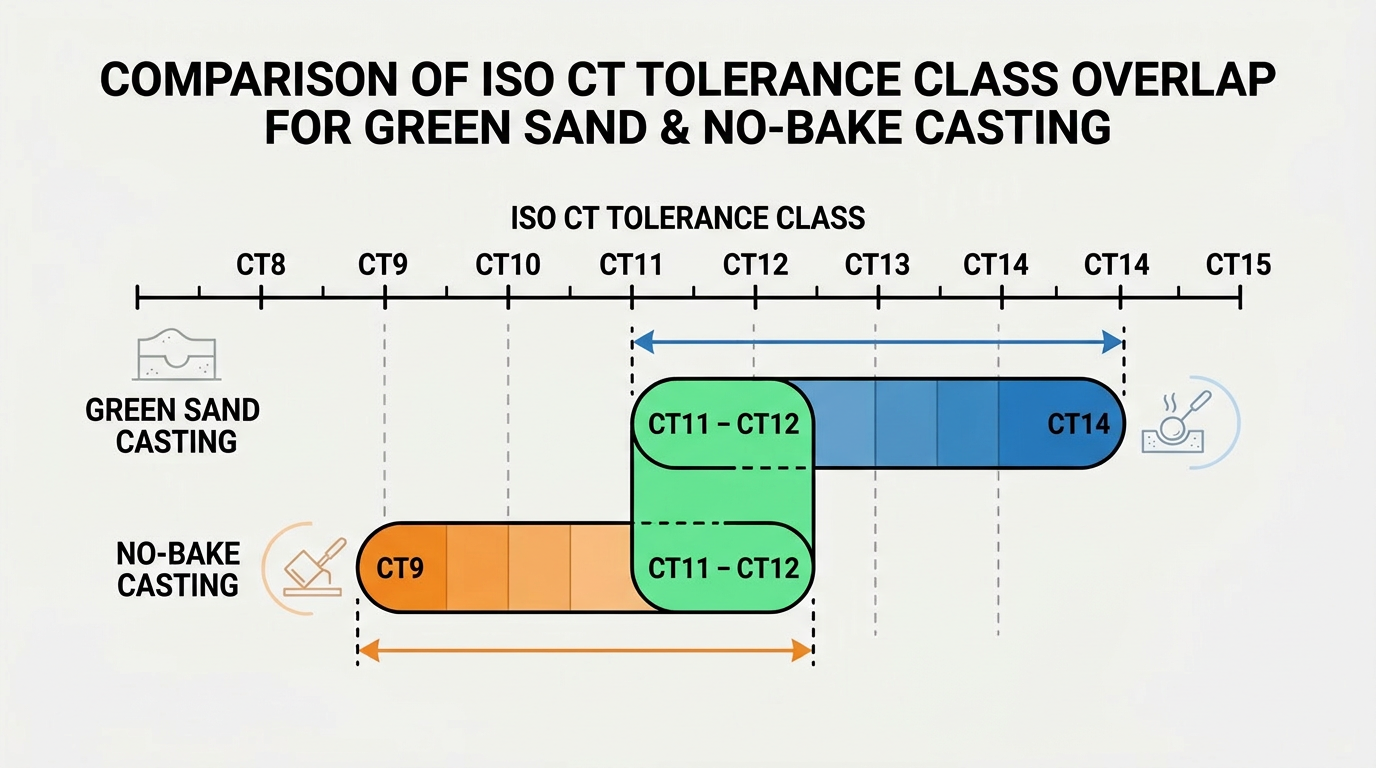
In ISO casting tolerance (CT) classes, green sand falls in the CT11 to CT14 range, roughly +-0.5% to +-2.0% of a given dimension. No-bake achieves CT9 to CT12, or about +-0.3% to +-1.2%. Notice the overlap at CT11-CT12. For a 100 mm feature, that shared zone means green sand can hold +-1.0 mm while no-bake hits +-0.8 mm — a difference many parts never need.
Surface finish tells a clearer story. No-bake delivers Ra 3-6 micrometers straight from the mold. Green sand lands at Ra 6-12 micrometers. If your print calls for a machined surface anyway, that gap disappears at the mill.
Before you spec the process, check the print. If the casting’s critical surfaces will be machined, the as-cast finish difference rarely matters. If you need as-cast surfaces below Ra 6, no-bake is the right call.
Why Piece Price Alone Misleads on Cost
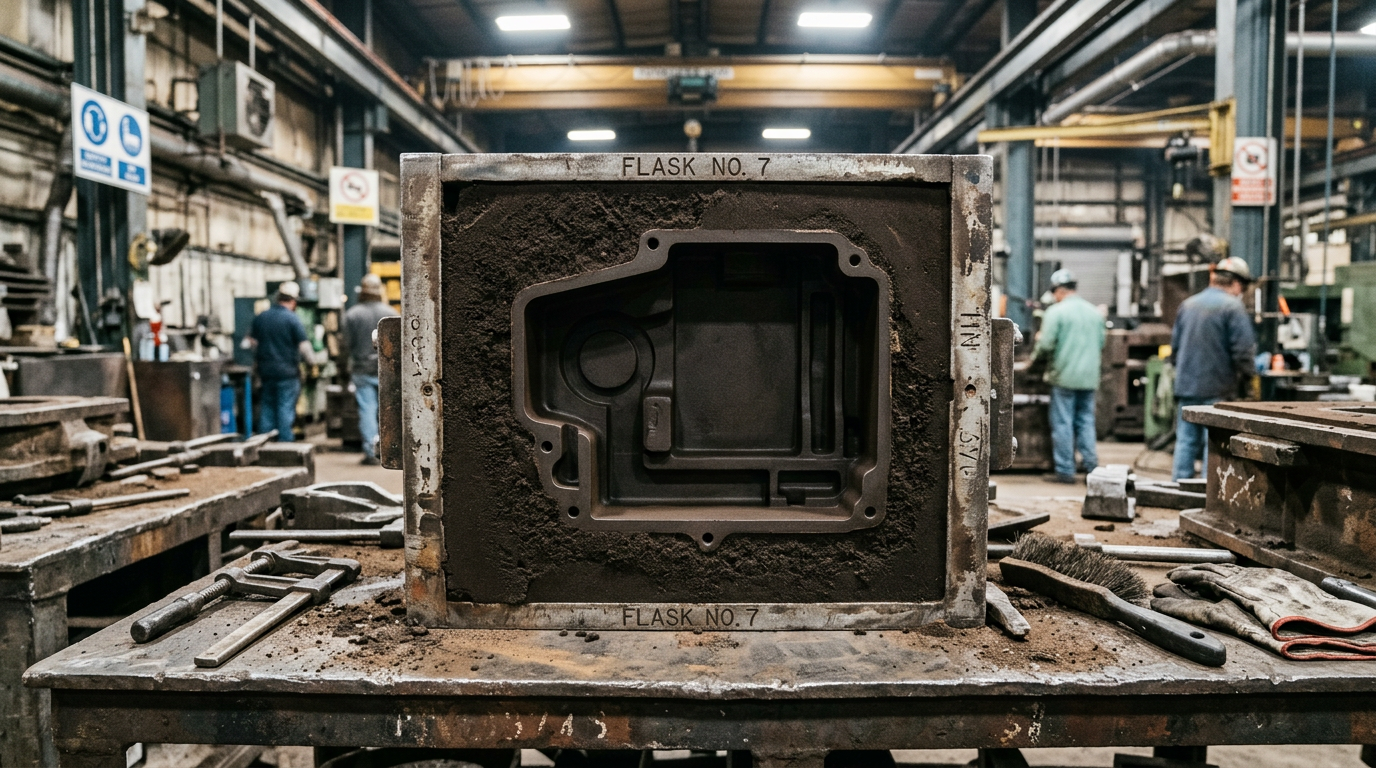
No-bake raw materials run 30-50% more than green sand, and the mold itself costs roughly twice as much. On a per-piece quote, green sand wins almost every time.
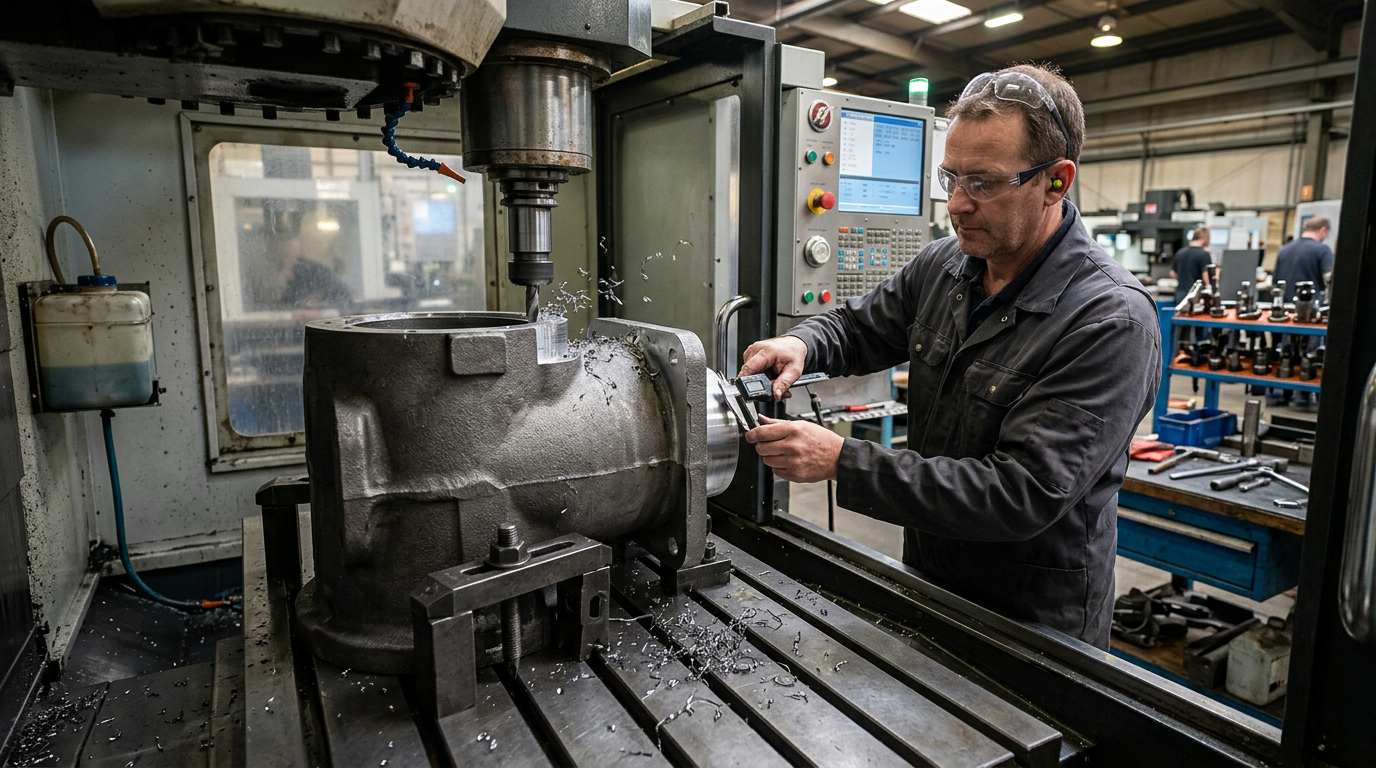
I’ve seen foundry cost comparisons where no-bake actually came out cheaper than green sand for medium grey iron castings — once machining costs were included. Tighter as-cast tolerances meant less stock removal, fewer setups, and faster cycle times on the CNC. The casting cost more; the finished part cost less.
The total cost equation flips based on three variables:
- Machining intensity — Parts with multiple machined surfaces favor no-bake’s tighter as-cast dimensions. Parts with one or two machined faces? The green sand savings usually hold.
- Scrap exposure — A scrapped no-bake casting wastes more material cost per piece. At higher volumes, green sand’s lower per-unit risk adds up.
- Tooling amortization — Green sand match plates cost more upfront than no-bake loose patterns, but amortize faster at volume. For a 200-piece order, tooling cost per part dominates the equation. For 5,000 pieces, it’s noise.
Don’t accept a foundry quote at face value without asking what machining allowance is built in. That single number often determines which process is actually cheaper for your finished part.
How Volume Changes Everything
Mechanized green sand lines produce up to 500 molds per hour. No-bake produces 20-30. That’s not a marginal difference — it’s a 15-25x throughput gap that makes volume the single most decisive factor in process selection.
No-bake’s sweet spot is roughly 1-5,000 castings per year. Below that range, the setup and pattern costs dominate regardless of process. Above it, green sand’s throughput advantage crushes the per-unit math.
But the crossover point is not a fixed number. A 500 lb valve body at 2,000 units per year might still favor no-bake because the mold rigidity prevents dimensional drift that would require expensive secondary machining. A 15 lb bracket at the same volume is almost certainly green sand. Weight shifts the entire equation — heavier castings amplify no-bake’s rigidity advantage, while lighter parts rarely stress a green sand mold enough to cause dimensional problems.
The most common mistake I see in new projects is foundries defaulting to whatever process their equipment supports, then engineering the rigging around the process limitation. Work the decision the other way: define the part requirements first, then find the process — and the foundry — that fits.
The Five-Factor Decision Matrix
Most engineers know their volume and part weight but stop short of mapping those against tolerance class, surface requirements, and alloy. Here’s the framework I use when a customer asks which process fits their project.
| Factor | Favors Green Sand | Either Process | Favors No-Bake |
|---|---|---|---|
| Annual volume | >5,000 parts | 1,000-5,000 | <1,000 parts |
| Part weight | <50 lbs | 50-500 lbs | >500 lbs |
| Tolerance class | CT13-CT14 acceptable | CT11-CT12 | CT9-CT10 required |
| Critical surfaces | All machined post-cast | Mixed | As-cast finish needed |
| Alloy | Standard grey/ductile iron | Carbon steel | High-alloy, specialty |
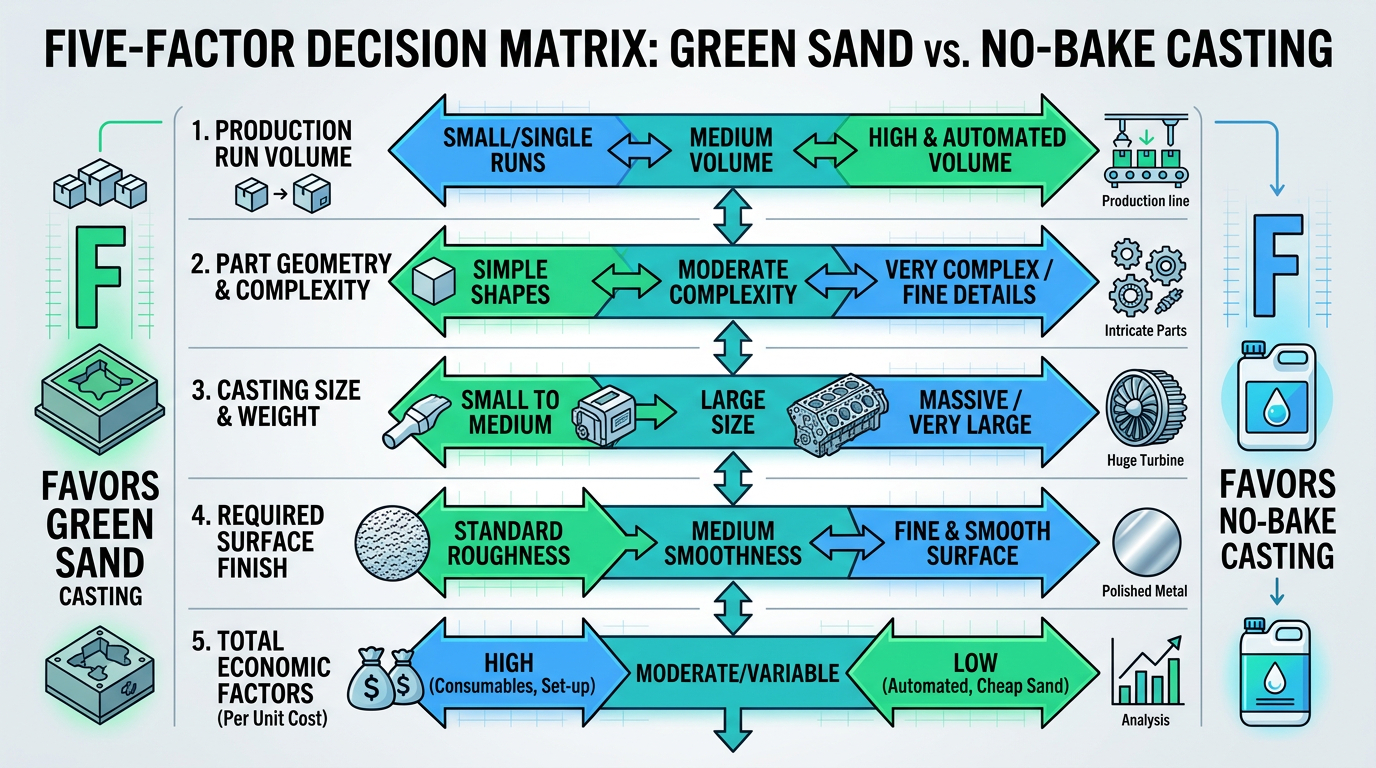
Start from the top. If three or more factors point the same direction, your answer is clear. If they split, weight the top two rows — volume and part weight drive more process decisions than tolerance class alone.
Here’s how it works in practice. Say you need 3,000 grey iron brackets at 25 lbs each, CT12 tolerance, with two machined mounting surfaces. Volume is in the “either” column. Weight favors green sand. CT12 is shared territory. Machined surfaces mean as-cast finish doesn’t matter. Grey iron runs well in both processes. Four of five factors lean green sand or neutral — and the per-piece cost savings seal it. Now change that bracket to a 600 lb pump housing at 200 units per year, and every factor flips.
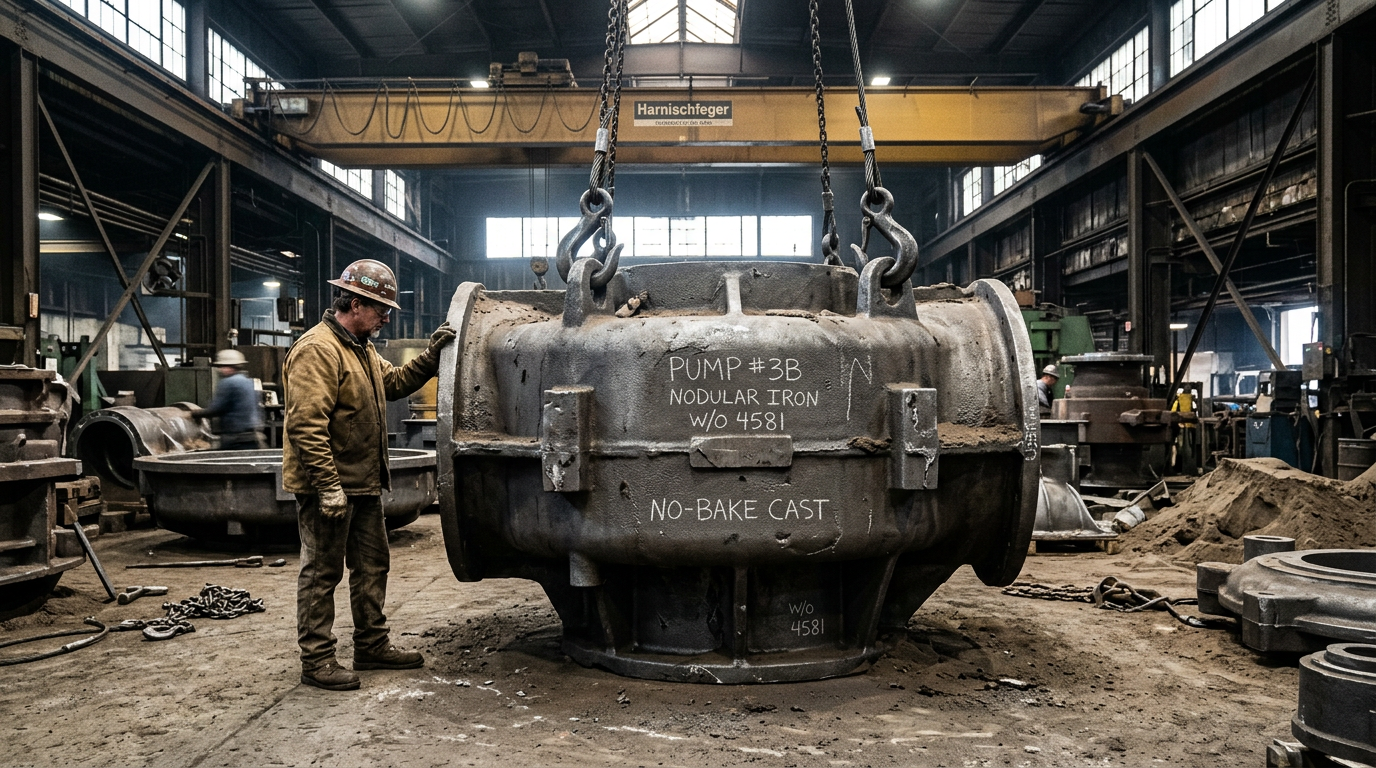
Good gating design prevents 70% of casting defects regardless of which process you choose. I’ve pulled beautiful castings from green sand molds with well-engineered rigging, and I’ve scrapped no-bake parts where the gating was an afterthought. The mold is only half the equation.
Making the Right Choice
The question is never “which process is better?” It’s “which process fits this part, at this volume, with these tolerances?” Run your project through the five factors. If the answer still isn’t clear, request sample castings from both processes — a trial run costs far less than committing to the wrong process for a production contract. Most foundries that run both sand types will tell you the same thing: neither process wins every job, and the ones that claim otherwise are selling their installed capacity, not solving your problem.