Sand casting accounts for roughly 46% of global metal casting volume — a $190 billion industry. That number surprises people who hear “70% or more” repeated online, but the higher figures reflect ferrous casting by weight, not the full market including die-cast aluminum and zinc. Sand casting dominates large-part and ferrous metalwork because no other process matches its flexibility across production scales and part sizes.
I’ve spent 15 years making molds, pouring metal, and chasing down defects. Most process explanations read like a textbook checklist. The reality on the shop floor is messier and far more dependent on getting the details right.
How Sand Casting Works
The process has six stages, but they are not equal. Sand preparation and solidification control matter most — skip the details on either one, and you will scrap castings.
Pattern and Sand Preparation
Everything starts with a pattern — a replica of the final part, oversized to account for metal shrinkage (typically 1-2% for steel, less for iron). Patterns can be wood for short runs, aluminum for mid-volume, or 3D-printed for prototyping. The most common mistake I see in new patterns is ignoring draft angles. Without 1-1.5 degrees of taper on vertical walls, the pattern tears the sand when you pull it out.
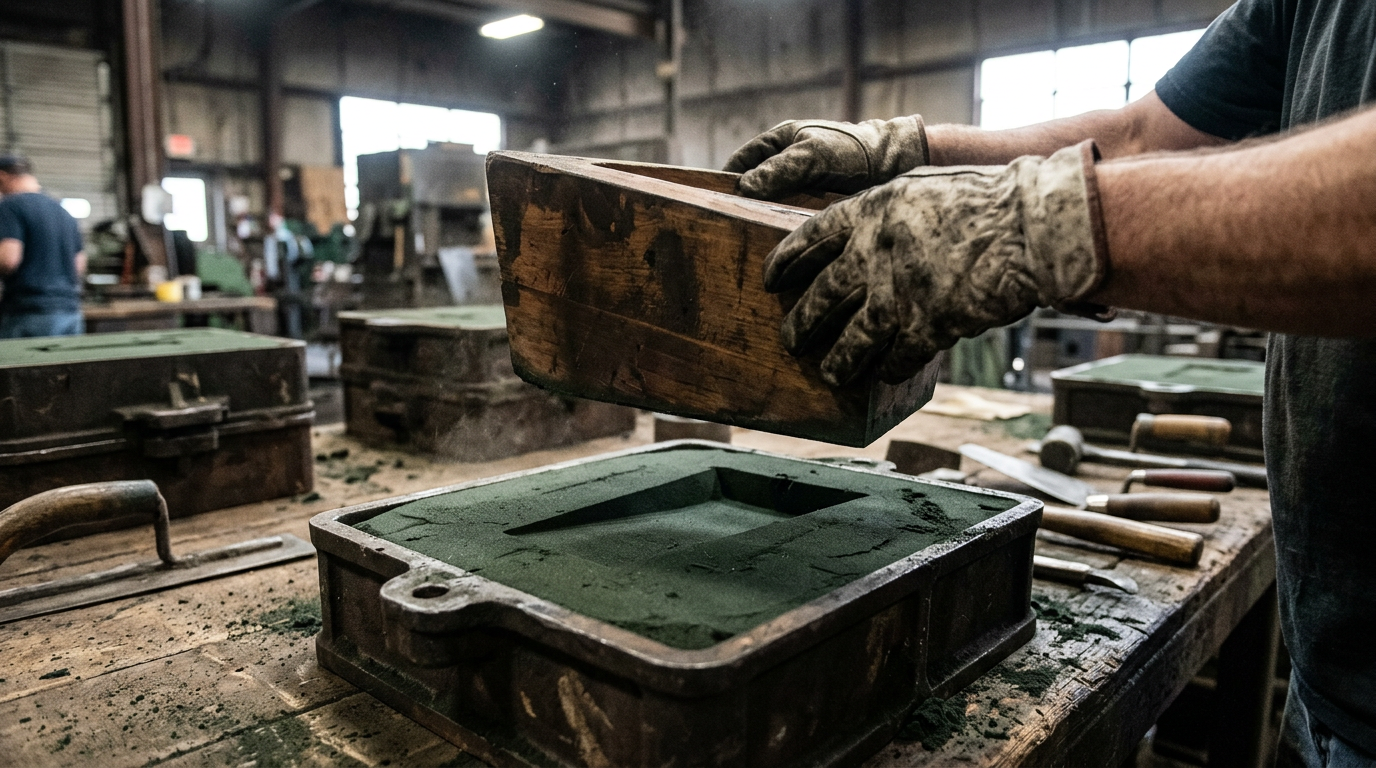
Green sand — a mix of silica sand, clay binder (bentonite), and water — is the workhorse. “Green” means moist, not the color. Here is the paradox: moisture activates the clay binder and gives the mold strength, but too much generates steam when hot metal hits it, trapping gas bubbles in your casting. The window between “too dry to hold shape” and “too wet, porosity everywhere” is narrow.
Molding and Gating
The mold is built in two halves: the cope (top) and drag (bottom). You pack sand around the pattern in each half, then separate them to remove the pattern and cut the gating system — channels (sprue, runner, ingates) that guide molten metal into the cavity, plus risers that act as metal reservoirs.
Good gating design prevents 70% of casting defects. Risers must solidify last — if a riser freezes before the section it feeds, that section starves of liquid metal and voids form inside.
Pouring and Solidification
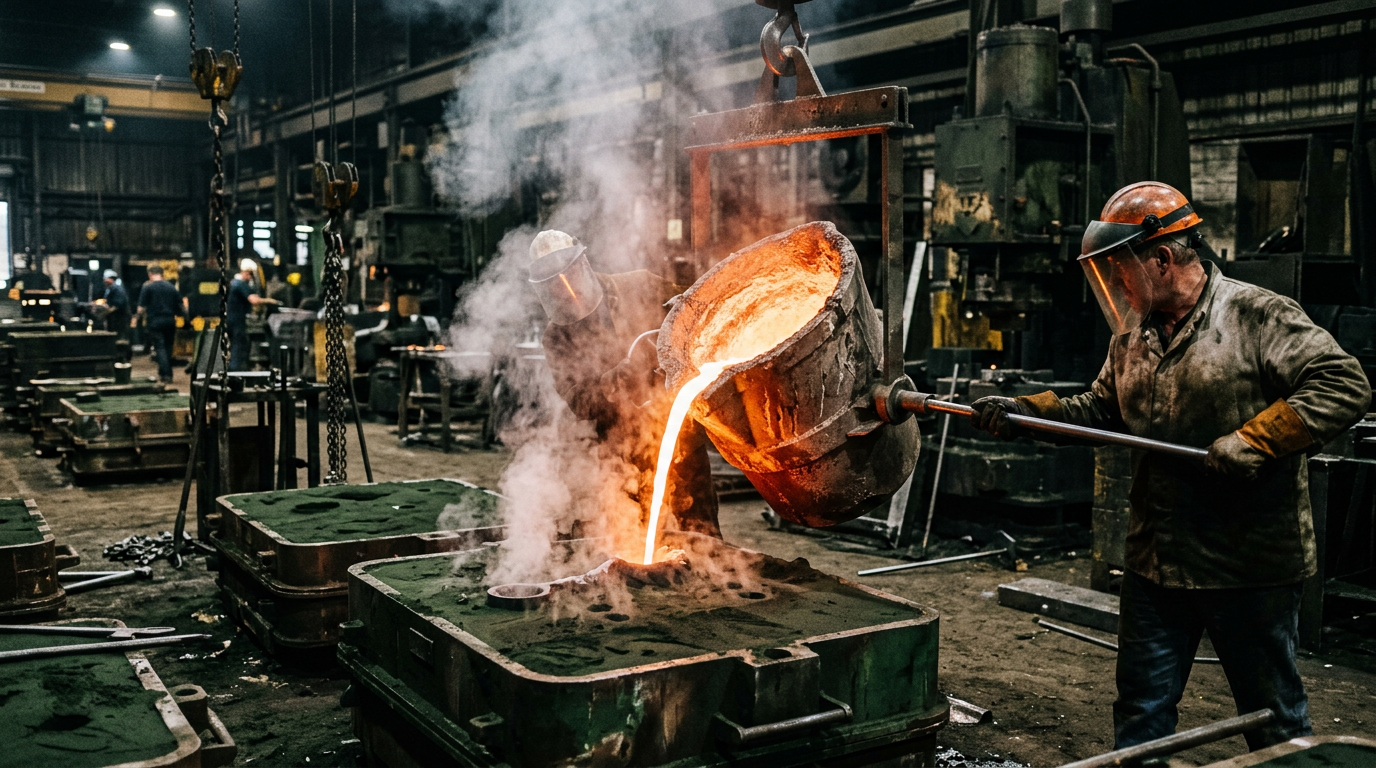
Metal is melted and poured through the sprue. Pour too hot and you get excessive shrinkage; too cold and metal freezes before filling thin sections.
Solidification is not passive waiting. Shrinkage is geometry-dependent — thick sections freeze last and need dedicated risers feeding them liquid metal throughout cooling. Before you pour, check that every thick section has a riser path. Get this wrong, and you find voids buried inside otherwise good-looking castings.
Shakeout and Finishing
The sand mold is broken apart (shakeout) and the raw casting removed. Gates, risers, and flash are cut off, followed by grinding, heat treatment if required, and machining to final dimensions. As-cast surface finish typically runs 250-500 RMS microinches. Critical surfaces get CNC machined — in-house machining capability means castings can ship as finished, ready-to-install components.
Materials and Part Sizes
Sand casting handles nearly every engineering alloy. Cast iron — gray and ductile — accounts for over 55% of all castings produced globally. Carbon steel, stainless steel, aluminum, and bronze are all routine.
Part sizes range from a few pounds to over 100 tons. Die casting tops out around 50-75 pounds; investment casting rarely exceeds a few hundred. If your part is larger, sand casting is likely your only option.
When Sand Casting Fits and When It Doesn’t
Sand casting’s real advantage is economic flexibility, not precision. It serves both one-off prototypes (wood patterns, minimal tooling) and production runs of thousands (metal patterns, automated lines).
Sand casting fits when:
- Parts weigh more than a few pounds and less than several tons
- Production volumes range from one prototype to several thousand per year
- As-cast tolerances of +/- 1.5 mm or looser are acceptable
- Complex internal geometries require sand cores
Sand casting does not fit when:
- Thin walls under 3 mm are needed consistently
- Surface finish must be better than 125 RMS without machining
- Annual volumes exceed 10,000+ identical parts (die casting becomes cheaper)
- As-cast tolerances tighter than +/- 0.5 mm are required
What the Textbook Leaves Out
I have watched beginners struggle through three or four pours before getting an acceptable casting. The problems are almost never about the metal — they are about sand preparation and mold handling. Sand edges crumble when the pattern is pulled because the mix is wrong or the parting agent fights the binder.
Pattern quality determines casting quality. A rough pattern surface transfers directly to the mold cavity and then to your casting. If you are seeing recurring defects in the same location pour after pour, work backwards from the riser and the pattern before blaming the metal.
Always pour a trial run on new patterns. I have seen gating designs that looked perfect on paper produce shrinkage porosity in every pour until we moved a riser two inches closer to a thick section.
Getting Started with Sand Casting
Start with three questions: What does the part weigh? What alloy does it need? What are the tightest tolerances required as-cast? Those answers tell a foundry 80% of what they need to quote your project.
Bring a 3D model with critical dimensions called out. Ask about pattern costs upfront — wood patterns keep first-run investment low while you validate the design. After the trial proves out, production volume determines whether upgrading to a metal pattern makes sense.
The foundries that consistently produce good castings are the ones that treat sand prep and gating as engineering problems, not afterthoughts.