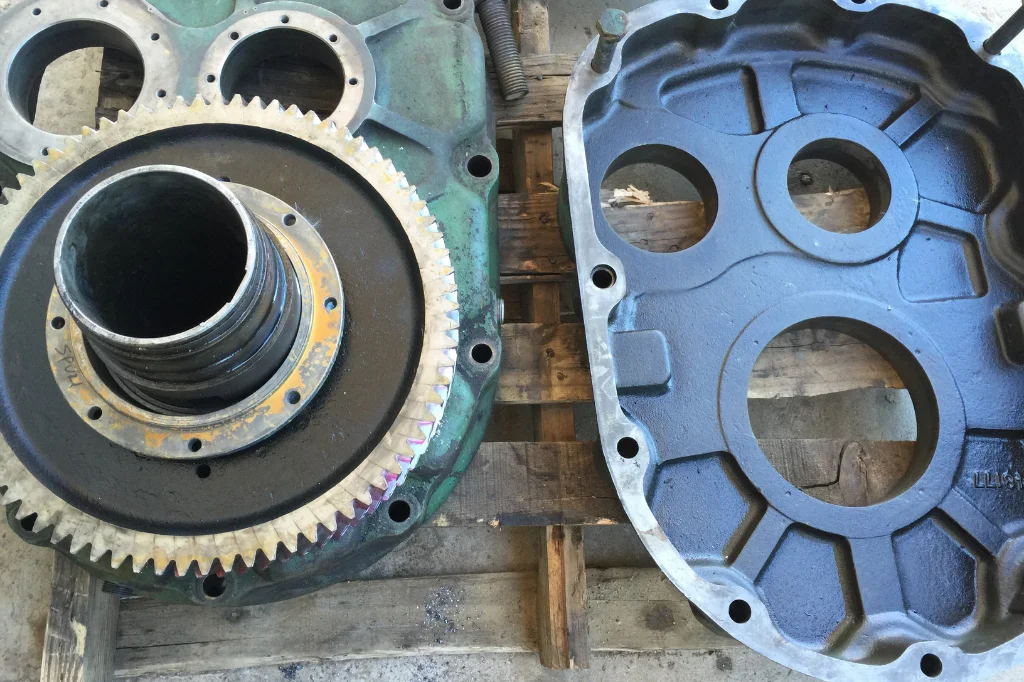
Custom Gearbox Housing Manufacturing & Machining Services
We engineer and manufacture heavy-duty custom gearbox housings for industrial applications. From resin sand casting to 5-axis CNC machining, we deliver ready-to-assemble gear cases direct to North American loading docks.
What is a Custom Gearbox Housing and Why Does Precision Matter?
A custom gearbox housing serves as the rigid foundation for any mechanical power transmission system. The gear case must protect internal components from harsh industrial environments while dissipating the immense heat generated by friction. More importantly, the housing must maintain absolute dimensional stability. If the internal bearing bores shift under heavy torque, the gear teeth will misalign and wear prematurely.
At Kurt Foundry, we specialize in pouring and machining heavy-duty gear reducer housings for the construction, mining, and agricultural sectors. We understand that a custom gearbox casing is not just a metal shell. The casting requires strict metallurgical control to prevent internal porosity, especially in thick bearing hubs where shrinkage defects commonly occur.
We eliminate supply chain middlemen. Our foundry engineers review your CAD drawings, cast the raw housing, and utilize in-house 5-axis CNC centers to machine the bearing and shaft alignments to precise tolerances. You receive a fully finished component ready for your assembly line.
Materials Used for Custom Gearbox Casings
Selecting the correct alloy for your gear reducer housing dictates the performance and lifespan of the entire transmission unit. We pour a wide range of ferrous metals to match your specific torque and environmental requirements.
| Material Family | Standard / Grade | Tensile Strength (MPa) | Key Benefit for Gearbox Housings |
|---|---|---|---|
| Gray Iron | ASTM A48 Class 30 / 35 | ≥ 207 – 241 | Exceptional vibration damping and superior machinability. Ideal for standard industrial gearboxes. |
| Ductile Iron | ASTM A536 65-45-12 | ≥ 448 | High impact resistance and tensile strength. Best for heavy-duty gear cases experiencing shock loads. |
| Carbon Steel | ASTM A216 WCB | 485 – 655 | Extreme toughness and weldability. Used for massive structural gearboxes in mining and oil applications. |
Engineering the Perfect Gear Case
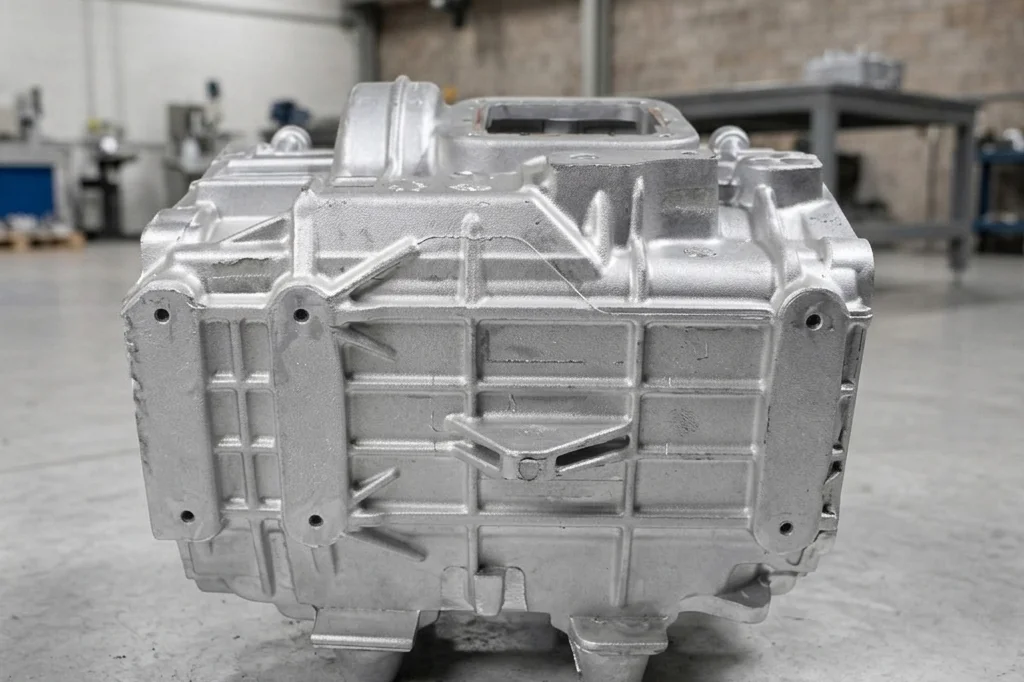
Exceptional Vibration Damping
High-speed gear rotation generates significant vibration. We frequently recommend custom gray iron castings for standard gearbox applications. The flake graphite microstructure within the gray iron acts as a natural dampener, absorbing mechanical resonance before that vibration can damage the internal bearings or surrounding machinery.
Precision CNC Machining for Bearing Alignment
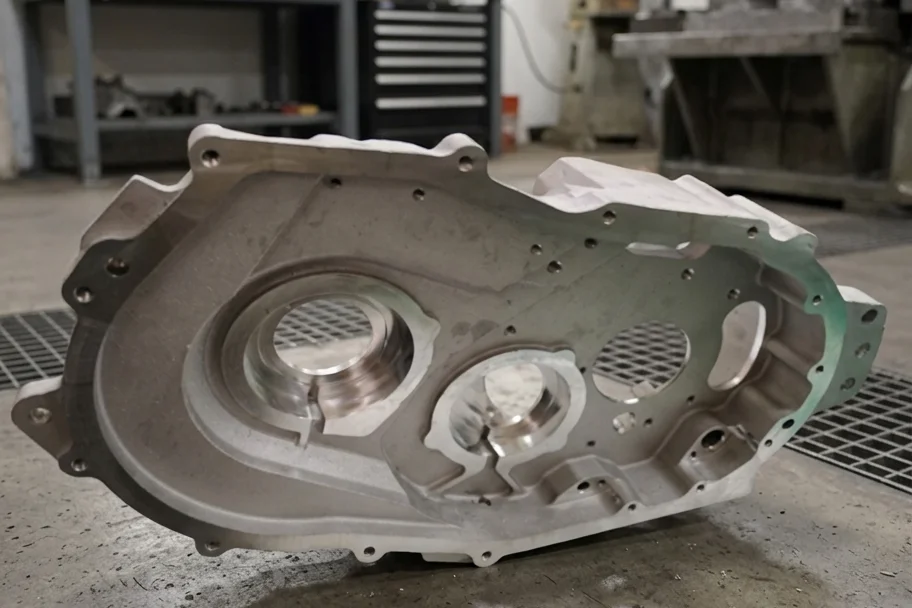
A raw casting is useless if the internal shafts do not align perfectly. We do not outsource our machining. Kurt Foundry utilizes dedicated 5-axis CNC milling centers to bore the bearing housings and tap the mounting holes. We routinely achieve tight surface roughness standards (such as Ra0.8) on critical mating surfaces to ensure leak-free gasket seals.
High-Torque Impact Resistance
For applications involving sudden mechanical shock—such as agricultural PTO gearboxes or heavy crane hoists—standard iron will crack. For these extreme environments, we pour custom ductile iron castings. The spherical graphite structure provides the yield strength necessary to contain massive torque spikes without fracturing the outer casing.
Our Manufacturing Process for Gear Reducer Housings
We control every step of the sand casting process to ensure your custom gear cases meet strict engineering standards.
DFM & Solidification Simulation
Our engineers analyze your 3D CAD model using Magmasoft simulation. We design optimal gating and risering systems to promote directional solidification. This simulation software prevents shrinkage cavities inside the thickest sections of the gear case.
Resin Sand Molding
We utilize furan resin-bonded sand to create the molds. Resin sand provides extreme rigidity compared to traditional green sand. That rigidity ensures the heavy molten metal does not warp the mold cavity, maintaining excellent dimensional accuracy for large housings.
Spectrometer-Verified Pouring
Before we pour any metal, our metallurgists analyze the molten bath using optical emission spectrometry. We verify the exact carbon equivalent and alloy composition to ensure strict compliance with ASTM or DIN standards.
Heat Treatment & Stress Relieving
Heavy gear cases often develop internal residual stresses during the cooling phase. We perform in-house normalizing and tempering, particularly for custom carbon steel castings, to relieve these stresses and improve the machinability of the metal.
Precision CNC Machining
The heat-treated castings move directly to our machining workshop. Our technicians mill the mating flanges flat, bore the precise bearing locations, and drill the necessary bolt patterns.
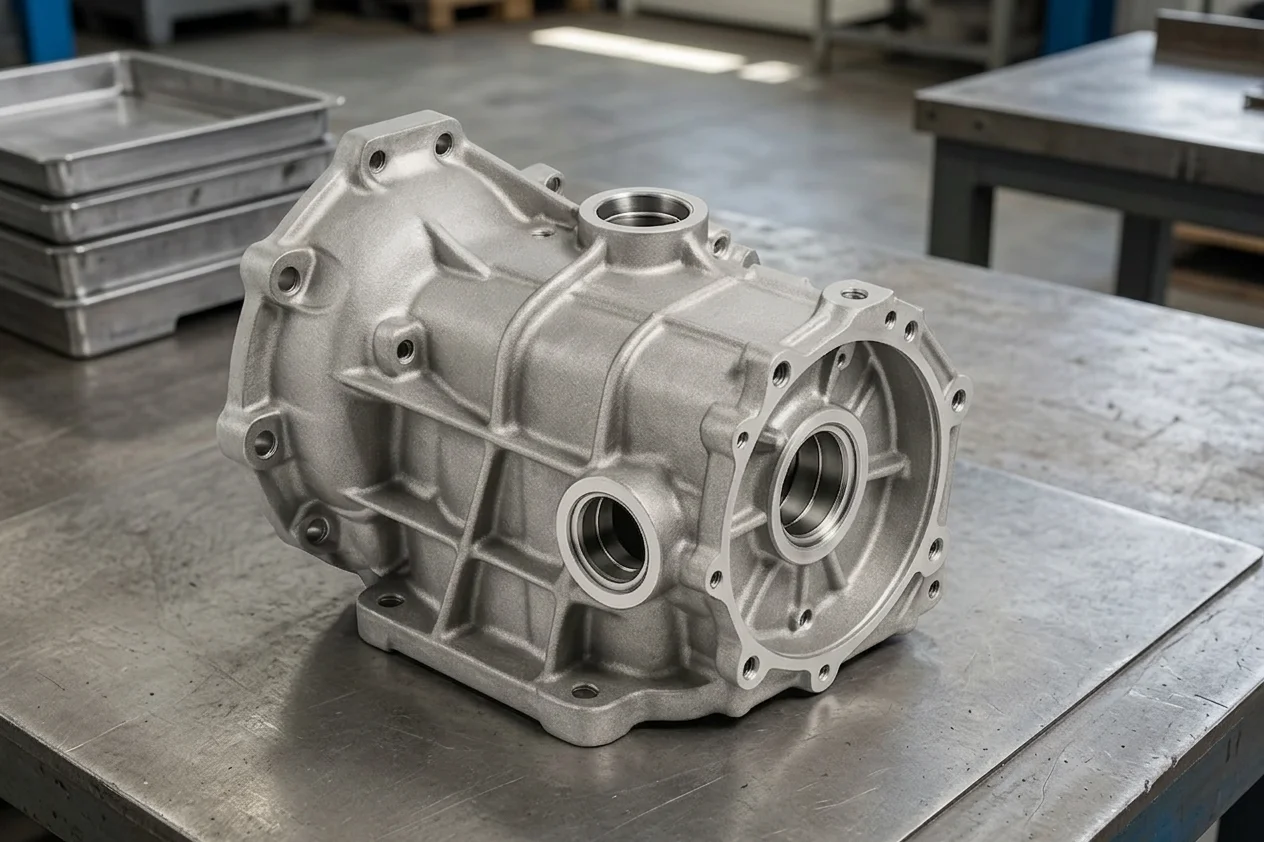
Quality Control & CNC Capabilities
We do not guess when it comes to quality. Every batch of metal poured at Kurt Foundry undergoes rigorous testing. We provide fully traceable Material Test Reports (MTRs) with every shipment, giving your procurement team total peace of mind.
- CMM Inspection: We use Coordinate Measuring Machines to verify that every CNC-machined bore and flange meets your exact CAD tolerances.
- Spectrometry: Pre-pour chemical analysis guarantees the correct alloy grade.
- Mechanical Testing: In-house tensile, yield, and hardness testing confirm the structural integrity of the gear casing.
- NDT Capabilities: We utilize Ultrasonic Testing (UT) and Magnetic Particle Inspection (MPI) to detect any hidden internal flaws before the housing leaves our facility.
Frequently Asked Questions
Aluminum die casting is excellent for small, lightweight, high-volume automotive parts. However, for heavy industrial machinery, aluminum lacks the compressive strength and vibration damping required. Resin sand casting allows us to pour massive, high-strength iron and steel gearboxes weighing anywhere from 50 lbs to 5,000 lbs, which die casting simply cannot handle.
Yes. We operate a fully integrated facility. You send us your 3D CAD models (STEP or IGES) and 2D PDF drawings. We will cast the raw housing and use our in-house CNC centers to machine all internal bores, tapped holes, and mating surfaces exactly to your print specifications.
Lead times depend on the complexity of the core boxes and the overall size of the casting. Generally, initial tooling and first-article prototypes take 4 to 6 weeks. Once the prototype is approved, standard production runs take an additional 4 to 5 weeks.
We provide heavy shot blasting for a clean, uniform raw cast finish. For the machined areas, we routinely hold tight surface roughness tolerances down to Ra0.8 for bearing bores and gasket mating surfaces. We can also apply industrial rust-preventative primers or final powder coatings based on your requirements.
Thick sections, like bearing hubs, cool slower than thin walls, making them prone to shrinkage porosity. We combat this defect by using 3D solidification simulation software to engineer strategic risers that feed molten metal into the hub as it cools. We also place metal chills inside the sand mold to force the thick sections to cool faster, ensuring a dense, solid microstructure.
Ready to Optimize Your Supply Chain?
Stop managing multiple vendors for casting and machining. Send us your CAD files today. Our engineering team will review your gearbox housing designs and provide a highly competitive direct-factory quote within 48 hours.
Get Your Free Quote Now