
Pick up a handful of beach sand and a handful of casting sand, and you will feel the difference immediately. Beach sand rolls between your fingers like tiny glass beads. Casting sand feels gritty, almost sharp, and clumps when you squeeze it. That textural gap hints at an engineering gap that determines whether molten metal becomes a usable part or a scrapped mess.
The short answer: casting sand is not regular sand. It is a carefully formulated mixture of base sand, clay binder, moisture, and additives, each controlled to give the mold the strength, heat resistance, and gas permeability a casting requires. Regular sand — from a beach, riverbed, or hardware store — lacks every one of those engineered properties.
How Casting Sand Differs from Regular Sand
Grain Shape and Size
Angular grains are the foundation. Foundry-grade silica sand is selected — sometimes crushed — so that grains have angular or sub-angular faces. Those irregular surfaces interlock like puzzle pieces when packed into a mold, giving the sand enough structural strength to hold its shape while liquid metal fills the cavity. Beach and river sand grains, tumbled smooth by water, are rounded. They slide past each other like marbles. Squeeze a handful into a shape and it crumbles the moment you let go.
Grain size is equally controlled. Foundry sand typically falls between 0.15 mm and 0.6 mm, a range that balances surface finish against gas permeability. Go finer and the casting surface improves, but gases have fewer paths to escape. Go coarser and gas venting is easy, but the surface looks like orange peel. Regular sand has no controlled size distribution — you get whatever nature deposited.
Binder and Additives
Raw sand alone — even angular sand — cannot hold a mold. Green sand, the most common sand casting formulation, blends roughly 85-90% silica sand with 5-10% bentonite clay as a binder, 2-5% water, and about 5% sea coal. The clay activates with moisture to coat each grain, creating a cohesive matrix. Sea coal burns off at pouring temperature and forms a thin gas layer between metal and sand, preventing the mold wall from fusing to the casting.
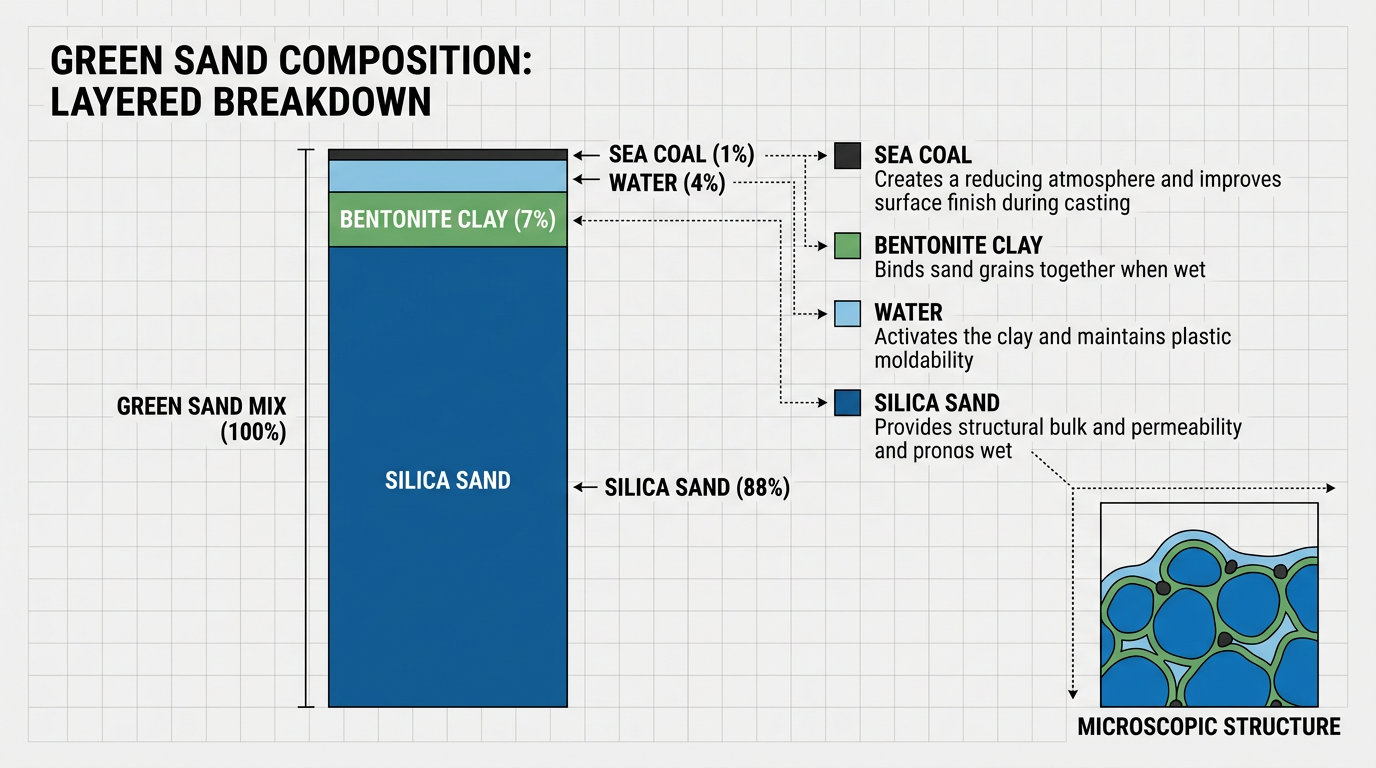
Here is where casting sand becomes a genuine balancing act. Adding more clay and water increases mold strength, but it also blocks the tiny channels between grains that gases need to escape. Push the binder content too high and permeability drops to the point where trapped gas blows holes in the casting. Every foundry tunes these ratios for their specific alloys and part geometry — there is no universal recipe.
Regular sand has no binder, no additives, and no engineered balance. Even if you mixed in some clay from your yard, you would not achieve the controlled permeability or the reducing atmosphere that sea coal provides.
Thermal and Mechanical Properties
Casting sand must resist temperatures above 1,500 C without the grains fusing together. That resistance — called refractoriness — depends on silica purity. Foundry-grade sand runs above 85% SiO2; beach sand varies wildly and often contains shell fragments, organic matter, and mineral contaminants that lower the fusing point and release gases at the worst possible moment.
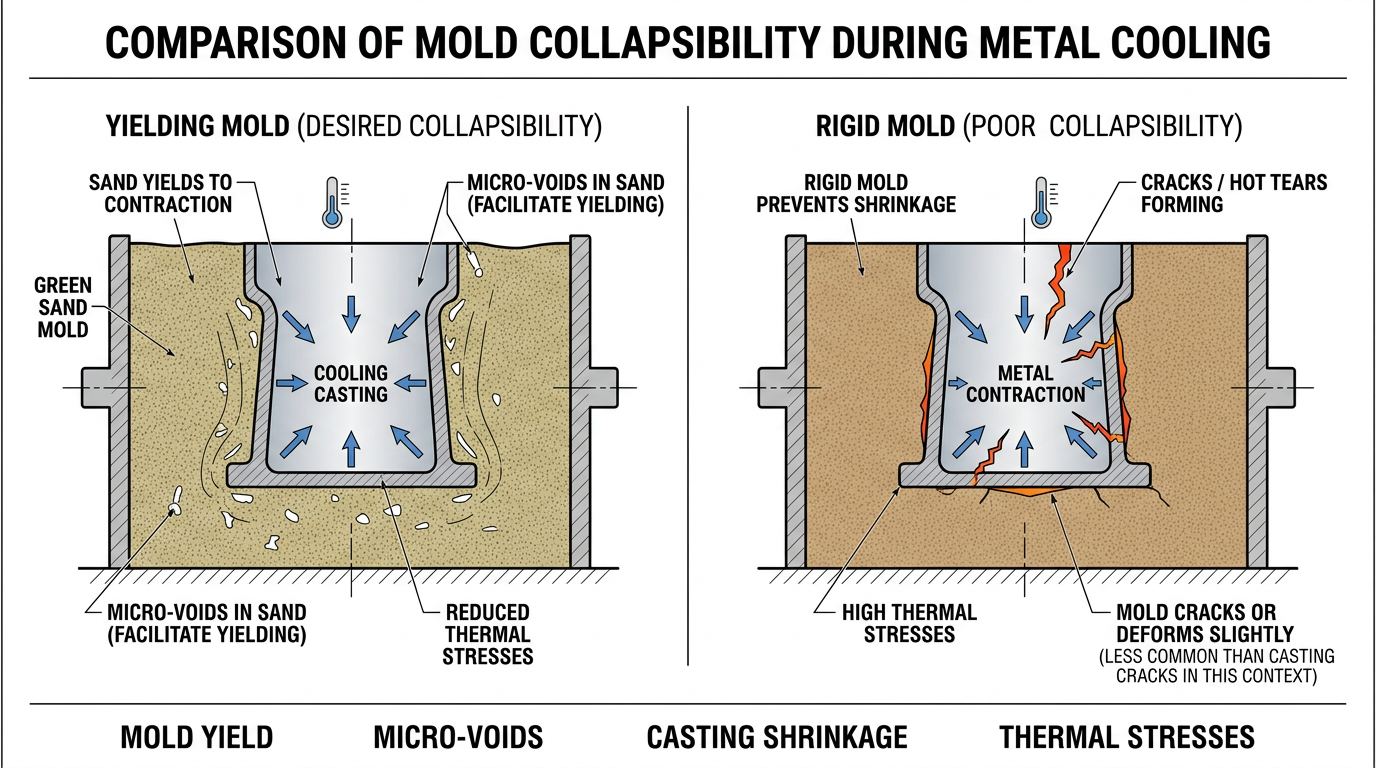
Equally important is a property most people never consider: collapsibility. After the metal solidifies, it contracts as it cools. The mold must yield to that contraction. Casting sand includes additives like wood flour that burn away during pouring, creating micro-voids so the sand collapses under shrinkage stress instead of resisting it. Without engineered collapsibility, the rigid mold fights the cooling metal and the casting develops internal tears and cracks — damage that may not show up until the part is machined or loaded in service.
What Actually Goes Wrong When You Use Regular Sand
The question matters to a sourcing engineer for one reason: sand control is a process control, and a foundry that cuts corners on sand chemistry produces a predictable failure sequence:
- Mold collapse before pour: rounded grains cannot interlock, so fine details crumble during assembly and the mold cavity deforms before metal even reaches it.
- Steam defects at pour: moisture trapped inside rounded grains flashes to steam on contact with liquid metal. In a poorly permeable mold it blows through the casting surface — rough pits and blow holes — or, in bad cases, causes a steam ejection that scraps the mold.
- Tighter margins on steel: at steel pouring temperatures above 1550 degrees C, the moisture margin is thinner than for iron — which is why steel foundries run tighter sand-moisture control.
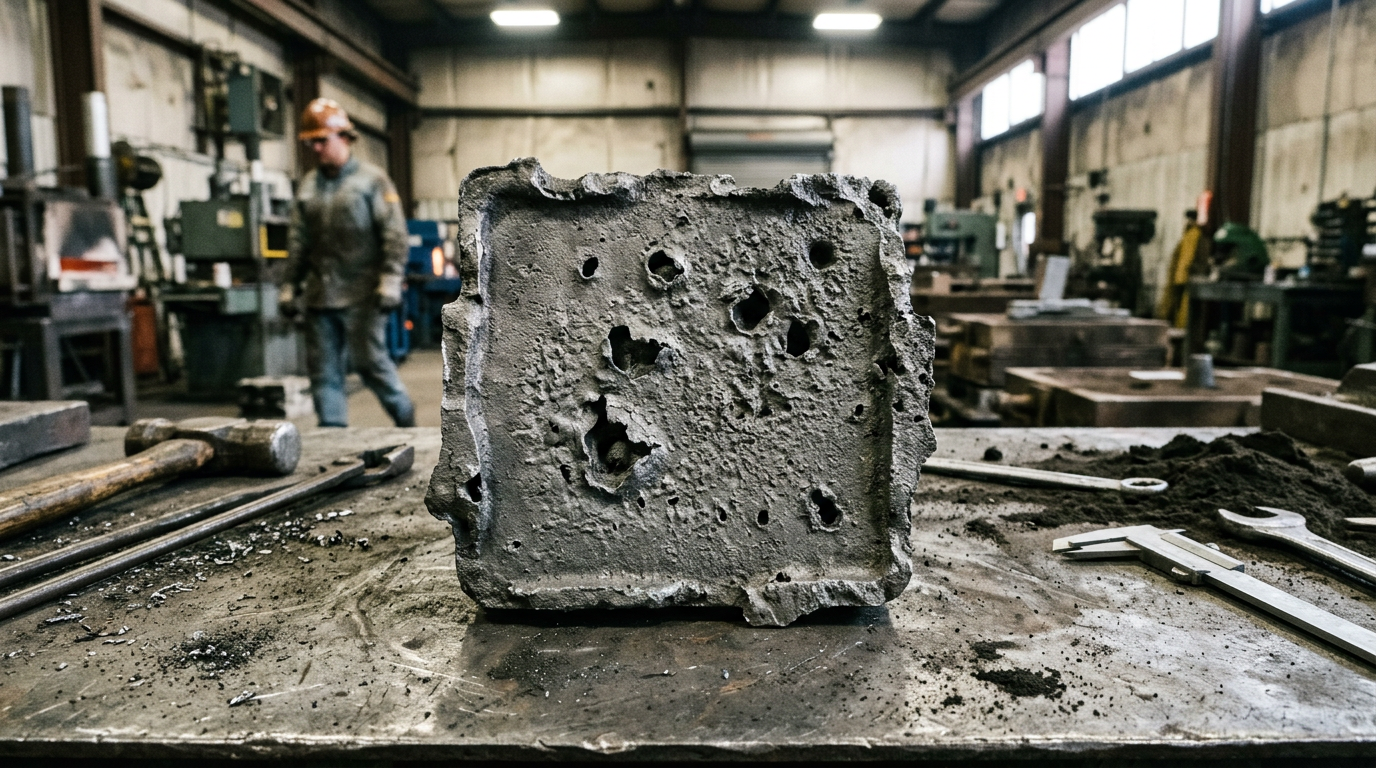
Even if the casting somehow solidifies, the sand is too rigid. Regular sand does not collapse to accommodate metal shrinkage, so the casting develops hot tears — internal cracks along grain boundaries where the metal was pulled apart during cooling. You will not see them on the surface. You will find them when the part fails under load.
Unengineered sand in a casting mold is not a quality trade-off. It is a guaranteed scrap part — and the same logic applies in production: a foundry that does not test and rebalance its sand system every shift is running toward the same failure modes, just more slowly.
The Bottom Line
Casting sand is engineered in the same sense that concrete is engineered — it is a system of base material, binder, water, and performance additives, each tuned to work together under extreme conditions. Regular sand is just one ingredient of that system, and using it alone is like pouring cement powder into a form and expecting structural concrete.
If you are sourcing castings or evaluating a foundry, sand quality is one of the first process controls worth asking about. The sand mixture a foundry uses tells you how seriously they control their process from the very first step.