
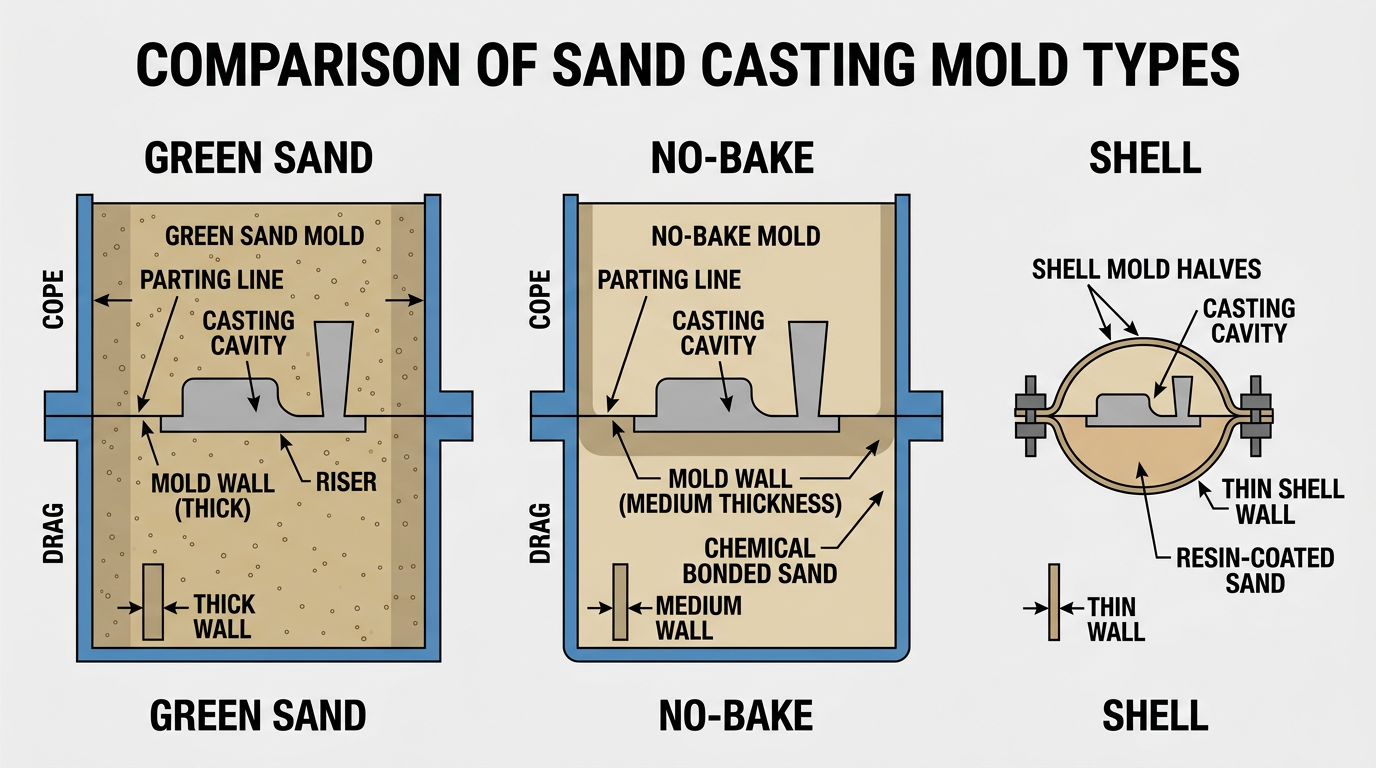
Sand type and mold type are not the same thing, even though most references use the terms interchangeably. The sand is a material input. The mold type is a construction method — how that sand gets shaped, bonded, and held together before you pour metal into it. Three mold construction methods dominate production foundries: green sand, no-bake, and shell. They suit different part sizes, tolerances, and volumes, and picking the wrong one costs you money in machining, scrap, or both.
Green Sand Molds
More castings are produced in green sand molds than all other sand casting methods combined. “Green” has nothing to do with color — most green sand is actually black from sea coal additives. The term means the sand is moist, uncured. Water activates bentonite clay particles that bond the sand grains together, creating a mold that holds its shape just long enough to accept molten metal.
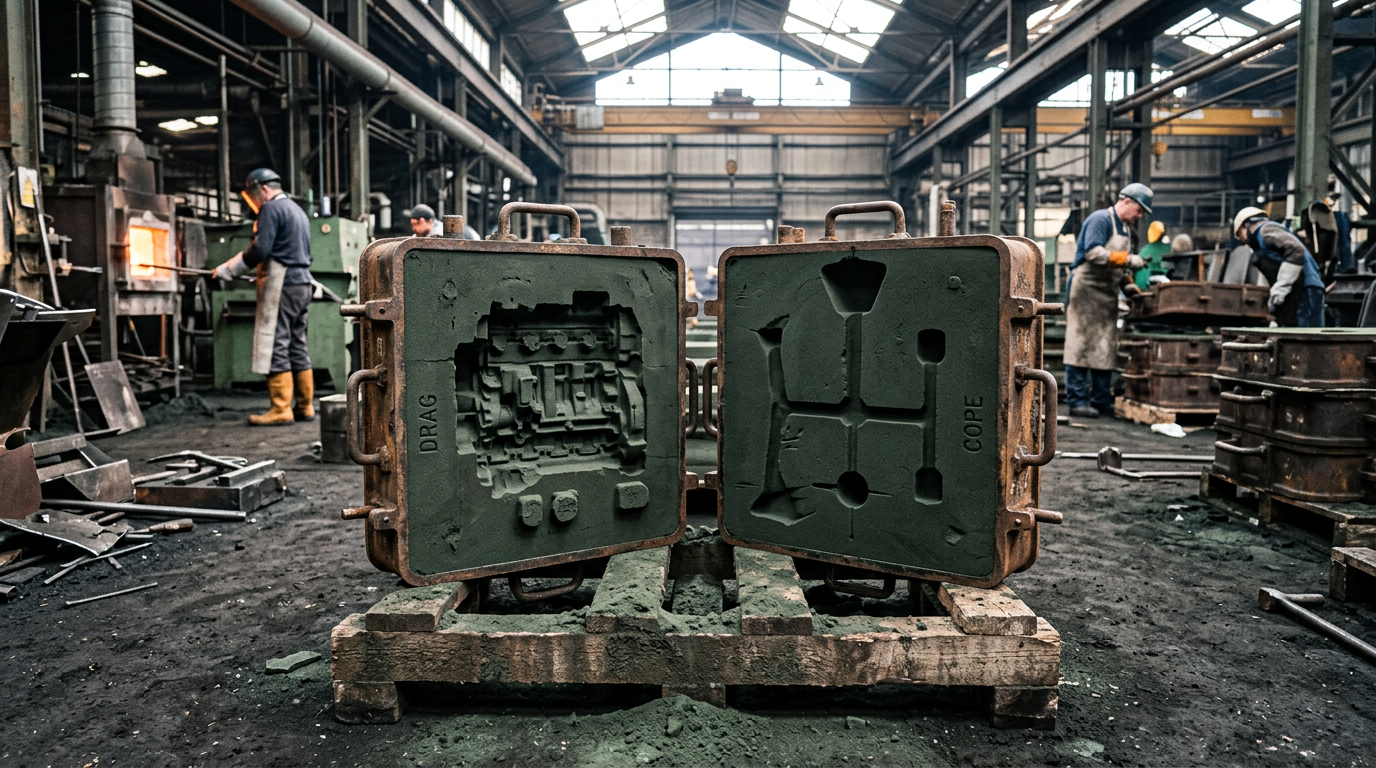
A typical green sand mix is roughly 75-85% silica sand, 5-11% bentonite clay, 2-4% water, and small additions of sea coal or other carbonaceous material. The beauty of this system is speed and recyclability. After shakeout, you recondition the sand and use it again.
When to Specify Green Sand
Green sand works best for small to medium castings in moderate to high volumes. If your part is a manageable size — something two workers can handle — and you need hundreds or thousands of them, green sand is almost always your starting point. Tooling costs are low, per-unit costs are the lowest available, and most foundries run green sand lines as their default process.
The trade-off is dimensional tolerance. Green sand molds shift slightly under metallostatic pressure, and moisture can cause gas-related surface defects. If your print calls for tight as-cast dimensions, the downstream machining to hit spec can erase the upfront savings.
No-Bake (Chemically Bonded) Molds
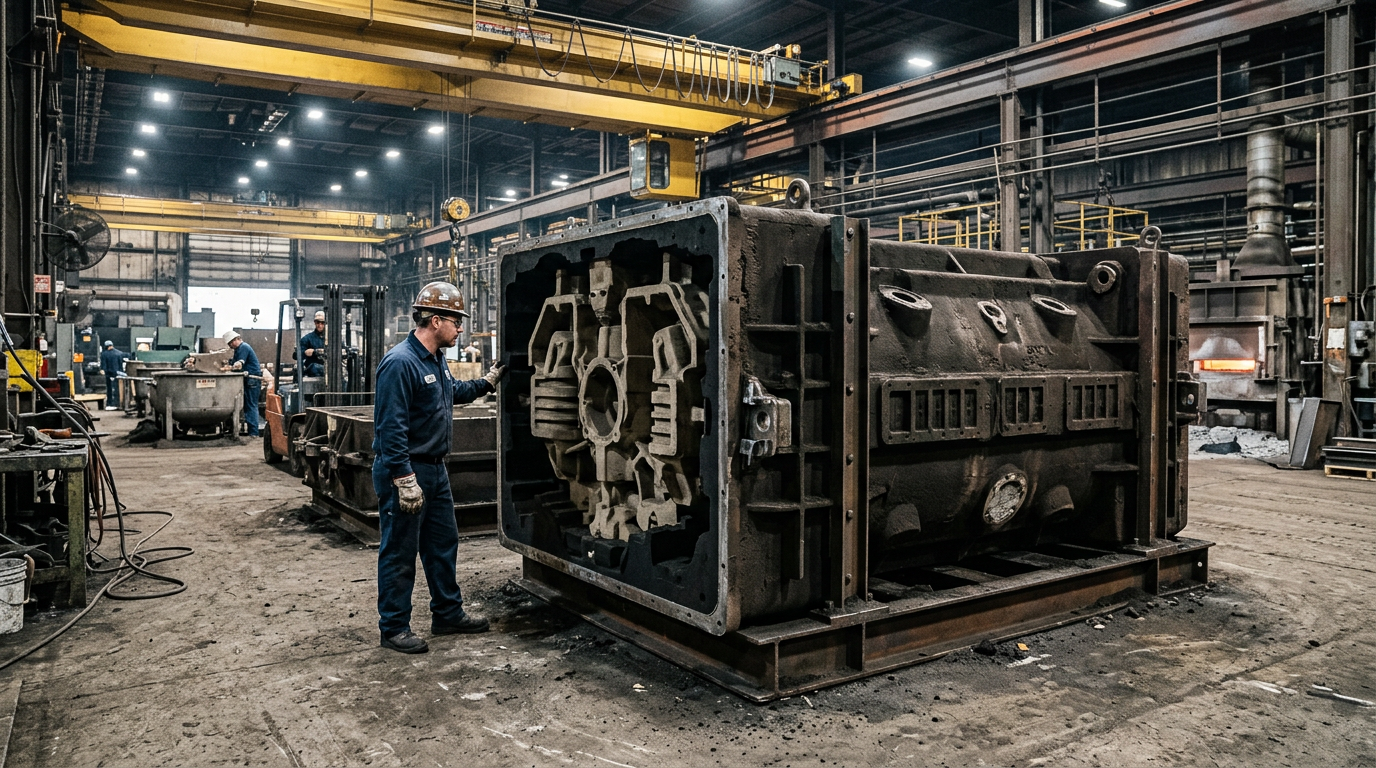
No-bake molds — also called airset molds — use a resin-and-catalyst system instead of water and clay. Sand is mixed with a chemical binder (commonly furan or phenolic urethane), packed around the pattern, and left to cure at room temperature. The result is a rigid, dimensionally stable mold that does not flex under the weight of molten metal.
This rigidity is why no-bake handles heavy, complex work that green sand cannot. Castings exceeding 3,500 lbs with intricate internal coring are routine in no-bake shops.
When to Specify No-Bake
No-bake is the right call for large castings, complex geometries, or any job where dimensional accuracy matters more than per-unit mold cost. Low-to-medium production volumes — prototype runs through a few hundred pieces — fit this process well.
The most common mistake I see in specifying molds is assuming green sand is always cheaper. Binder costs are higher for no-bake, yes. But when you factor in reduced machining time and lower scrap rates on tolerance-critical parts, no-bake often delivers lower total cost. I have seen carbon steel castings with complex internal passages come off a no-bake line needing half the machine time of the same part run in green sand.
Shell Molds
Shell molding uses sand pre-coated with thermosetting resin. The coated sand is blown onto a heated metal pattern, and the heat cures the resin into a thin, rigid shell. Two shell halves are glued or clamped together to form the complete mold.
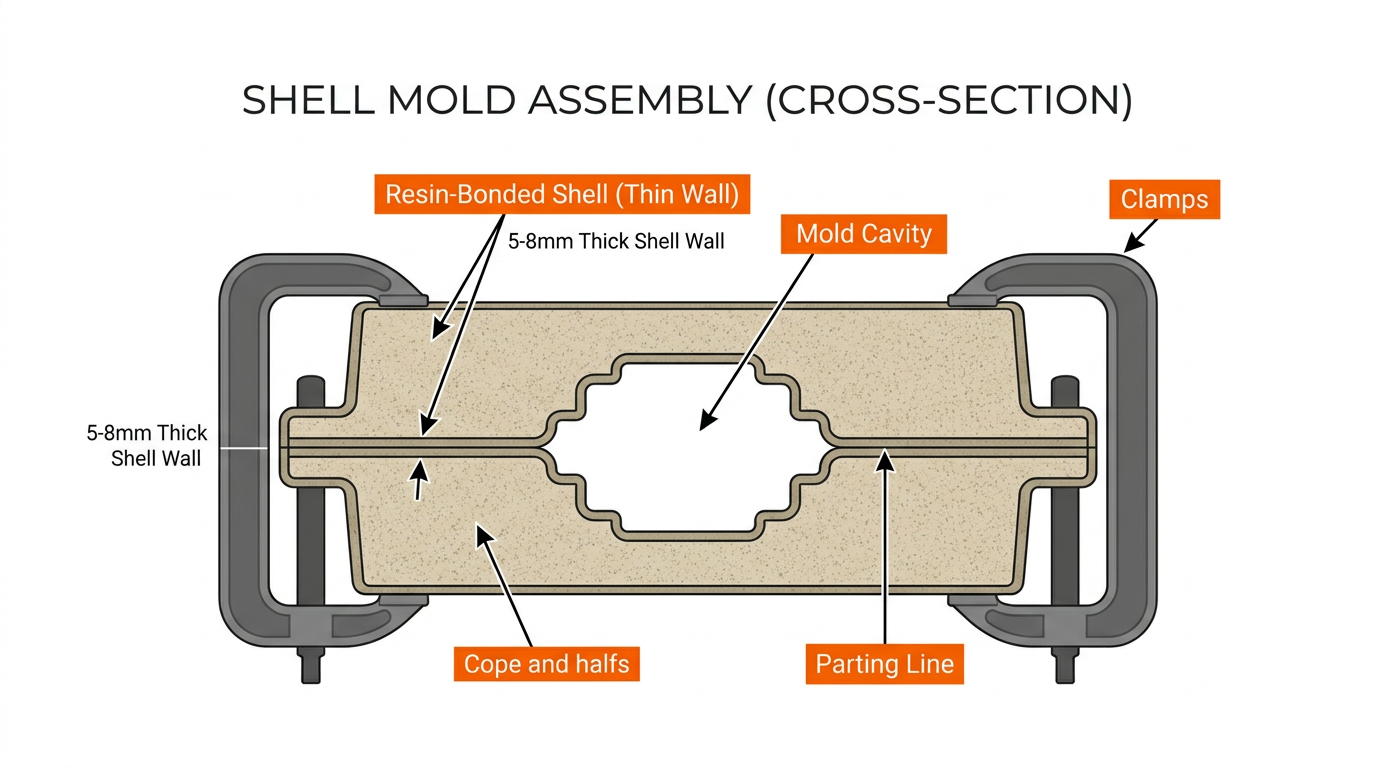
Because the shells are lightweight and stackable, a foundry can store dozens of completed shell molds in the space one flask-based mold occupies. That translates directly to higher production throughput per square foot of floor space.
When to Specify Shell Molds
Shell molding excels at small, semi-intricate parts in high volumes — valve bodies, connecting rods, cam housings. Surface finish and dimensional accuracy are better than green sand, approaching investment casting quality at a fraction of the cost.
The limitation is size. Shell molds cannot support the metallostatic pressure of heavy pours. Once your part moves beyond a few dozen pounds, look at green sand or no-bake instead.
Which Mold Type Should You Specify?
Start with three questions: How big is the part? How many do you need? How tight are your tolerances?
| Factor | Green Sand | No-Bake | Shell |
|---|---|---|---|
| Part weight | Small to medium | Large (3,500+ lbs possible) | Small only |
| Volume | Medium to high | Low to medium | High |
| Relative tolerance | Standard | Tighter | Tightest |
| Mold cost | Lowest | Moderate | Moderate to high |
| Best for | General-purpose production | Large/complex, precision-critical | Small, semi-intricate, high-volume |
Ductile iron castings with thick sections and heavy risers almost always end up in no-bake because the mold must resist metallostatic pressure without shifting. A 5 lb gray iron bracket in lots of 5,000 is textbook green sand. A precision steel valve body at 2,000 pieces per year may justify shell mold tooling.
Before you pour, check which mold types your foundry actually runs. Not every shop offers all three. Match your project requirements to the mold method, then confirm your foundry can execute it — that single conversation saves more money than over-specifying on the drawing.
Making the Right Choice
The mold type sets your casting’s dimensional baseline before any machining begins. Getting it wrong does not just add cost — it changes the defect profile, the machining allowance, and the lead time for every part in the run. Start your next foundry conversation with part weight, annual volume, and the tightest tolerance on the print. Those three numbers narrow the mold choice to one or two options before you discuss anything else.