
Green sand casting is sand casting in a mold bonded with clay and water instead of a chemical resin. The mold is still moist when the metal goes into it — that is what “green” means, and nothing in the mixture is green in color. After shakeout the same sand is screened, remulled and used again for the next mold.
It is the default way ferrous parts get molded. What that choice does to a part on your drawing shows up in three places: how much machining stock the cast surfaces need, how much draft the walls need, and where the parting line can safely sit.
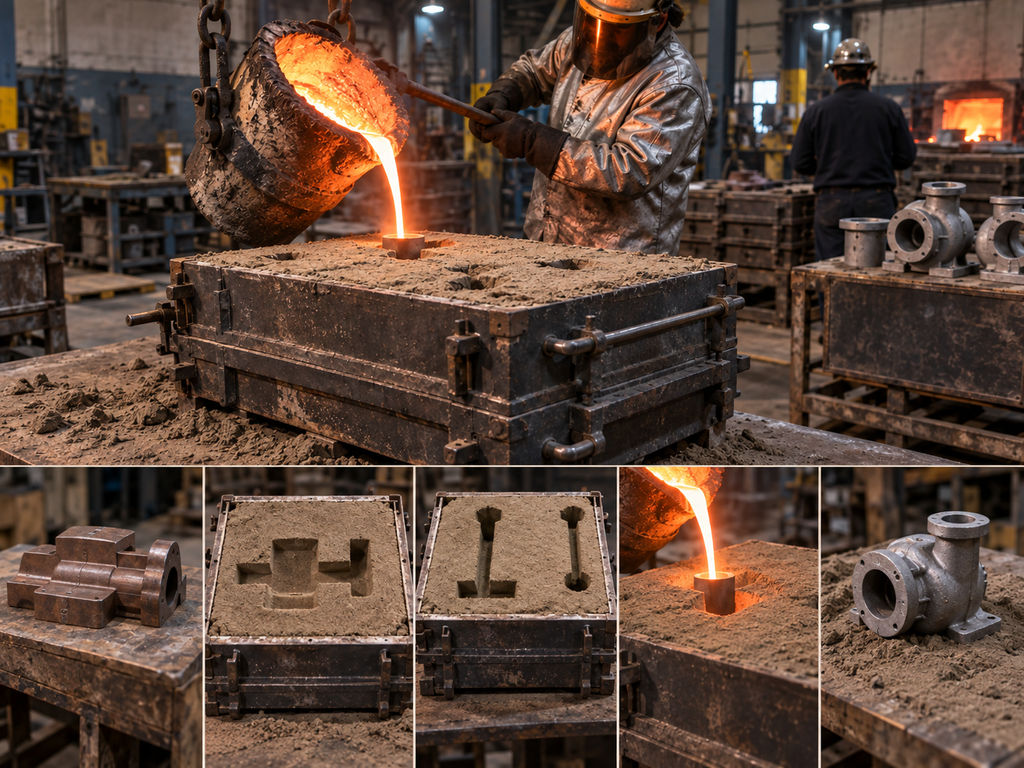
What is green sand made of
Green sand is silica sand held together by bentonite clay activated with water, plus a carbonaceous additive for surface finish — there is no chemical binder anywhere in the mix. The base is a high-grade silica sand that carries the shape and takes the heat; everything else is there to make it hold together and let go cleanly.
| Ingredient | Typical share | What it does |
|---|---|---|
| Silica sand | Balance | Refractory skeleton of the mold — holds the cavity shape against the heat and pressure of the pour |
| Bentonite clay | 5–10% | The binder; develops strength and plasticity once it is wetted |
| Water | 2–5% | Activates the clay and sets how the sand flows and compacts |
| Sea coal | About 5% | Burns at the mold face to improve the cast surface |
Water is the ingredient that runs the system and the one most often abused. Moisture develops the plasticity of the clay bond, and that bond is what controls most sand-related defects.
The moisture window is narrow and specific to the plant — it is set by which clay is used and how much, and by what else is in the mix — so there is no universal moisture or compactability target to hold a supplier to. What matters is that compactability and moisture are tested every shift and the mix stays inside that plant’s own window. Drift shows up on the casting itself: run wet and parts come out oversize with gas and expansion defects, run dry and you get cuts, washes and burn-on.
How does green sand casting work
Green sand casting runs as a closed loop — the sand that came off the last shakeout is what molds the next part — and it takes six steps to go around it.
Step 1: Build the pattern and gating
The pattern is not the part. It is cut oversize to cover metal contraction, drafted so it will draw out of the sand without tearing it, and it carries the gating and risers with it. On a production green sand line the cope and drag halves sit on opposite faces of one matchplate, which is what makes the process fast and what registers the two mold halves to each other.
Draft allowances published for steel castings put an automated green sand line at 1.0° on most features and 1.5° in deep pockets — the same as no-bake and shell molding.
Machining stock is the other thing the pattern has to carry. Do not call out less than 0.25 in. (6 mm) on any surface molded in the cope, and orient the part so critical machined faces are molded in the drag whenever the geometry allows it.
Step 2: Mull the sand back into its window
Return sand from the last shakeout is cooled, screened for lumps and tramp metal, then mulled with makeup clay, water and sea coal until it is back inside the plant’s compactability window.
Step 3: Mold the cope and drag
The prepared sand is blown and squeezed around the pattern in two flasks, drag below the parting line and cope above it. Compaction is what gives the mold its hardness, its cast surface and its dimensional repeatability, so the squeeze pressure is a controlled variable, not a setting someone picks.
Cores are set into the drag after the pattern is drawn. In a green sand shop they are almost always resin-bonded — a moist clay core would not hold its own weight or its own dimensions in a hot cavity.
Buying green sand castings?
We run both green sand and resin sand molding for grey and ductile iron. Send your drawing and we will tell you which process fits your part weight and tolerances.
Get a process recommendation →Step 4: Close and pour
The cope is set down on the drag and clamped or weighted, then the mold is poured. The clamping matters: liquid iron pushes the cope upward and the mold walls outward, and a mold that lifts or swells gives you flash at the parting line and an oversize casting everywhere else.
Step 5: Cool, shake out, return the sand
The casting stays in the mold until it is strong enough to handle, then the mold is broken up on a vibrating shakeout deck and the sand drops through the grid straight back into the sand system. Roughly 90% of the sand a foundry uses recirculates this way, which is the reason a green sand mold costs what it does.
Step 6: Cut off the gating, clean and inspect
Gates and risers come off, the casting is shot-blasted, and the parting line and ingate stubs are ground flush. From there it goes to whatever the print calls for — heat treatment, machining, chemistry and dimensional inspection.
Green sand casting vs. resin sand casting
The two processes differ in one thing, the binder, and every other difference follows from it: clay and water make a mold that is compacted into strength and can be shaken apart and remixed, while resin makes a mold that hardens chemically, holds its shape more rigidly, and takes real work to reclaim.
| Feature | Green Sand Casting | Resin Sand Casting |
|---|---|---|
| Binder | Clay + water | Chemical resin |
| Mold condition | Moist | Chemically hardened |
| Mold strength | Moderate | Higher |
| Surface finish | Moderate | Better |
| Dimensional accuracy | Moderate | Better |
| Mold cost | Lower | Higher |
| Production volume | Excellent for high volume | Often used for low-to-medium volume |
| Large castings | Suitable | Especially suitable |
| Sand recycling | Relatively easy | More complicated |
Dimensional accuracy is the row that needs the most qualification, because the gap is conditional on size. Below about 50 lbs, green sand is dimensionally similar to the other sand molding processes; above 200 lbs, no-bake typically holds tighter, according to a statistical study of more than 140,000 features on production steel castings. On smaller parts the accuracy premium buys nothing.
For iron there is a printable number to work from. A 2024 tolerance assessment of production iron castings puts the recommended band at DCTG 8 to 12 per ISO 8062 — and that band belongs to sand molding as a family, not to green sand as a penalty within it.
Across the parting line, green sand is the more accurate of the two. Green sand molding adds no significant dimensional variability across the parting face, while no-bake adds roughly 0.040 in. (1 mm) at 6σ. The mechanism is tooling: a matchplate registers cope to drag on a single piece of steel, whereas separate no-bake cope and drag boxes have to be aligned mold by mold. A close-tolerance feature that must cross the parting line is safer in green sand.
Cost pulls in two directions at once, so it matters which cost is being compared. Per mold, green sand is cheaper — clay and water against resin and catalyst. Per pattern it is the dearer one: green sand tooling normalizes at 100% against 80% for chemically bonded, and takes 18 weeks to build against 12. That is why the choice between green sand and no-bake is a volume question before it is a quality question — you are amortizing dearer, slower tooling against cheap consumable sand.
Surface finish is better read as machining stock than as a roughness number. General machine finish allowance runs 6 mm (0.25 in.) for green sand against 5 mm (0.19 in.) for most chemically bonded work — a millimeter of stock, not a different class of part.
Conclusion
Green sand casting is the volume process for iron castings: a clay-and-water mold, compacted rather than cured, poured moist, then broken up and mulled back into the next mold. Its reputation for looseness is half-earned — the accuracy gap against resin sand is real above 200 lbs and largely absent below 50, and across the parting line it runs the other way.
Have a part that should be green sand cast?
Kurt Foundry casts grey iron, ductile iron and carbon steel parts to your drawing, with pattern making, CNC machining and inspection under one roof and an IATF 16949:2016 certified quality system. Send your CAD drawing for a free DFM review and a quote within 48 hours.
Get a Free QuoteSee grey iron casting capabilities →