
Sand-related defects account for 30 to 40 percent of all casting rejections. A large share of those trace directly to the core — not because the core-making steps are difficult, but because the engineering decisions made before production began were wrong. I can teach anyone the physical steps of packing sand into a core box in an afternoon. What takes years to learn is selecting the right binder for the application, designing vents that actually work through the entire pour, and sizing core prints that prevent shift. Get those decisions wrong, and the best process in the world still produces scrap.
Core-Making Methods and When to Use Each One
Four core-making methods serve different production volumes, complexity levels, and dimensional requirements. Choosing the wrong method wastes time at best and creates systemic defects at worst.
Shell Core (Hot Box)
Shell cores deliver the best surface finish and tightest tolerances of any production method. The core box runs at 450-550 degrees F, and the resin-coated sand (with a melt point around 205-218 degrees F) fuses into a rigid, hollow shell. Cold tensile strength should hit 350 psi minimum.
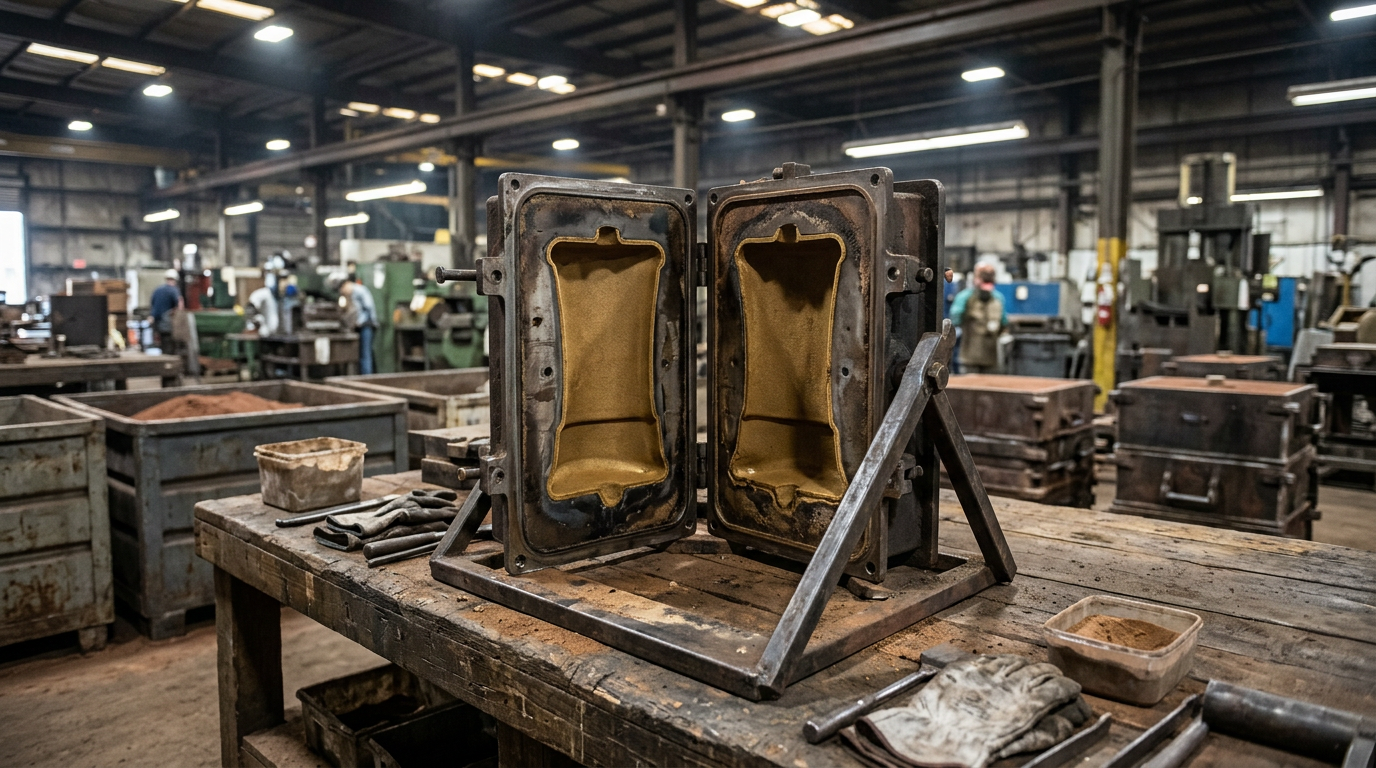
Shell cores make sense for high-volume work where surface quality justifies the tooling investment — hydraulic valve bodies, pump housings, anything with thin internal passages. The downside is cost: heated tooling is expensive, and cycle times are slower than cold box.
Cold Box (PUCB)
Phenolic Urethane Cold Box (PUCB) is the most widely used organic binder process in North America, and for good reason. Cores cure at room temperature using a catalytic gas (usually triethylamine), producing high-strength cores in seconds rather than minutes.
PUCB dominates medium-to-high-volume production where cycle time matters. It handles complex geometries well and produces dimensionally consistent cores. The tradeoff is emissions — traditional hydrocarbon-based PUCB formulations generate measurable HAPs and odor, though newer biodiesel and silicate variants cut emissions by half or more.
No-Bake (Air Set)
No-bake cores cure at room temperature without gas catalysts — the binder self-hardens after mixing. Working time is limited (typically 5-15 minutes depending on catalyst level), so the method suits larger cores and lower volumes where operators need time to pack complex shapes.
I recommend no-bake for prototype work and short runs where core box heating or gas delivery infrastructure does not exist. The longer cure time is the main limitation for production environments.
Hand-Rammed Cores
Hand ramming is the simplest method — an operator packs sand into a core box manually, often using sodium silicate (water glass) as the binder and CO2 gas for hardening. No special equipment beyond the core box itself.
Use hand ramming for one-off prototypes and very low volumes. Dimensional consistency suffers compared to machine-made cores, but for a single casting or proof-of-concept, it works without capital investment.
How to Select the Right Binder System
Binder selection is an engineering decision that locks in your defect profile, curing infrastructure, and per-core cost before production begins. Getting it wrong is expensive because you cannot change binder systems mid-run without retooling.
The Minimum Effective Dose
The right binder level is the lowest amount needed to achieve safe handling strength — not the highest amount that feels comfortable. Every gram of excess binder becomes gas during pouring. That gas has to go somewhere, and if venting cannot keep up, it ends up as porosity in the casting.
This runs against operator instinct. The natural tendency is to add a safety margin, bump the binder ratio up a few tenths of a percent “just in case.” But the relationship between binder and defect risk is not linear — too little causes core breakage, too much causes gas defects. The optimum sits at the minimum for mechanical integrity.
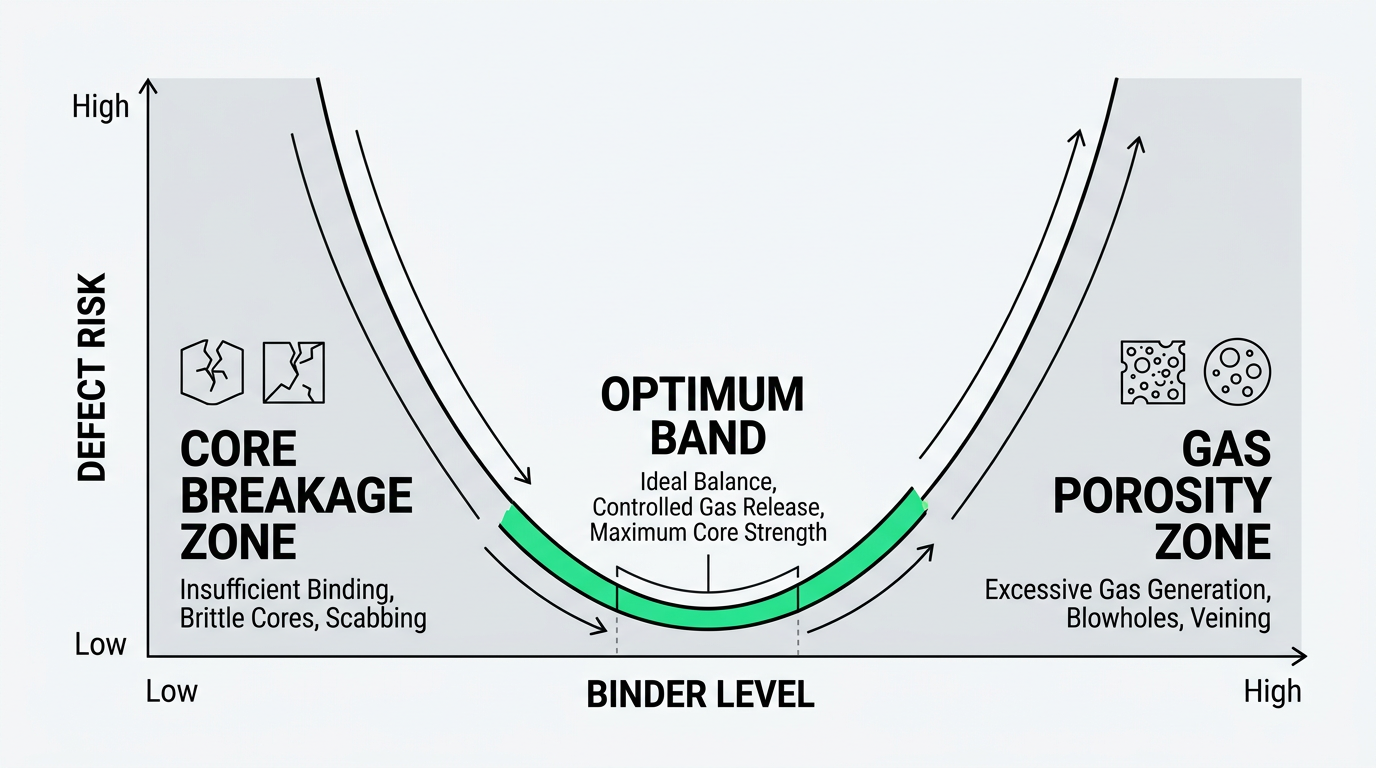
Regular mixer calibrations keep binder delivery consistent. A mixer drifting 0.2% high on binder can turn a clean casting program into a porosity nightmare that looks like a venting problem.
PUCB Ratios and Temperature Sensitivity
For PUCB systems, standard testing shows a 1.3% total binder level with a 55/45 Part 1 to Part 2 ratio. Applications needing longer bench life push to 1.5% total. Binder content across cold box processes generally ranges from 0.9 to 2% depending on sand fineness and casting geometry.
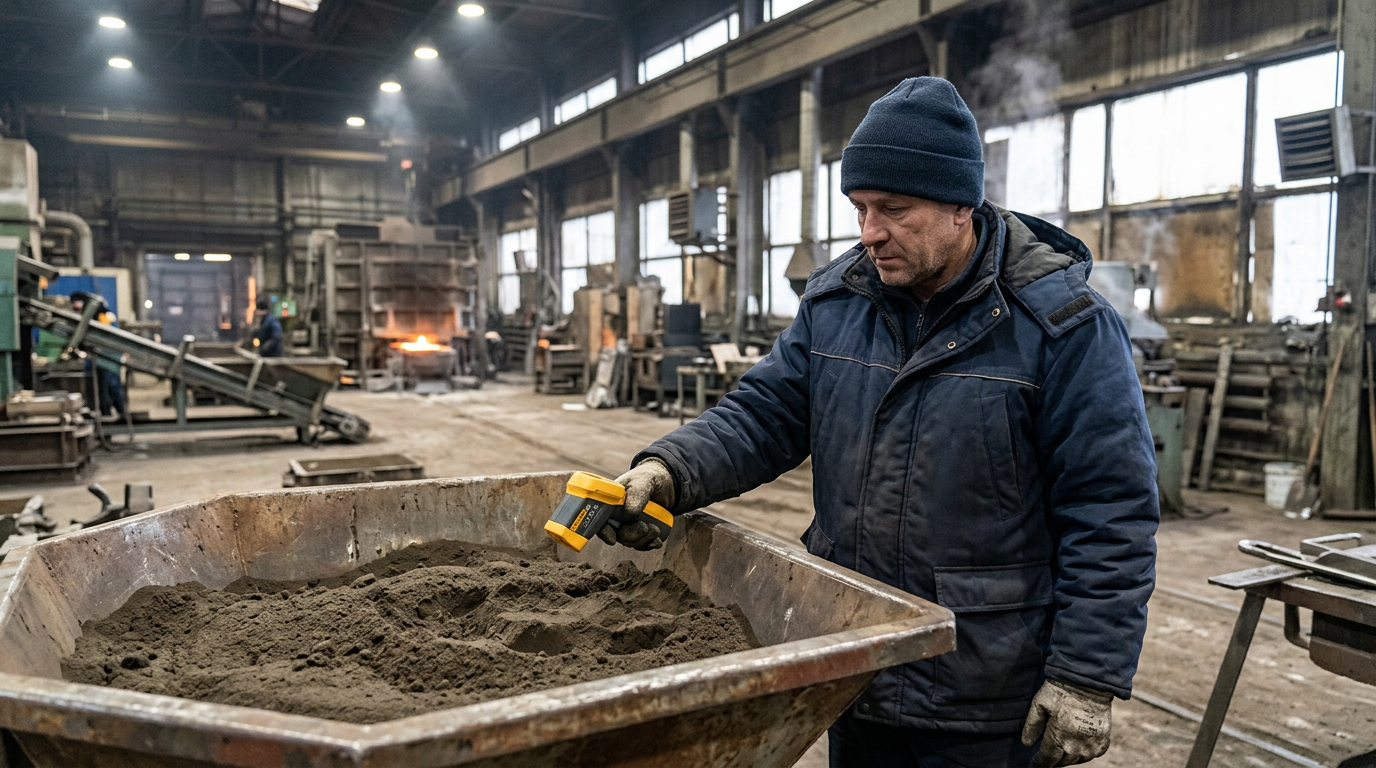
Here is what actually happens on the shop floor that no spec sheet tells you: an 18-degree-F change in sand temperature doubles or halves PUCB binder reactivity. The ideal sand temperature is 70-85 degrees F. A core made at 7 AM in January with sand at 50 degrees F will not cure the same way as the same recipe at 2 PM in July with sand at 90 degrees F. I have seen foundries chase defects for weeks before someone checked the sand temperature.
Three PUCB variant families exist. Hydrocarbon/aromatic formulations offer the lowest cost with a 50-plus year track record. Biodiesel/aliphatic variants provide faster cycles and higher strength with better bench life. Silicate-based versions minimize emissions, odor, and smoke — increasingly important for facilities near residential areas or under tightening air permits.
Reclaimed Sand and LOI Monitoring
Reclaimed sand saves money but introduces gas risk. Loss On Ignition (LOI) values consistently above 2% — measured before adding new binder — signal that residual carbonaceous material from previous binder cycles will generate additional gas during pouring.
Before you blame the process for porosity, check the LOI on your reclaimed sand. High-reclamation foundries face elevated risk regardless of how carefully they control fresh binder ratios. Fines passing the 200 screen should stay below 1% to maintain permeability and prevent excessive binder demand.
Core Box Design and Core Prints
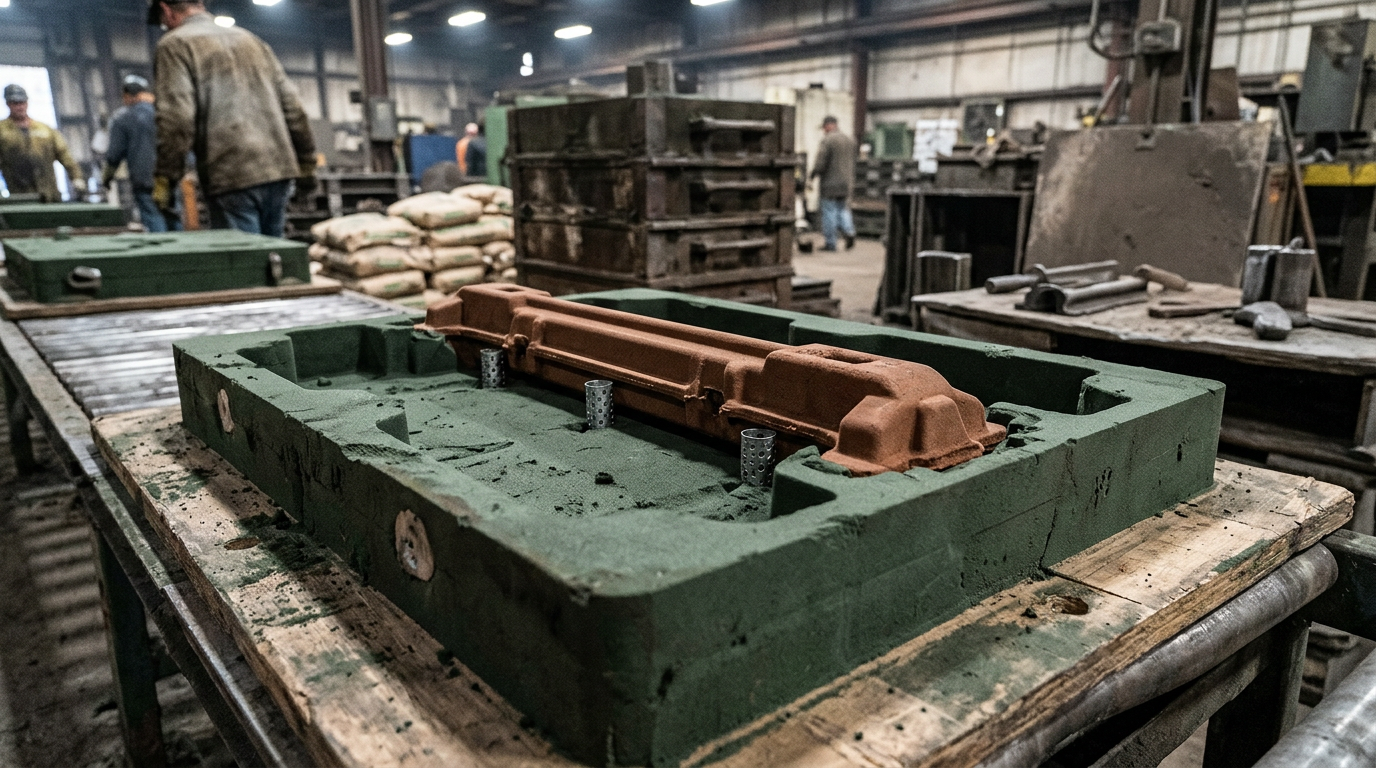
A core box determines the core’s shape, but the core prints determine whether that shape stays where it belongs during pouring. Undersized or poorly drafted prints are behind most core shift defects I troubleshoot.
Core Print Sizing
Core prints must support the core’s weight against metallostatic pressure while maintaining alignment in the mold. For most applications, a print length equal to one-half to one-third the core’s unsupported span prevents shift. The print’s cross-section should be generous enough that the sand does not crush under the weight of incoming metal.
Standard draft angles run 2 degrees, with 1 degree as the absolute minimum for easy extraction. Going below 1 degree risks tearing the core surface during removal, which creates loose sand that ends up as inclusions in the casting.
When a core is more complicated — T-shapes, branches, irregular geometry — each leg needs its own print or support point. Leaving an open end without a print is asking for shift. For complex cores, I use chaplets as secondary support at mid-span, but chaplets are a backup, not a substitute for proper print design.
Dimensional Tolerances
Sand casting linear tolerances generally fall around +/- 0.4-0.5 mm, with an additional 0.2-0.25 mm allowance over core joints. These numbers assume proper core print registration and consistent sand compaction.
The practical consequence: if your wall thickness tolerance is tight, core print precision matters more than anything else in the process. A core that shifts 0.5 mm cuts your margin in half before any other variation stacks up. Check print fit in the mold before committing to a production run.
How to Vent a Core
Venting is where I see the most confusion and the most preventable defects. Operators push a few wires through the core and call it vented. That approach might displace air during filling, but it will not handle the sustained gas load from binder decomposition — and that distinction matters.
Three Vent Types and What Each Does
Not all vents serve the same purpose, and they cannot substitute for each other:
- Flow-off vents displace cavity air during initial metal fill. They freeze off quickly once metal reaches them. Adequate for air displacement but useless for binder gas, which peaks after the metal has already sealed the flow-off paths.
- Top-down (prick) vents create escape paths 1-2 inches below the cope or drag surface. These provide a shorter, easier route for binder decomposition gas to reach atmosphere. A core cannot have too many top-down vents as long as handling strength is maintained.
- Scratch vents relieve gas at the parting line. They work, but risk metal runout if overdone — use them as supplementary paths, not primary gas relief.
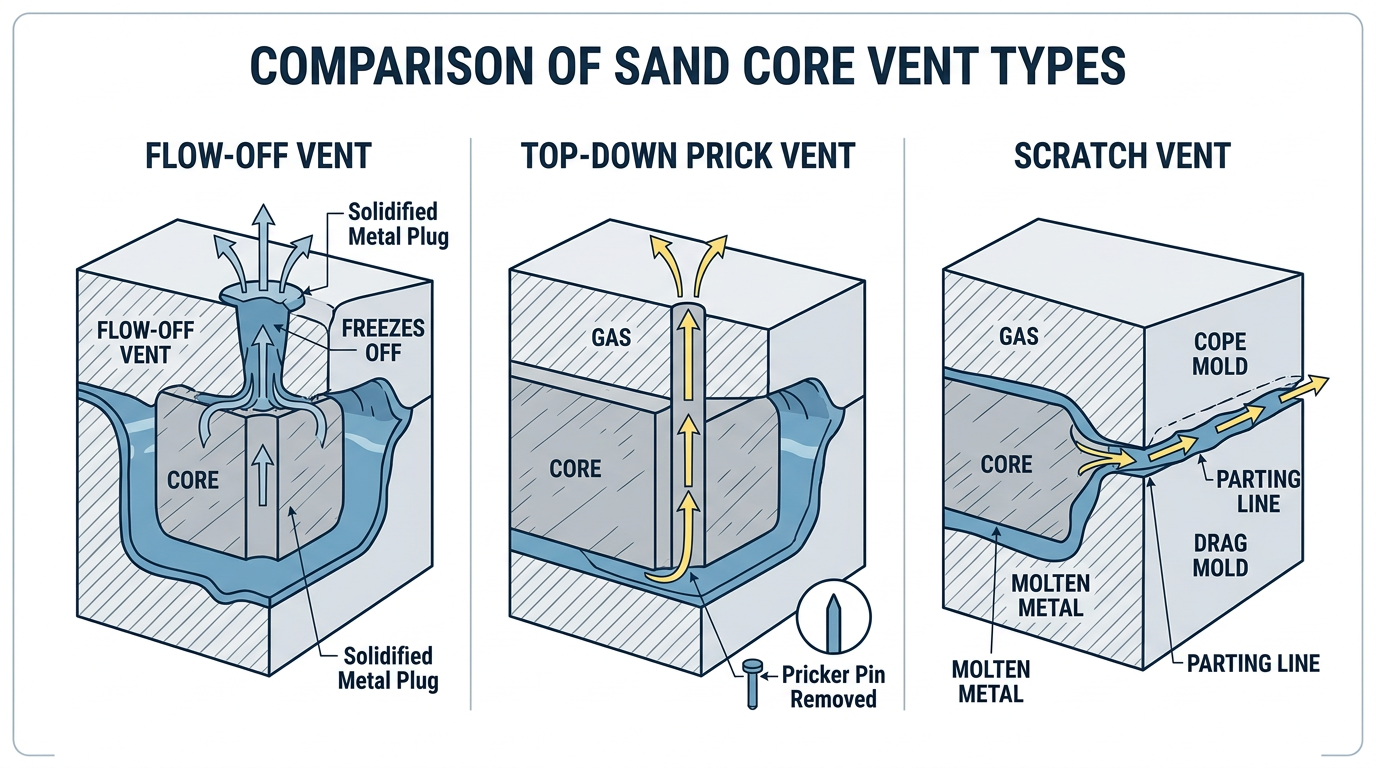
The critical mistake is conflating air displacement with gas escape. Flow-off vents handle the first; top-down vents handle the second. If you only vent for air displacement, binder gases will accumulate after the vents freeze over and push into the still-liquid metal. The result is subsurface porosity that only shows up after machining.
Vent Maintenance and Hidden Blockage
I have pulled cores from a machine that looked perfect — consistent cure times, stable machine settings, good surface hardness. Castings still had increasing porosity. Direct inspection revealed nearly 50% vent obstruction from accumulated sand and binder buildup that was completely invisible from the operator station.
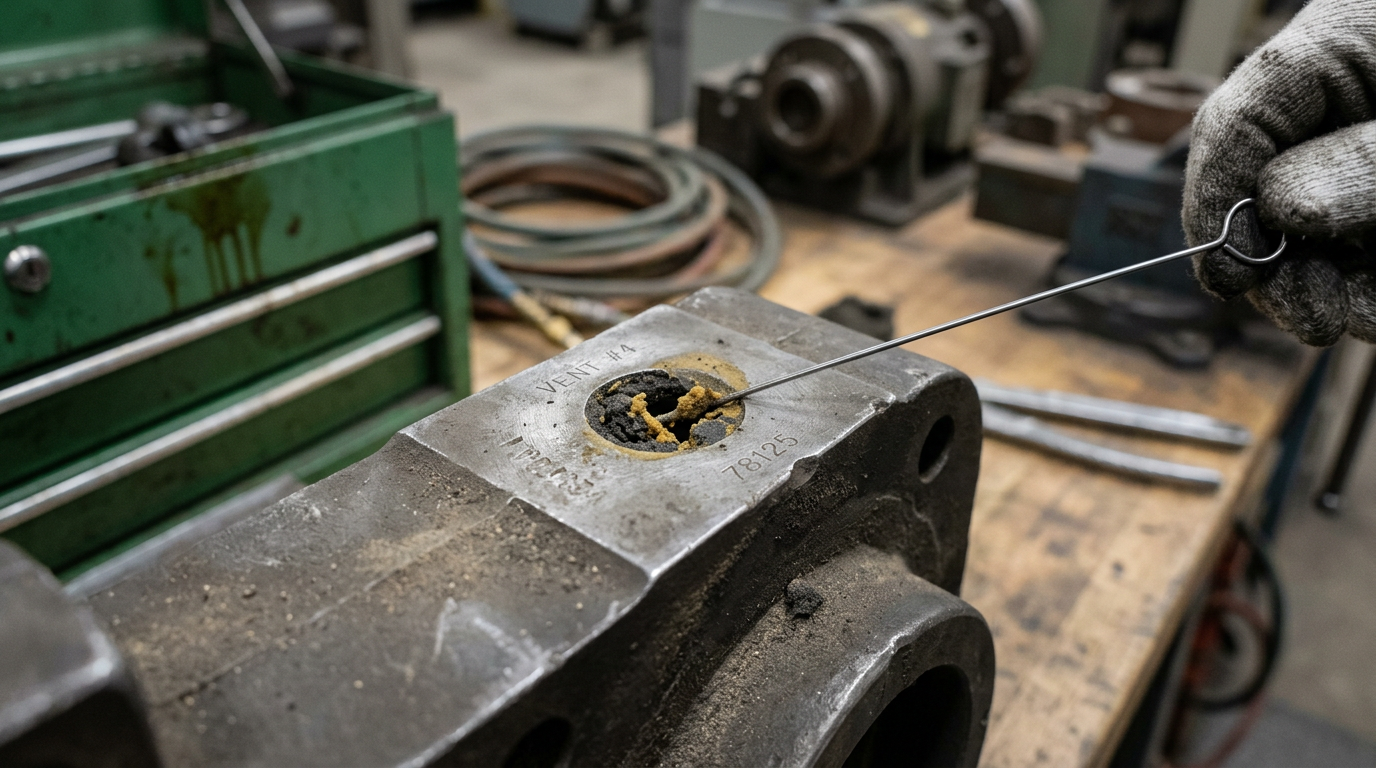
Process parameters cannot detect progressive vent degradation. Cure time stays constant because curing is a chemical reaction independent of airflow. Surface hardness stays constant for the same reason. The only way to catch vent blockage is direct physical inspection — smoke tests, airflow gauge measurements, or visual examination after box disassembly.
Build vent inspection into your preventive maintenance schedule. Waiting until defect rates spike means you have already shipped questionable castings.
3 Core-Making Mistakes That Show Up as Casting Defects
These three errors account for the majority of core-related scrap I encounter in production foundries. Each one traces back to an upfront decision, not a process execution error.
Mistake 1: Excess Binder Causing Gas Porosity
More binder feels safer. It is not. I have worked on A216 WCB valve bodies where cored passages produced blowholes at every core interface. The binder decomposition gases continued building pressure after the top surfaces solidified, displacing still-molten metal into voids. The fix required both reducing binder content and adding ceramic vent inserts at core interfaces — confirming that binder and venting decisions work together, not independently.
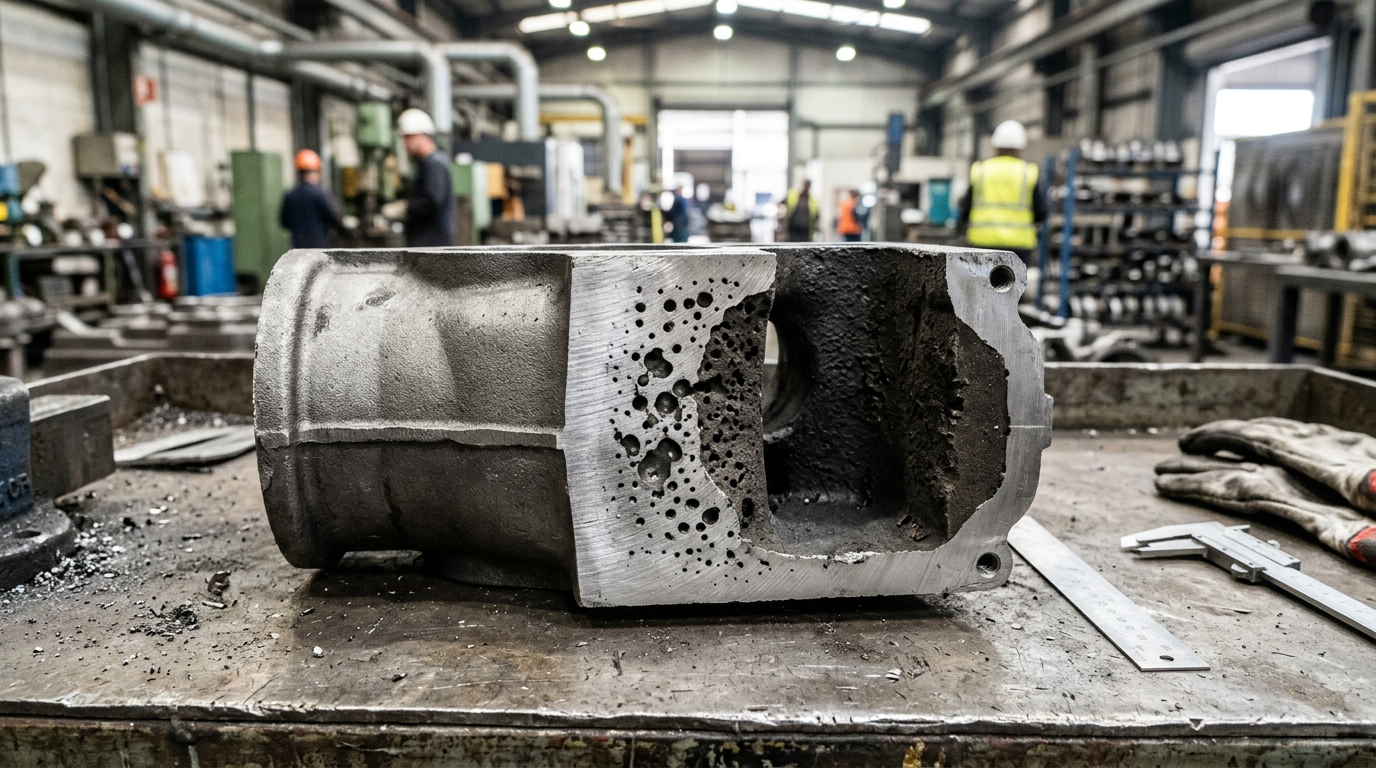
If porosity outlines the core like a halo, you are looking at a metal-core reaction. Work backwards from the binder level before adjusting anything else.
Mistake 2: Treating All Vents as Equal
Using only flow-off vents because “we have venting” is a recipe for subsurface porosity. Flow-off vents freeze off within seconds of metal contact. The binder decomposition gases that peak minutes later have no escape path. Add top-down vents at 1-2 inch depth intervals wherever the core contacts metal — these remain open long enough to handle the sustained gas load.
Mistake 3: Ignoring Core Storage Conditions
A core that tests perfectly after production can fail at pouring if storage conditions allow moisture reabsorption. Warm cores and cores stored hot absorb more moisture than cores cooled before storage. That moisture converts to hydrogen and oxygen at pouring temperature, creating gas defects identical to binder-related porosity.
Store cores in dry conditions at ambient temperature. Keep core prints free of coating material — coatings on print surfaces impair fit and promote shift. If cores must sit more than a few days, verify moisture content before use.
The Core Checklist
Before you pour, check these decision points — they prevent more scrap than any process adjustment made during production:
- Binder level at the minimum for handling strength, not the maximum for comfort. LOI below 2% on reclaimed sand. Sand temperature between 70-85 degrees F for PUCB.
- Venting with top-down vents for binder gas escape, not just flow-off vents for air displacement. Inspect vents on a schedule, not when defects appear.
- Core prints sized to resist metallostatic pressure with 2-degree draft minimum. Check print fit in the mold before running production.
Every binder gram you add becomes gas. Every vent you skip becomes a potential blowhole. Every undersized print becomes core shift. The steps themselves are simple — the engineering behind them is where castings succeed or fail.