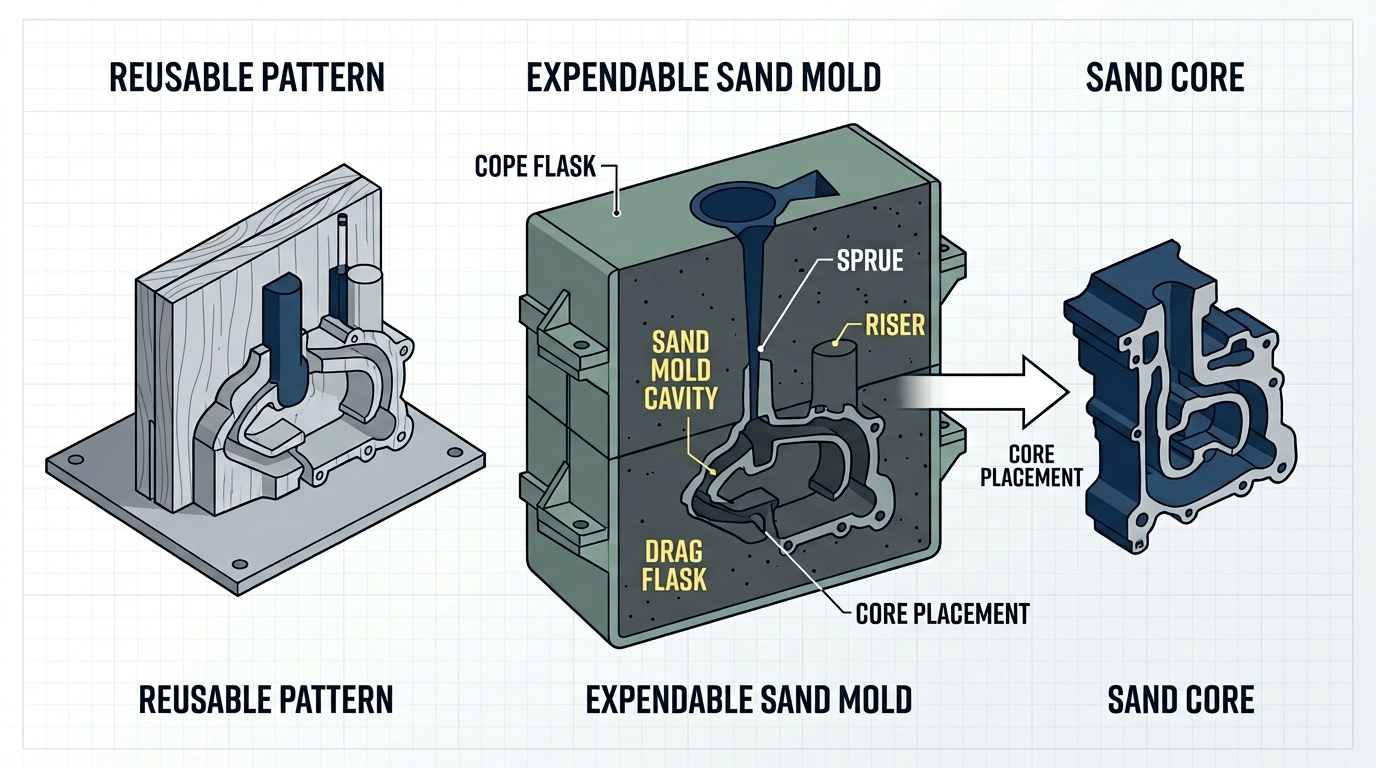
Most people walking into a foundry for the first time call the pattern “the mold.” It is not the mold. The pattern is the reusable tool that creates the mold cavity; the core is the expendable sand insert placed inside that cavity to form hollow spaces in the finished casting. Confusing these two tools leads to miscommunication on drawings, incorrect RFQ specs, and costly back-and-forth with your foundry.
The pattern shapes the outside of your casting. The core shapes the inside.
What Does a Pattern Do?
A pattern is a replica of the final casting, built slightly oversize to compensate for metal shrinkage, machining stock, and draft angles. Steel shrinks roughly 2% as it cools; gray iron about 1%. The pattern accounts for that contraction so the finished casting lands on dimension.
Vertical surfaces need 0.5 to 3 degrees of draft — a slight taper that lets the pattern pull cleanly out of the packed sand without tearing the mold apart. Skip the draft and you will damage the mold impression every time you withdraw the pattern.
Pattern material depends on how many castings you need. A hardwood pattern works for one or two pours. Tooling resin handles moderate runs at a fraction of metal cost. Aluminum or cast iron patterns are the standard for production volumes because they hold dimensional accuracy over thousands of molds.
The most common mistake I see in new patterns is treating them like simple copies of the part drawing. A pattern is engineered tooling. It carries shrinkage allowance, draft, machining stock, and sometimes distortion compensation for asymmetric shapes — all built into one physical tool. Get the pattern wrong, and every casting that follows inherits the error.
What Does a Core Do?
A core is a temporary placeholder made of bonded sand that occupies space inside the mold cavity where you want a hole, passage, or hollow section in the finished casting. When molten metal fills the mold, it flows around the core. After solidification, the core is broken out and removed, leaving the internal geometry behind.
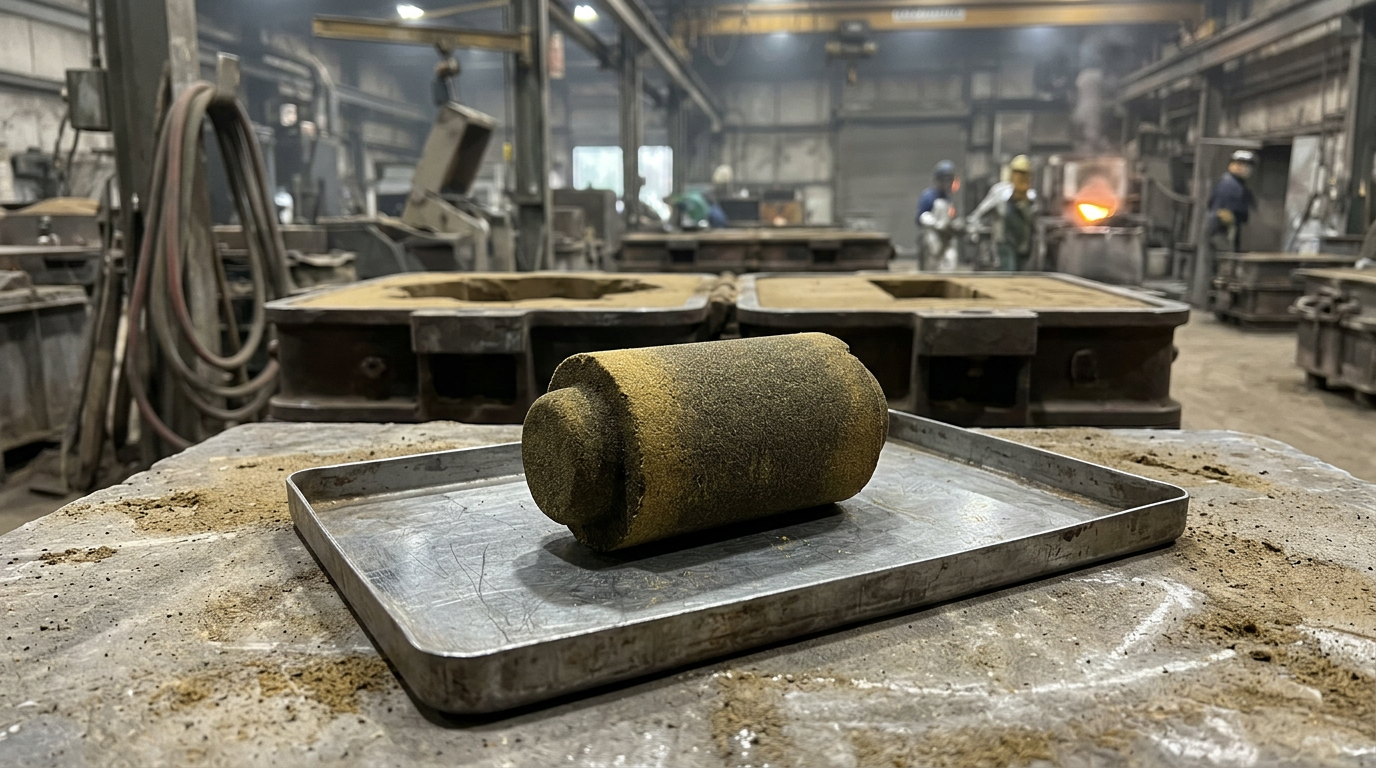
Think of a pipe fitting with a through-bore. The sand casting core creates that bore — no machining required. Without a core, you would pour a solid block and have to drill or bore the passage afterward, which is slow, expensive, and sometimes geometrically impossible.
Cores need four properties to survive the pour: permeability to vent trapped gas, strength to resist the pressure of liquid metal, refractoriness to withstand pouring temperatures, and collapsibility so they break apart cleanly during shakeout. A core that lacks any one of these either creates defects or refuses to come out of the casting.
Not every casting needs a core. A solid bracket, counterweight, or mounting plate uses only a pattern. Cores come into play only when your part has internal cavities or passages that the cope-and-drag mold halves cannot form on their own.
How Pattern and Core Work Together
The pattern is pressed into sand in the cope (top) and drag (bottom) flask halves, creating the external cavity. The pattern is withdrawn. Then the core — made separately in a core box — is set into the mold before the two halves close.
The pattern and core are designed together even though they are separate tools. The pattern carries features called core prints: shaped protrusions that create recessed seats in the sand mold where the core sits. Without accurate core prints, the core shifts during the pour. Core shift is one of the most common dimensional defects I see in cored castings — the internal passage ends up off-center because the core floated under the buoyancy of molten metal.
| Attribute | Pattern | Core |
|---|---|---|
| Purpose | Shapes external mold cavity | Creates internal cavities |
| Reusable? | Yes — thousands of molds | No — destroyed every pour |
| Material | Wood, resin, metal | Bonded sand |
| Present during pour? | No — removed before closing | Yes — stays inside mold |
| Designed by | Pattern maker / foundry | Core designer / foundry |
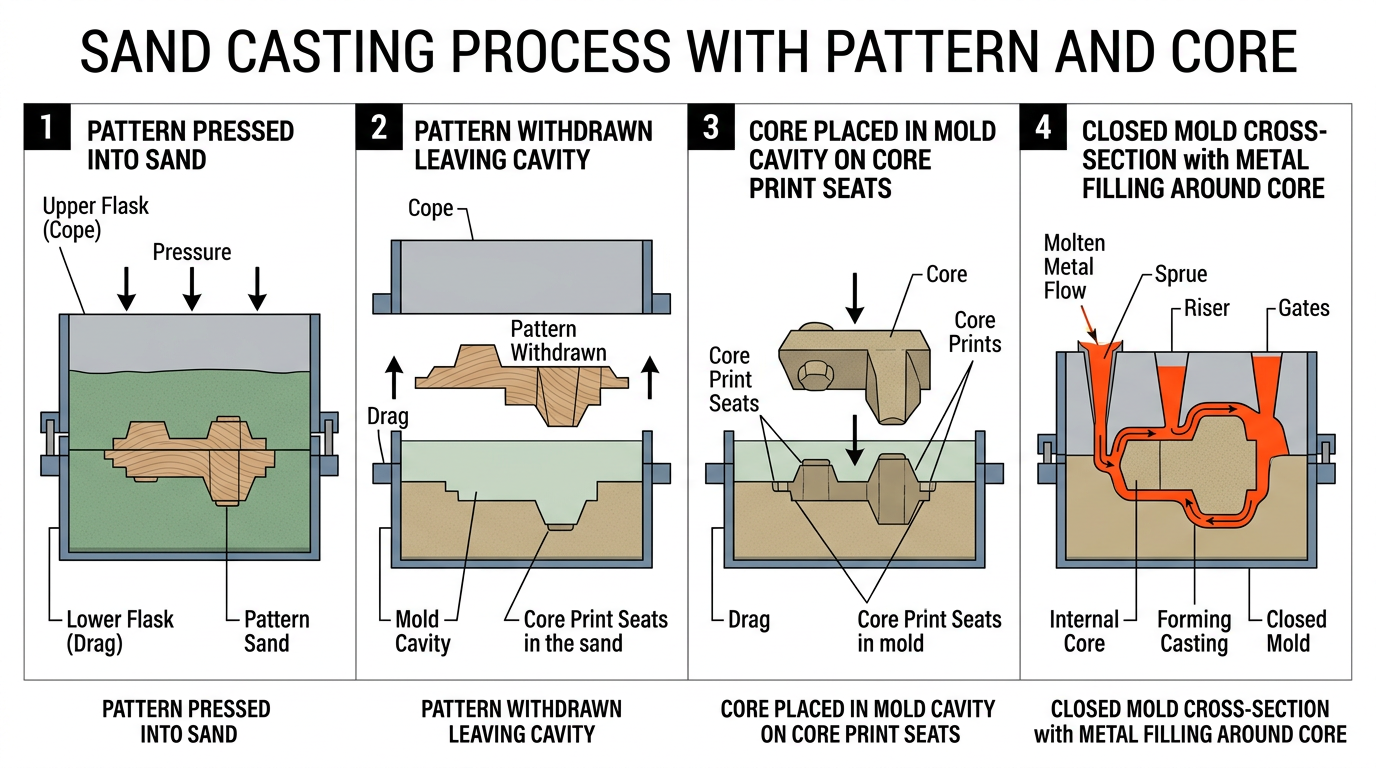
Before you pour, check that the core is seated firmly in its prints and that the print surfaces are clean. A 2-degree misalignment at the core print becomes a wall-thickness problem on the finished casting.
Getting the Terminology Right
When you send a drawing to a foundry, specifying “pattern” when you mean “core” — or vice versa — delays quoting and can result in tooling built to the wrong intent. The pattern is the foundry’s reusable master tool. The core is the expendable sand insert for internal features. The mold is the sand cavity they produce together.
One detail that catches most design engineers off guard: the foundry designs both the pattern and the core, not the customer. Your job is to define the casting geometry and tolerances. The foundry determines how to tool it — which surfaces become the parting line, where core prints go, and how many cores the part needs. Communicating clearly about which internal features are critical dimensions versus which can float helps the foundry improve core placement and keep your tooling cost down.