
Ductile iron is one of the most widely cast ferrous alloys in production. The material is not experimental, niche, or difficult to source.
Yet the question keeps surfacing from design engineers, and for good reason. The answer is straightforward — yes — but the real engineering challenge starts after that. Specifying a generic “ductile iron” on your drawing is like specifying “steel” without a grade. A 60-40-18 and a 120-90-02 are fundamentally different materials with different applications. Grade selection and casting design are where ductile iron projects succeed or fail.
How Ductile Iron Is Cast
Ductile iron is produced through sand casting, with one critical addition that gray iron does not receive: magnesium treatment. Adding approximately 0.03-0.06% magnesium to molten iron transforms the graphite morphology from flakes (gray iron) to spheroids (ductile iron). That single change in graphite shape doubles or triples tensile strength, elongation, and impact resistance.
The process follows a specific sequence:
- Melting: Base iron is melted in an electric induction furnace at roughly 2,700 F (1,480 C). Chemistry targets include carbon at 3.4-3.8% and silicon up to 2.75%.
- Magnesium treatment: Magnesium is introduced via a ferro-silicon-magnesium alloy using a sandwich or tundish-cover ladle method. Magnesium fades rapidly, so the treatment-to-pour window is tight — usually under 10 minutes.
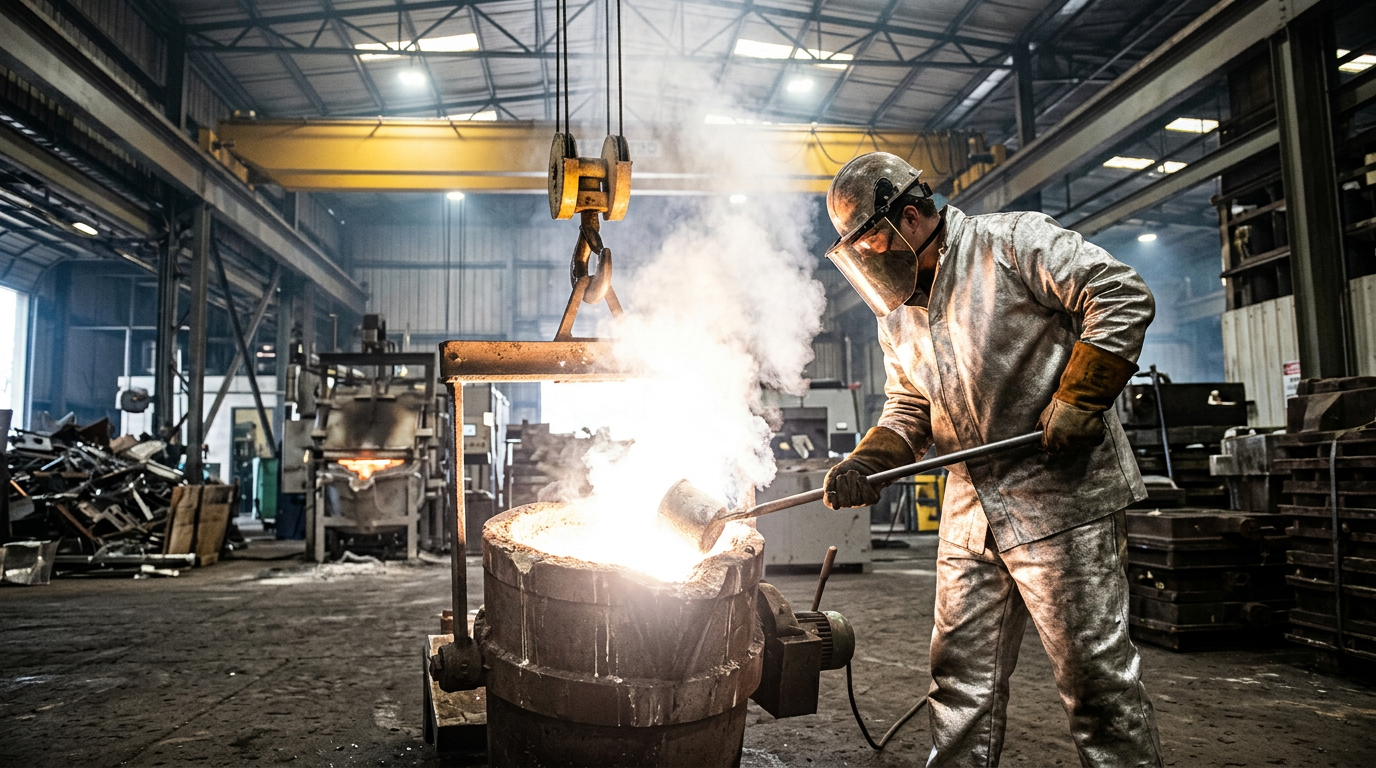
- Inoculation: A ferro-silicon inoculant is added just before or during pouring to promote graphite nucleation. Poor inoculation is the single most common cause of carbide formation in ductile iron, and carbides destroy machinability.
- Pouring and solidification: Ductile iron solidifies differently from gray iron — it expands during graphite precipitation but shrinks overall, requiring larger risers and more aggressive feeding than gray iron castings of the same geometry.
One detail that trips up engineers new to ductile iron: the nodular graphite structure demands tighter process control than gray iron. Inoculant type, addition rate, pouring temperature, and treatment-to-pour time all affect nodularity. A casting with 80% nodularity and one with 95% nodularity can meet the same ASTM grade minimum — but they will not perform identically in fatigue service.
ASTM A536 Grades and Properties
ASTM A536 defines ductile iron grades by three numbers: minimum tensile strength (ksi), minimum yield strength (ksi), and minimum elongation (%). The grade tells the foundry exactly what microstructure to target.
| Grade | UTS (ksi) | YS (ksi) | Elongation (%) | Matrix | Typical Applications |
|---|---|---|---|---|---|
| 60-40-18 | 60 | 40 | 18 | Ferritic | Pressure-containing housings, valves, pumps, wind energy components |
| 65-45-12 | 65 | 45 | 12 | Ferritic-pearlitic (70:30) | Automotive suspension, pump volutes, mining equipment, power transmission gears |
| 80-55-06 | 80 | 55 | 6 | Pearlitic-ferritic | Crankshafts, connecting rods, heavy-duty gears |
| 100-70-03 | 100 | 70 | 3 | Pearlitic (normalized or Q&T) | High-strength structural, heavy equipment pins, track links |
| 120-90-02 | 120 | 90 | 2 | Tempered martensite | Wear-critical components, high-load bearings |
The ASTM spec gives you minimums, but here’s what actually matters: the matrix controls everything. Grade 60-40-18 requires a fully ferritic matrix, typically achieved through a full anneal. Grade 65-45-12 hits its properties as-cast with a natural 70:30 ferrite-pearlite ratio — no heat treatment required. That makes 65-45-12 the workhorse grade and the default candidate when engineers evaluate ductile iron as a steel replacement.
Moving up to 80-55-06 and 100-70-03 increases strength but sacrifices ductility sharply. These grades often need normalizing or quench-and-temper heat treatment, adding cost and lead time. Before you specify 100-70-03 for a high-strength application, compare the total cost — material plus heat treatment plus machining — against a carbon steel casting. The advantage narrows quickly once you factor in processing.
For engineers coming from a steel background: ductile iron’s density is 0.256 lb/in3 (7.1 g/cm3), roughly 10% lighter than steel. Combined with better machinability in ferritic grades and lower casting cost, grades 60-40-18 and 65-45-12 genuinely compete with low-alloy steel castings for structural applications.
Design Rules for Ductile Iron Castings
Ductile iron is forgiving as a material but unforgiving in casting design. Half of all shrinkage defects trace back to metallurgical factors like carbon equivalent and inoculation — but the other half come from geometry decisions that the design engineer controls.
Wall Thickness and Section Transitions
Minimum practical wall thickness for sand-cast ductile iron is roughly 0.25 in (6 mm), though 0.375 in (10 mm) is safer for consistent soundness. Thinner walls cool too fast, promoting carbides instead of the nodular graphite structure you need.
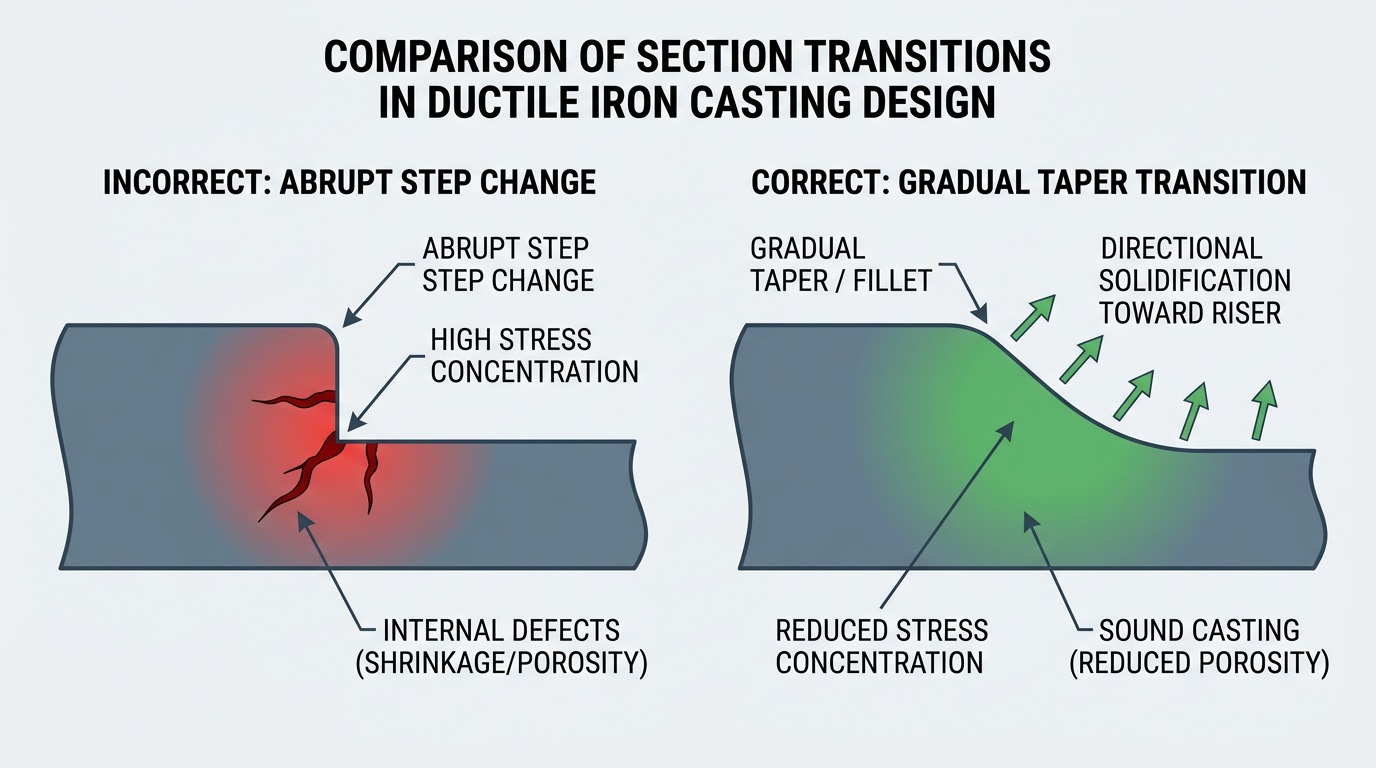
Section thickness should be greatest under the riser and reduce progressively as the geometry moves away from feed points. I’ve seen castings with a 3:1 section ratio that looked fine on a stress model but cracked during cooling because the thin web solidified and contracted while the heavy boss was still liquid.
Transition between thick and thin sections gradually — a taper ratio of roughly 3:1 (length to thickness change) prevents hot-spot formation.
Rib and Boss Design
Ribs should be approximately 80% as thick as the adjoining section wall. Thicker ribs create localized hot spots that the riser cannot feed. Thinner ribs solidify too early and act as crack initiation sites.
Never align ribs on opposite faces of a casting. Opposed ribs create a locally thick section that produces shrinkage porosity and inconsistent hardness. Stagger them.
Corners and Intersections
Sharp external corners cool faster than the surrounding material, producing inconsistent hardness. Generous fillet radii — at least equal to the wall thickness — eliminate this problem.
Aligned cross members promote uneven cooling, leading to hot spots and distortion. Stagger intersections wherever the geometry allows.
Machining Allowance
I’ve seen too many projects specify minimum machining stock to save material cost, only to discover that cored holes and surfaces shift during solidification. Insufficient stock often backfires — rework charges and rejection rates far exceed what the extra material would have cost. Specify at least 0.125 in (3 mm) per side for general machining surfaces, more for bores and critical datums.
The foundry controls melt chemistry and inoculation. You control geometry. Design for solidification sequence, not just for the final load case.
When Ductile Iron Is the Wrong Choice
Ductile iron handles an enormous range of applications, but it is not universally superior.
- Thin-wall or intricate castings. Below 0.25 in wall thickness, ductile iron produces carbides and poor nodularity. Gray iron handles thin sections far better because flake graphite nucleates more readily.
- Vibration damping. Gray iron’s flake graphite dissipates vibrational energy far more effectively than nodular graphite. Machine tool bases and damper housings perform better in gray iron.
- Weldability requirements. Ductile iron can be welded but requires extensive preheat (600-1,200 F), nickel-based filler metals, and slow cooling. If your component needs field welding, a carbon steel casting is a better starting point.
- Extreme low-temperature service. Impact resistance drops in subzero service. For cryogenic or arctic applications, consider low-temperature steel grades (ASTM A352) instead.
- Very high strength with ductility. Past grade 100-70-03, heat treatment cost and processing complexity approach comparable steel castings. Run the full cost comparison before committing.
Material selection is 80% of casting success. Choosing ductile iron for the right application delivers excellent performance at lower cost. Choosing it for the wrong one creates problems no amount of process optimization can fix.
Making the Right Specification
Specifying “ductile iron” without a grade is the most common mistake I see on casting drawings. Start with service conditions — load type, impact exposure, operating temperature, corrosion environment — and work backward to the ASTM A536 grade. For most structural and pressure-containing applications, 65-45-12 is the starting point. Move to 60-40-18 when elongation and impact matter more than strength, or up to 80-55-06 when you need hardness and can accept less ductility.
Put the ASTM grade, required nodularity (80% minimum for standard applications), and heat treatment condition on your drawing. Leave inoculation methods, gating design, and riser placement to the foundry. Specify the outcome, not the process. Then invest your engineering effort where it pays the most: section transitions, fillet radii, and machining allowances that let the casting solidify cleanly.