
A wood pattern that warps after six months of storage costs you more than the aluminum pattern you avoided buying upfront. I’ve watched shops lose entire production runs because they picked pattern material based on a simple volume chart and ignored everything else — geometry, tolerance requirements, how long the pattern sits between orders.
Pattern material drives casting quality more than most engineers realize. The material you choose determines not just how many pulls the pattern survives, but how much draft you need, how tight your tolerances hold over time, and whether your castings stay consistent from the first pour to the five-hundredth.
Wood Patterns
Wood remains the default for low-volume work — roughly 50 or fewer pieces per year — because it’s inexpensive, widely available, and fast to machine. But “wood” is not one material. Species selection is one of the most consequential decisions in pattern making, and the wrong choice creates defects no amount of gating design can fix.
Choosing the Right Wood Species
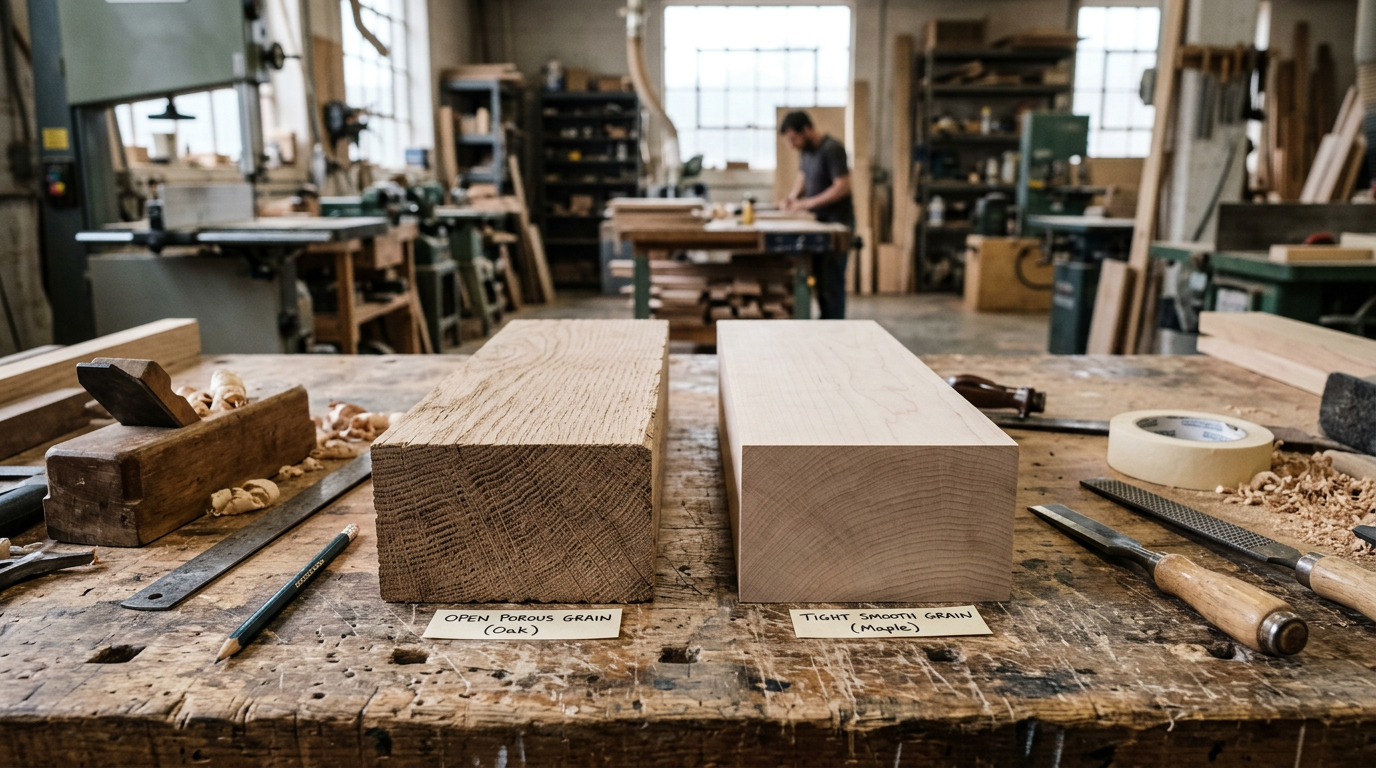
The most common mistake I see in new patterns is using whatever hardwood is handy instead of proper pattern wood. I pulled an oak pattern once that had material pull-in across half the casting face. The open grain structure grabbed sand and coating material during ramming, leaving divots and porosity on every pour. Oak is hard, sure — but hardness isn’t the point. Grain structure is.
Mahogany is the standard for good reason: tight grain, excellent dimensional stability, and it machines to a smooth finish that releases cleanly from green sand. Hard maple is another solid choice — it wears better than mahogany on high-contact surfaces. For intricate patterns with fine detail, jelutong carves cleanly without tearing.
Pine works for rough patterns, prototype work, and large simple shapes where dimensional precision isn’t critical. A smart hybrid approach uses a pine body with mahogany glued onto parting surfaces and edges — you get the cost savings of pine where it doesn’t matter and the performance of mahogany where it does.
Finishing and Storage
Every wood pattern must be sealed — lacquer, varnish, or enamel. Unsealed wood absorbs moisture from green sand and swells, changing dimensions between pulls. Keep moisture content below 10% before sealing. Store patterns in climate-controlled areas; a pattern that sits in an unheated warehouse through a humid summer will not hold the same dimensions it had in January.
Metal Patterns
Metal patterns — primarily aluminum and cast iron — justify their higher upfront cost through longevity, dimensional stability, and tighter allowable draft angles. For production volumes above 5,000 pieces annually, metal is almost always the right call.
Aluminum vs. Cast Iron
Aluminum handles the majority of metal pattern applications. It’s lightweight enough that pattern makers can handle it without hoists on mid-size tooling, it machines easily, and it resists corrosion in storage. For gray iron castings and ductile iron castings in steady production, aluminum patterns routinely deliver tens of thousands of pulls without measurable dimensional change.
Cast iron patterns are reserved for the heaviest production — very high-volume runs where even aluminum’s wear rate becomes a factor. The tradeoff is weight: cast iron patterns often require crane handling, which slows mold setup.
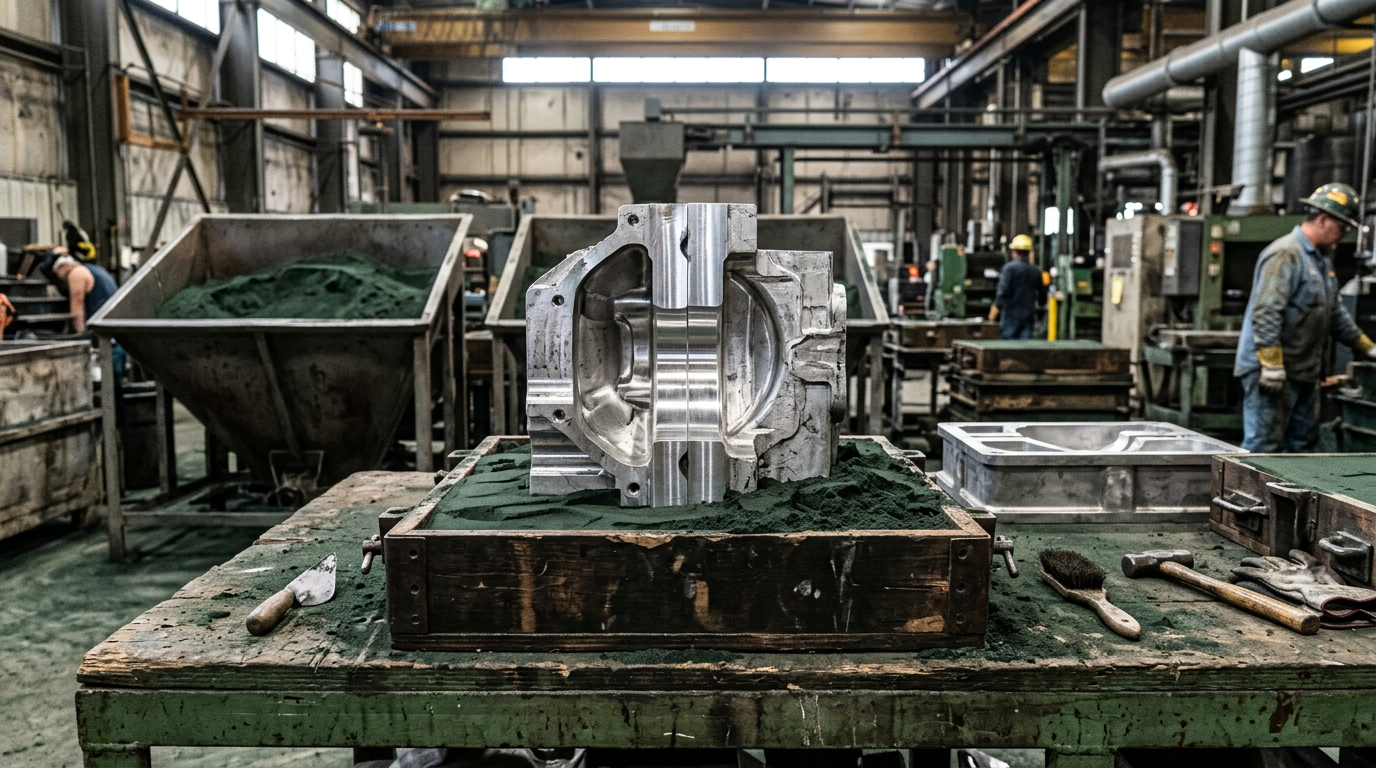
Metal patterns also allow tighter draft angles. At a 1-inch surface height, wood patterns need 3.0 degrees of external draft to pull cleanly from green sand. Metal and plastic patterns need only 1.5 degrees at the same height. That difference matters when your design calls for near-vertical walls — metal patterns let you hold closer to design intent.
| Surface Height | Wood Draft (External) | Metal/Plastic Draft (External) |
|---|---|---|
| 1 inch | 3.0 deg | 1.5 deg |
| 2-4 inches | 1.5 deg | 1.0 deg |
| 4-8 inches | 1.0 deg | 0.75 deg |
| 8-32 inches | 0.5 deg | 0.5 deg |
Plastic and Composite Patterns
Plastic and composite materials fill the gap between wood and metal for shops running 500 to 5,000 pieces per year — a volume range where wood wears out too fast and metal costs more than the job warrants.
Urethane composite board — often called brownboard in the shop — machines like wood but resists moisture and holds dimensions far better. It’s the natural upgrade when wood patterns start requiring rework between runs. High-density composite board (redboard) takes this a step further with better wear resistance, handling volumes that would chew through brownboard.
The key limitation with composites is impact resistance. Redboard chips and breaks if dropped or mishandled during mold setup. Aluminum survives the same abuse without damage. For patterns with thin walls or fragile ribs, this handling vulnerability often pushes the decision toward aluminum even at lower volumes.
Before you pour a trial run, check whether the pattern will see rough handling on the shop floor. If it will, skip composites and go straight to aluminum regardless of your volume numbers.
3D-Printed and Additive Patterns
3D printing has crossed the prototype-only threshold. Stereolithography (SLA) produces patterns with surface finish and dimensional accuracy rivaling machined urethane, and selective laser sintering (SLS) creates durable nylon patterns that survive multiple pulls in green sand.
For prototyping and design iteration, though, the more interesting question is whether you need a physical pattern at all. 3D sand printing builds the mold directly from a CAD file — no pattern, no core box, no physical tooling. Each design revision costs only a CAD update and a new print. The per-mold cost runs higher than traditional sand molding, but when you factor in two or three design revisions that would each require physical pattern rework, the economics shift quickly.
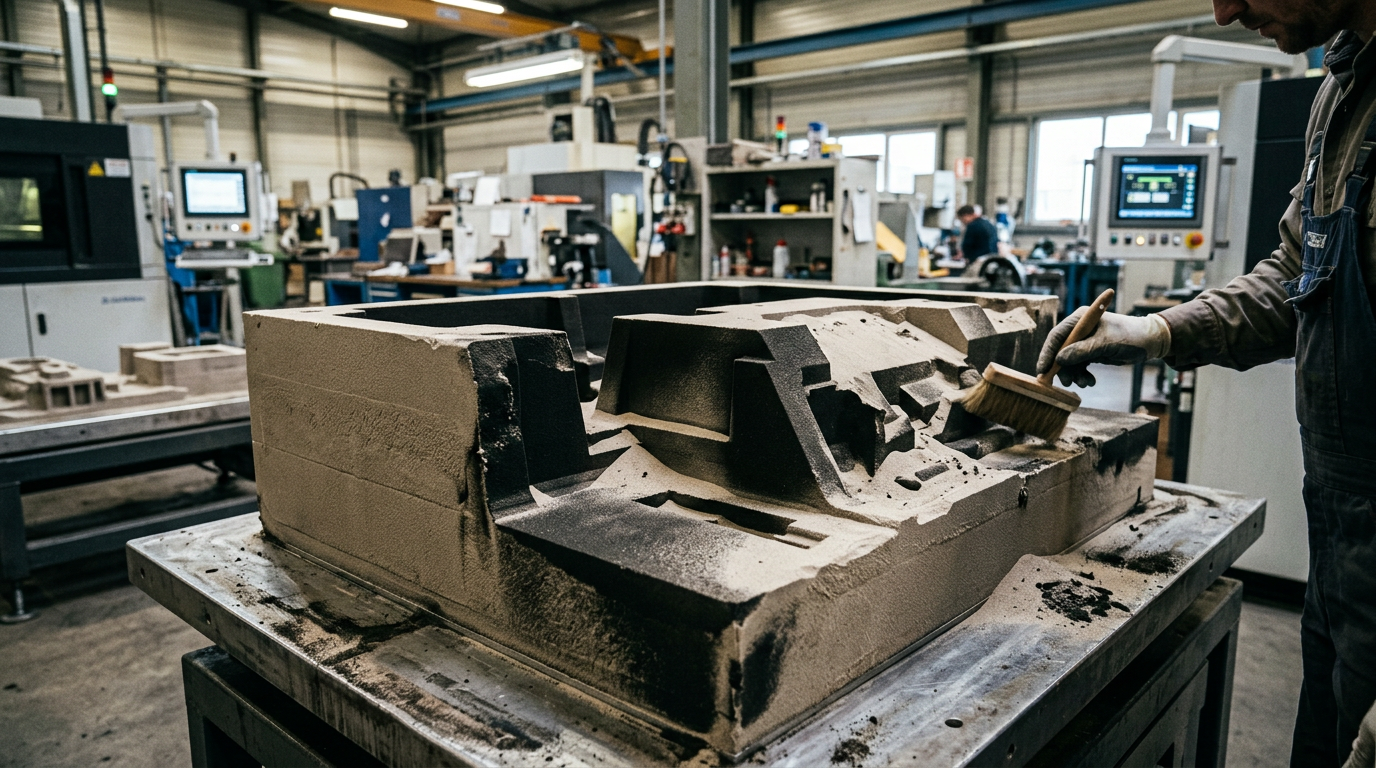
Where 3D-printed patterns fall short is production volume. Printed patterns wear faster than machined aluminum or even brownboard. They make sense for runs under a few hundred pieces, bridge tooling while metal patterns are being built, or geometries too complex for traditional pattern making.
How to Choose the Right Pattern Material
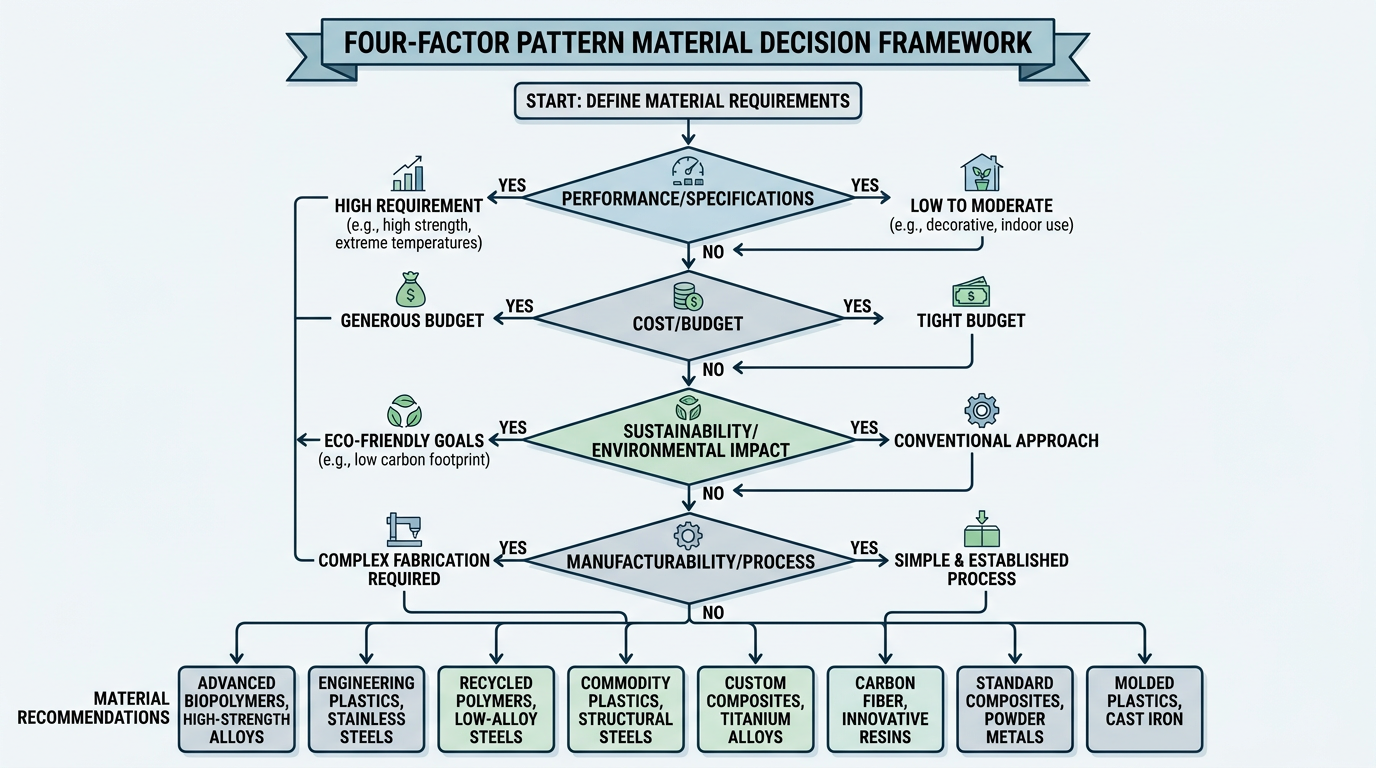
Volume alone — under 50 pieces equals wood, over 5,000 equals metal — is only a starting point; it misses the factors that actually drive cost and quality over the life of a pattern. Before you specify a material, I ask four questions.
What’s the tightest tolerance on the casting?
If you need wall verticality or thin features, the draft angle reduction from metal or plastic patterns may be non-negotiable even at low volume.
How complex is the geometry?
Thin walls, deep ribs, and fine detail push you toward harder materials faster than volume alone. A simple block shape at 2,000 pulls per year works fine in brownboard. A ribbed housing at the same volume may need aluminum.
How long between production runs?
A pattern stored for two years between orders needs dimensional stability that wood cannot guarantee. Aluminum or composite board holds dimensions indefinitely in reasonable storage conditions.
What’s the true cost per pull?
Run the math across upfront price, expected pulls, rework cost, and storage degradation — the cheapest pattern at purchase rarely wins past 100 pieces. Compare a $500 mahogany pattern to a $3,000 aluminum pattern across three representative volumes:
| Volume | Wood effective cost/pull | Aluminum effective cost/pull |
|---|---|---|
| 50 pieces | $10.00 (no rework yet) | $60.00 |
| 500 pieces | $2.40 (incl. $700 rework) | $6.00 |
| 5,000 pieces | $1.40 (incl. rework + rebuild) | $0.60 |
Amortize tooling over the pattern’s total lifetime pulls, not a single order quantity. A pattern serving a recurring carbon steel casting program amortizes across three to five years — the aluminum premium disappears fast against that horizon. The line item that never shows up in the spreadsheet is rework downtime: one $4,000 wood-pattern rework window can stall a $40,000 production order downstream. That hidden cost is why the aluminum crossover lands at 200-300 pieces in my experience, far below the 5,000-piece textbook threshold.
Making Your Pattern Material Decision
Pattern material selection is a casting quality decision, not just a purchasing decision. Start with these checks: confirm your tolerance requirements can be met with the draft angles your chosen material allows, verify the pattern will hold dimensions through your storage and reuse timeline, and calculate cost per pull over the pattern’s full expected life — not just the purchase price. The cheapest pattern is the one that produces acceptable castings from first pull to last without rework in between.