Every stainless steel family — austenitic, ferritic, martensitic, duplex, and precipitation-hardened — has established cast equivalents with ASTM designations. I’ve poured all of them. But the question that should follow “can it be cast?” is one most engineers never ask: what changes when stainless steel solidifies in a mold instead of being rolled into plate?
That answer involves deliberate microstructural differences, a ferrite paradox that surprises engineers trained on wrought alloys, and design rules that go beyond the basic answer. Get the metallurgy right, and cast stainless delivers complex geometries with corrosion resistance matching wrought counterparts. Get it wrong, and you’ll see intergranular corrosion on parts that passed every chemistry check.
Yes, Stainless Steel Can Be Cast
Sand casting, investment casting, and centrifugal casting all handle stainless steel alloys routinely. Commercial foundries offer 30+ cast stainless grades covering every major family, with individual castings ranging from under a pound to over 6,000 pounds.
The critical distinction from carbon steel: stainless alloys have a wider solidification temperature range — 1375 to 1530 C depending on grade — and 2-3% volumetric shrinkage during cooling. That wider freezing range makes stainless far more susceptible to hot tearing than carbon steel. Every gating, risering, and cooling decision must account for this.
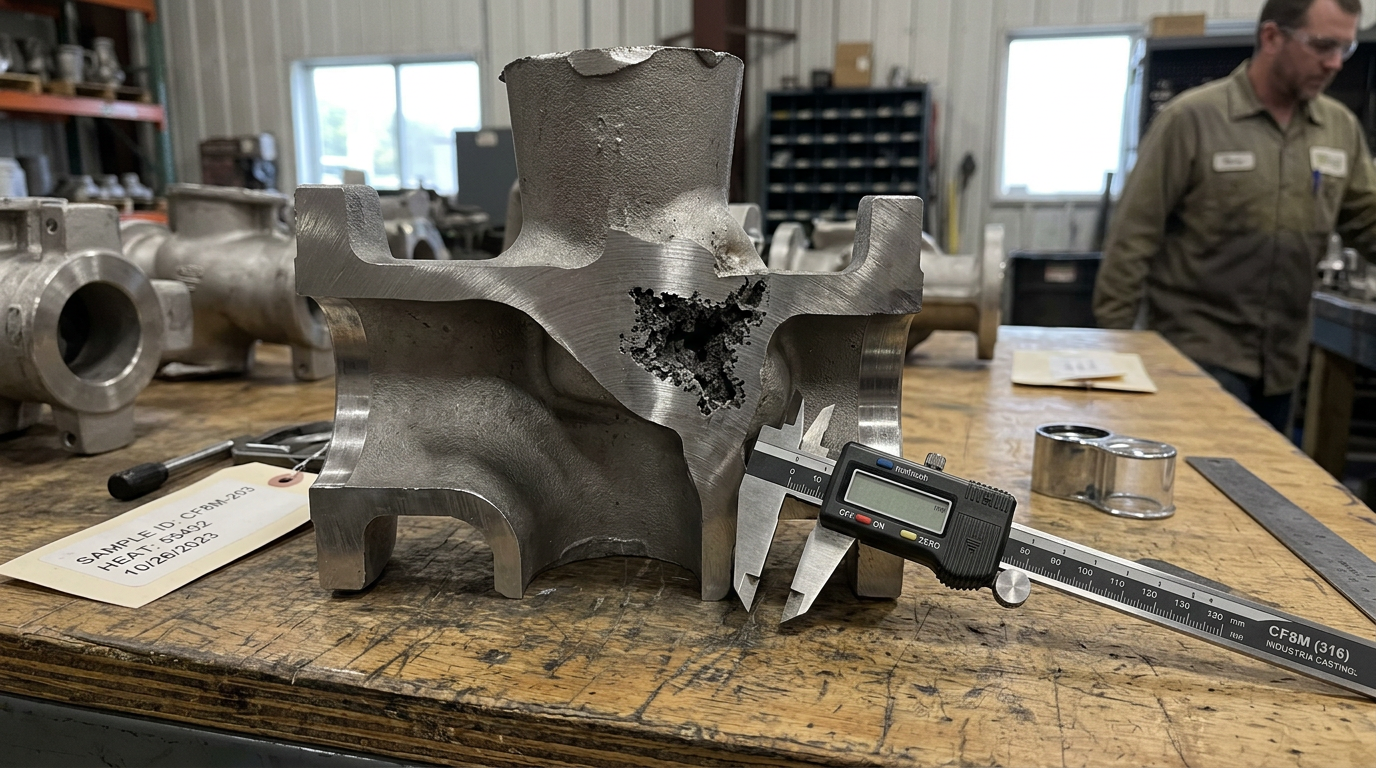
I’ve pulled CF8M pump bodies that failed intergranular corrosion testing despite chemistry reports showing 18.48% Cr, 9.55% Ni, and 2.10% Mo — all within ASTM A351 spec. The root cause was carbide precipitation from improper cooling rate during heat treatment. Chromium carbides formed at grain boundaries, creating chromium-depleted zones that corroded under chloride exposure. Material selection alone is never enough — process control is the other half of the equation.
Wrought-to-Cast Grade Mapping
Engineers working with wrought stainless specify 304, 316, 304L, 316L. Their cast counterparts carry SFSA designations that encode composition and service environment in a single string.
The SFSA Designation System
The Steel Founders Society of America (SFSA) system works like this: the first letter indicates intended service — C for corrosion-resistant, H for heat-resistant. The second letter progresses A through Z with increasing nickel content. Trailing numerals express maximum carbon content as a percentage times 100. Suffix letters denote additional alloying elements (M for molybdenum, N for nitrogen).
CF8M decoded: C (corrosion service) + F (mid-range nickel) + 8 (0.08% max carbon) + M (molybdenum added). The code tells you composition, service intent, and carbon limit before you open the spec sheet.
| Wrought Grade | Cast Equivalent | ASTM Spec | Key Difference |
|---|---|---|---|
| 304 | CF8 | A351 / A743 | 5-20% delta-ferrite retained |
| 316 | CF8M | A351 / A743 / A744 | Mo addition + ferrite |
| 304L | CF3 | A351 / A743 | Low carbon (0.03% max) |
| 316L | CF3M | A351 / A743 | Low carbon + Mo |
| 410 | CA15 | A743 | Martensitic, air-hardenable |
| 2205 | CD4MCuN | A890 | Duplex, 50/50 austenite-ferrite |
| 17-4 PH | CB7Cu-1 | A747 | Precipitation-hardened |
Why CF8 Is Not Just “304 in Cast Form”
This is the most common misconception I correct. CF8 retains 5-20% delta-ferrite deliberately — making it slightly magnetic. Wrought 304 is processed to be fully austenitic and nonmagnetic. When your QC team pulls a magnet test on a CF8 casting and gets a response, that’s not contamination. That’s the microstructure working as designed.
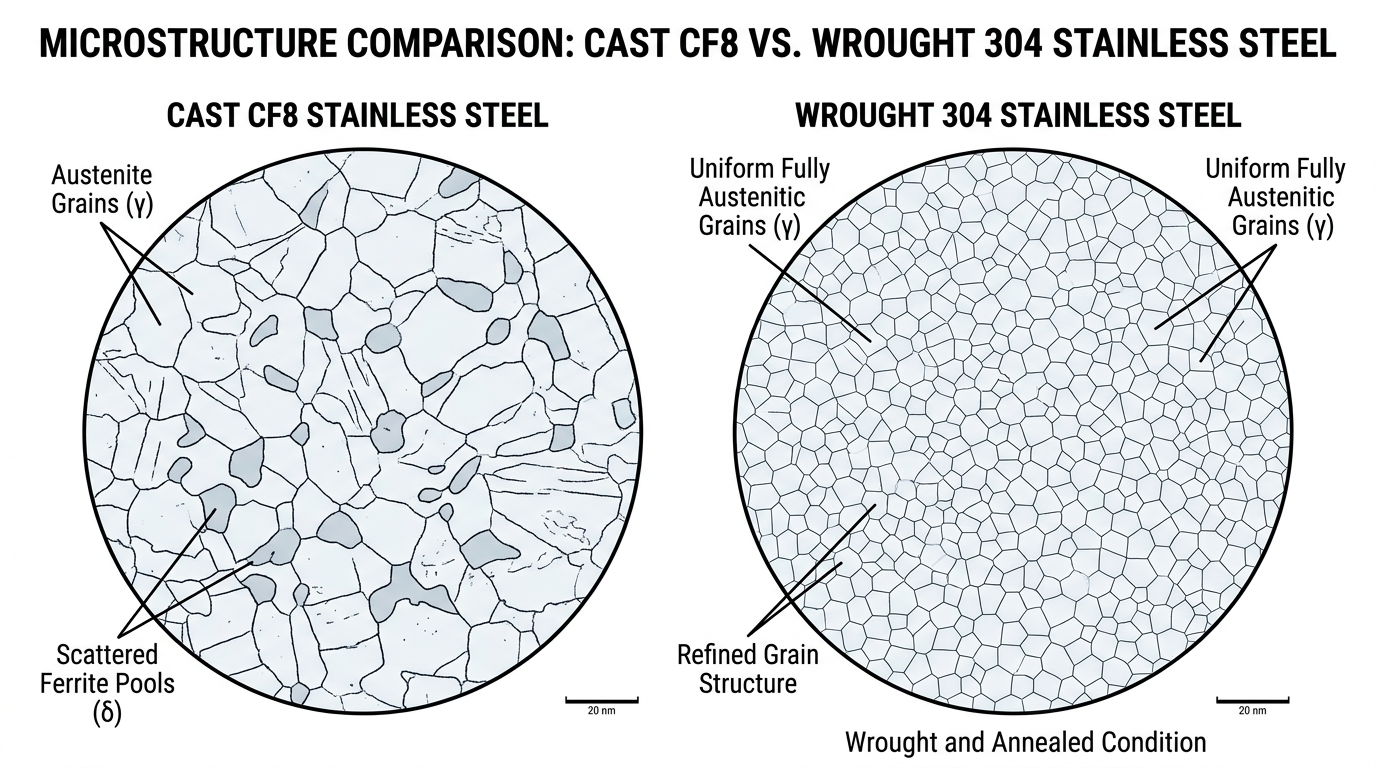
Cast grades also allow wider Cr and Ni composition windows to accommodate solidification variables that don’t exist in wrought processing. The resulting grain structure is coarser, tensile strength is generally lower, and fatigue resistance follows different curves. CF8M minimum tensile strength per ASTM A351 is 70 ksi with 30% elongation — adequate for most applications, but not interchangeable with wrought 316 in fatigue-critical service.
Before you specify the grade, understand the service conditions. A CF8 casting in a chloride environment above 60 C will likely develop stress corrosion cracking. For that service, you need CF8M or CF3M at minimum.
Why Ferrite Changes Everything
Delta-ferrite — the magnetic, body-centered cubic phase retained in cast austenitic stainless — is simultaneously the most important and most misunderstood feature of cast stainless steel.
The Ferrite Paradox
Ferrite does three things that make casting possible. It prevents hot tearing during solidification by disrupting crack propagation paths. It blocks stress-corrosion crack growth because ferrite pools within the austenitic matrix impede crack propagation. And it forces carbide precipitation into the ferrite phase rather than at austenite grain boundaries, reducing intergranular attack susceptibility.
The nuclear power industry requires a minimum of 5-7% ferrite for weldability. Foundry practice for corrosion-resistant castings typically targets 4-6%.
Three variables control ferrite content, and only one belongs to the metallurgist: chemical composition (the ASTM A800 formulae balancing Cr, Mo, and Si against Ni, C, Mn, and N), section thickness, and heat treatment. Section thickness is the variable most engineers overlook — thicker sections solidify slower and produce higher ferrite. The foundry has very little control over section thickness; the part designer determines it. Your geometry decisions directly influence the metallurgical outcome.
Temperature Limitations
The tradeoff appears above 315 C (600 F). Ferrite begins degrading metallurgically, and in the 425-650 C range, carbide precipitation shifts to ferrite pool edges. ASTM A351 explicitly states that grades CF3A, CF3MA, and CF8A are not recommended for service above 425 C (800 F). The very feature that makes these alloys castable limits their high-temperature service — a constraint wrought austenitic grades with minimal ferrite do not face.
For high-temperature stainless applications, specify H-series (heat-resistant) cast grades, which incorporate higher carbon for elevated-temperature strength at the expense of ambient corrosion resistance.
Which Casting Process Fits Stainless Steel
Sand, investment, and centrifugal casting all work for stainless — but stainless steel’s wider freezing range means every process needs adjusted gating and thermal management compared to carbon steel.
Sand casting handles the broadest weight range and works for most stainless grades. Expect tolerances of +/-0.010 inches on the first linear dimension and +/-0.005 per additional inch. Minimum section thickness for CF8M starts at 3/16 inch. Sand casting is the default for valve bodies, pump housings, and structural components where investment casting’s cost premium isn’t justified.
Investment casting achieves tolerances within +/-0.003 inches on holes and delivers superior surface finish. It earns its premium on thin-walled, geometrically complex parts — impeller vanes, surgical housings, aerospace brackets — where machining from wrought bar would waste most of the raw material.
Centrifugal casting suits pipe fittings, bushings, and cylindrical geometries where centrifugal force produces a denser, more uniform grain structure than static pouring.
Regardless of process, stainless casting demands tighter process control than carbon steel. I’ve seen a well-established CF8M casting — over 50,000 successful pours — develop surface shrinkage after nothing more than a riser sleeve change. Solidification modeling identified the fix: gating redesign and riser adjustments that cut scrap by an additional 1.5%. One variable change in a mature process caused defects.
Is Your Part a Good Casting Candidate?
Before you send an RFQ, run your component through four filters.
- Geometry complexity. Parts with internal passages, undercuts, or organic shapes that would require multi-axis machining from wrought bar are strong casting candidates. Simple prismatic shapes that machine efficiently from plate or bar stock rarely justify casting tooling costs.
- Production volume. Pattern and tooling costs amortize over quantity. Below 25-50 pieces for sand casting (or below 100 for investment casting), machining from wrought stock is often more economical. Above those thresholds, per-unit casting cost drops sharply.
- Tolerance requirements. As-cast sand casting tolerances (+/-0.010 to 0.015 inches) require secondary machining for tight-tolerance features. If your entire part demands tight tolerances, machining from wrought may cost less than casting plus finish machining. If only mating surfaces need precision, casting the near-net shape and machining critical features wins.
- Service conditions. Cast stainless matches wrought corrosion resistance for most environments. But cast austenitic grades face the ferrite-driven temperature ceiling at 425 C, and property variability is inherently wider — I’ve seen Brinell hardness swing from 158 to 204 across castings from the same heat. If your application demands tight mechanical property consistency or service above 425 C, wrought material is the safer specification.
The Bottom Line
Stainless steel is absolutely castable across every major alloy family, and the cast equivalents have decades of proven field performance. The engineering challenge isn’t whether it can be done — it’s recognizing that cast CF8M behaves differently than wrought 316 in ways that affect your design, your specification, and your quality expectations.
Specify the ASTM cast designation, not the wrought grade. Account for ferrite content in your service temperature evaluation. And design your section thicknesses knowing that geometry controls metallurgy in a casting. Get those three decisions right, and cast stainless becomes one of the most versatile manufacturing options available.