
Yes. Steel is sand cast every day — for valve bodies, pump housings, structural brackets, and pressure-containing components across every heavy industry. But steel is also the most demanding metal you can pour into a sand mold. At 2,800+ F pouring temperatures and nearly 6% volumetric shrinkage, steel punishes every shortcut in sand preparation, gating design, and heat treatment that aluminum or iron would forgive. Average casting yield at steel foundries runs just 53.3%, meaning nearly half the metal poured ends up as scrap, risers, or gates. The question isn’t whether steel can be sand cast — it’s whether your foundry understands what steel demands.
Which Steel Grades Can Be Sand Cast
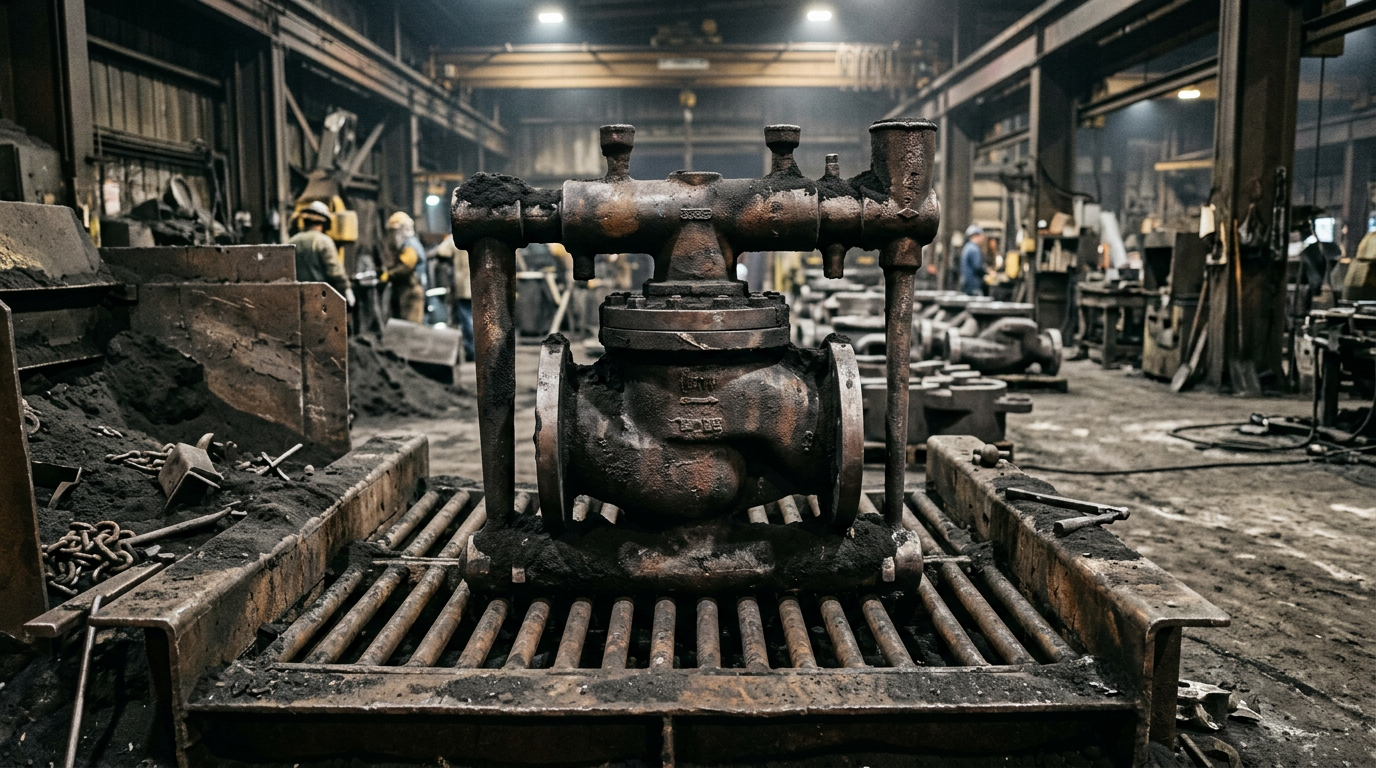
ASTM A216 WCB handles roughly 80% of carbon steel sand casting applications. It’s the workhorse grade for valve bodies, pump casings, and pressure-containing components operating below 1,200 F. But choosing WCB by default without checking service conditions is one of the most common specification errors I see.
The A216 family offers three grades, each filling a different role:
| Grade | Tensile Strength | Yield Strength | Elongation | Best For |
|---|---|---|---|---|
| WCA | 60-85 ksi | 30 ksi min | 24% min | Maximum weldability, low-pressure service |
| WCB | 70-95 ksi | 36 ksi min | 22% min | General-purpose pressure components |
| WCC | 70-95 ksi | 40 ksi min | 22% min | Higher-strength applications, thicker sections |
WCA’s lower carbon content (0.25% max vs. WCB’s 0.30%) makes it easier to weld without preheat — a real advantage for field-installed components. WCC bumps manganese to 1.20% max, which delivers 40 ksi minimum yield compared to WCB’s 36 ksi. That 4 ksi difference matters in thick-walled pressure vessels where wall thickness directly affects material cost.
Every A216 casting requires heat treatment — either annealing at 890-910 C or normalizing at 870-890 C. No exceptions. Skip it, and the microstructure tells the whole story: coarse, as-cast grain with unpredictable mechanical properties that will fail any third-party inspection.
For corrosion-resistant applications, ASTM A351 CF8M (the cast equivalent of 316 stainless) is the standard stainless steel sand casting grade. CF8 (304 equivalent) works where molybdenum isn’t needed. Both grades are routinely sand cast, but stainless demands even more attention to gating and feeding because its solidification behavior is less predictable than carbon steel.
Before you specify the grade, understand the service conditions. Temperature, pressure, corrosion environment, and weldability requirements narrow the field fast — and the ASTM spec gives you minimums, but here’s what actually matters: matching the grade to the actual failure mode you’re designing against.
What Makes Steel the Most Demanding Sand Casting Metal
Carbon steel pours at 1,500-1,600 C (2,730-2,910 F). Stainless steel isn’t far behind at 1,370-1,530 C (2,500-2,790 F). Compare that to aluminum at roughly 1,300 F, and the gap explains everything about why steel sand casting requires a fundamentally different process.
Temperature and Sand System Requirements
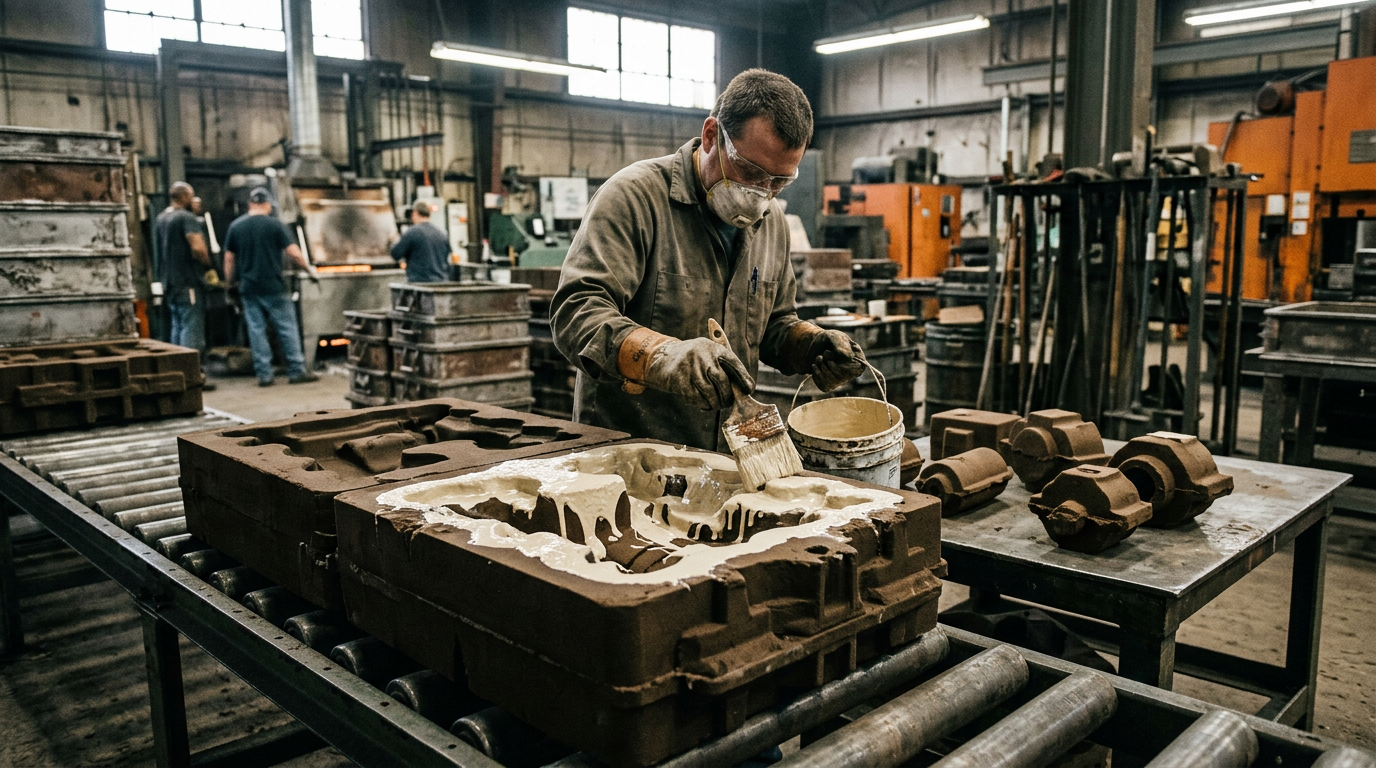
At 2,800+ F, standard green sand binders break down. Steel foundries use chemically bonded sand systems — typically no-bake (airset) processes with furan or phenolic urethane binders — because they maintain dimensional stability at temperatures that would destroy clay-bonded green sand molds. Molds are preheated to 100-200 C (212-392 F) before pouring to prevent thermal shock cracking at the mold-metal interface.
Refractory coatings on mold and core surfaces are not optional for steel. Without them, metal penetration into the sand creates a fused layer that requires hours of grinding to remove.
Three-Phase Shrinkage
Steel shrinks approximately 6% by volume during solidification — nearly double aluminum’s 3.5%. But the real problem isn’t the total shrinkage. It’s that engineers treat shrinkage as a uniform scaling factor when it actually occurs in three distinct phases:
- Liquid contraction — cooling from pouring temperature to the liquidus, before any solidification begins
- Solidification shrinkage — the phase change from liquid to solid, where the 6% volumetric contraction concentrates
- Solid-state contraction — cooling from solidus to room temperature, which determines pattern shrinkage allowance
A thick section connected to a thin rib cools at different rates. The thick section is still liquid while the rib has already solidified and locked its dimensions. Internal stresses build. Hot tears form. The casting looks fine on the outside but is unmachinable because geometric distortion exceeded the machining envelope.
I’ve seen this defect pattern in foundries that skip simulation on complex geometries. Applying a blanket 2% shrinkage allowance to a part with 3:1 section thickness variation guarantees dimensional failures.
Common Defects in Sand-Cast Steel
Roughly 90% of casting defects trace back to design decisions, not foundry execution. That number surprises engineers who assume quality is a foundry problem — but the grade you specify, the geometry you design, and the tolerances you call out determine whether the casting succeeds before the first grain of sand is packed.
The Real Cost of Steel Casting Defects
Cleaning and repair operations consume approximately 30% of total steel foundry costs. I’ve audited foundries where 91% of grinding time on a 50-piece order of 1,000 lb steel castings went to defect removal rather than normal finishing. That’s $45,500 in annual grinding costs on a single order — and the defects were preventable with better gating design.
Stainless steel castings are worse. Repair weld times on a single part number can range from 1 to 16 hours — a 16x variability that signals inconsistent feeding, not inconsistent welding skill.
Steel-Specific Defect Patterns
Three defects dominate steel sand casting:
- Hot tearing — constrained sections that cannot contract freely during solidification. Steel’s high shrinkage rate makes this far more prevalent than in iron or aluminum castings. The fix is designing relief into the geometry, not asking the foundry to “be more careful.”
- Metal penetration — liquid steel forcing into sand grain interstices at 2,800+ F. Without proper refractory coatings and sand grain fineness, the casting surface fuses with the mold, creating a hybrid metal-sand layer that only aggressive grinding removes.
- Gas porosity — steel is more reactive with moisture and binder gases than lower-melting-point metals. Mold and core dryness is critical. Even small amounts of residual moisture at 2,800 F generate steam that creates subsurface voids detectable only by radiographic inspection.
Gating redesign alone can transform defect rates. One foundry reduced scrap from 13.8% to 2.7% through gating modifications on a single pattern — saving $24,420 annually. Scaled across 28 patterns, the same initiative delivered $514,000 in annual savings.
When to Choose Sand Casting for Steel
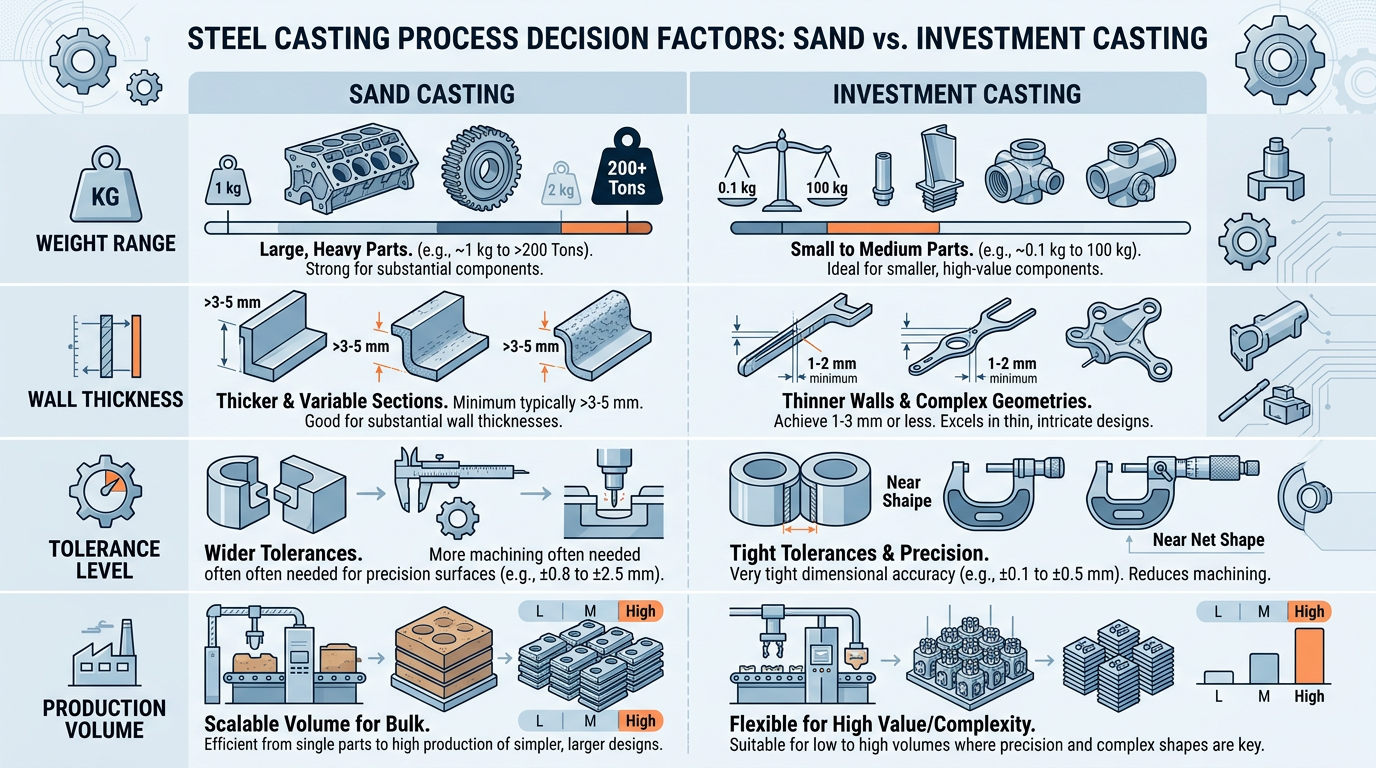
Sand casting is the default process for steel components above 50 lbs. No other casting method matches its combination of size capacity, alloy flexibility, and tooling cost for large steel parts. Sand molds handle steel castings up to 6,000 lbs — try that with investment casting, which tops out around 150 lbs domestically.
Below 50 lbs, the decision gets more nuanced. Investment casting delivers tighter tolerances, thinner walls (down to 1/8 inch minimum), and better surface finish — often eliminating secondary machining entirely. The per-unit cost is higher, but when you calculate the total cost including machining, the gap narrows or disappears.
Here’s how I frame the decision:
- Above 50 lbs, simple to moderate geometry — sand casting. Lower tooling cost, faster lead times, and the tolerances are adequate for most industrial applications.
- Below 50 lbs, complex geometry — get an investment casting quote alongside your sand casting quote. Compare total cost including secondary machining. You’ll be surprised how often investment wins.
- High volume (1,000+ pieces), any weight — sand casting’s per-unit economics improve with volume. Pattern tooling amortizes across the run, and cycle times are shorter than investment casting’s multi-step ceramic shell process.
- Thin walls under 1/4 inch — sand casting struggles here with steel. Steel’s poor fluidity at the end of fill means thin sections solidify before the metal reaches them. Investment casting or lost foam handles thin-walled steel parts more reliably.
What to Specify When Requesting a Steel Sand Casting Quote
The difference between a good steel sand casting and a scrapped one starts at the specification stage — before the foundry packs the first mold. Material selection is 80% of casting success, and no amount of foundry skill compensates for a poorly specified grade or an unrealistic tolerance callout.
When you request quotes, specify the ASTM grade (not just “carbon steel”), the service temperature range, any corrosion exposure, required mechanical testing (tensile, impact, hardness), and the NDT requirements (radiographic, magnetic particle, or liquid penetrant). If you’re unsure about the grade, describe the service conditions and let the foundry’s metallurgist recommend one. That conversation alone prevents more casting failures than any process improvement on the shop floor.