The average steel foundry converts only 53.3% of the metal it pours into finished castings. The rest — nearly half — goes to risers, sprues, gates, and scrap. Wall thickness is the single design variable with the most direct influence on where your metal ends up: in the part, or in the furnace for remelting.
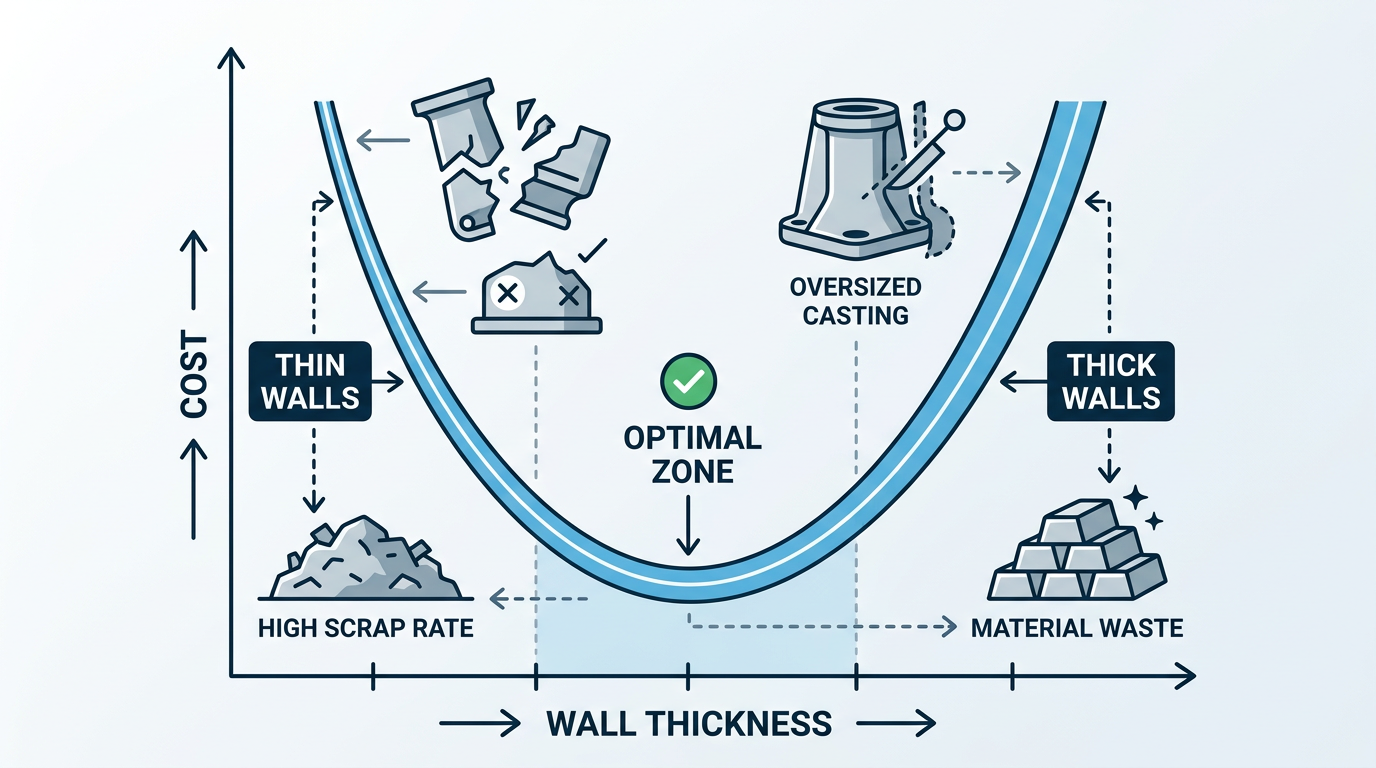
Most casting cost guides treat wall thickness as a design constraint — stay above the minimum, keep it uniform, move on. That framing misses the point. Wall thickness is a cost lever with a U-shaped curve: too thin drives up scrap from misruns and cold shuts, too thick drives up material cost, riser metal, and cycle time. The optimal zone varies by alloy, and hitting it can meaningfully shift per-part price.
Why Wall Thickness Is a Cost Lever, Not Just a Design Rule
Every millimeter of wall thickness change triggers a chain of cost consequences that compound through the casting process. Add 5 mm to a wall section, and you need a larger riser to feed it during solidification. That larger riser consumes metal at only 15-20% efficiency — meaning 80-85% of riser metal gets remelted, not shipped. The energy, labor, and furnace time for that remelting cycle adds roughly 7% to total casting cost across the industry.
Go too thin, and you get a different cost problem. Below the alloy-specific minimum, metal freezes before it fills the mold cavity completely. The result is misruns, cold shuts, and scrap — castings that go straight back to the furnace without ever reaching inspection.
Both directions cost money, but through completely different mechanisms. The sweet spot depends on your alloy, your geometry, and your foundry’s process capability.
I’ve seen procurement teams send RFQs with wall thickness specs pulled from die casting guidelines. Sand casting has fundamentally different economics — minimum walls are 2-3x thicker, feeding distances are longer, and the cost drivers are dominated by yield and riser efficiency rather than injection pressure and cycle speed.
Minimum Wall Thickness by Alloy
Pushing wall thickness below the process minimum doesn’t save material — it generates scrap. Here are the practical minimums for sand casting by alloy family.
| Alloy | Grade Range | Minimum Wall Thickness |
|---|---|---|
| Gray Iron | HT100 / HT150 | 4-6 mm |
| Gray Iron | HT200 | 6-8 mm |
| Gray Iron | HT250+ | 8-15 mm |
| Ductile Iron | All grades | 6 mm |
| Carbon Steel | Low/medium carbon | 8 mm (at 200 x 200 mm casting size) |
| Aluminum | All grades | 3 mm |
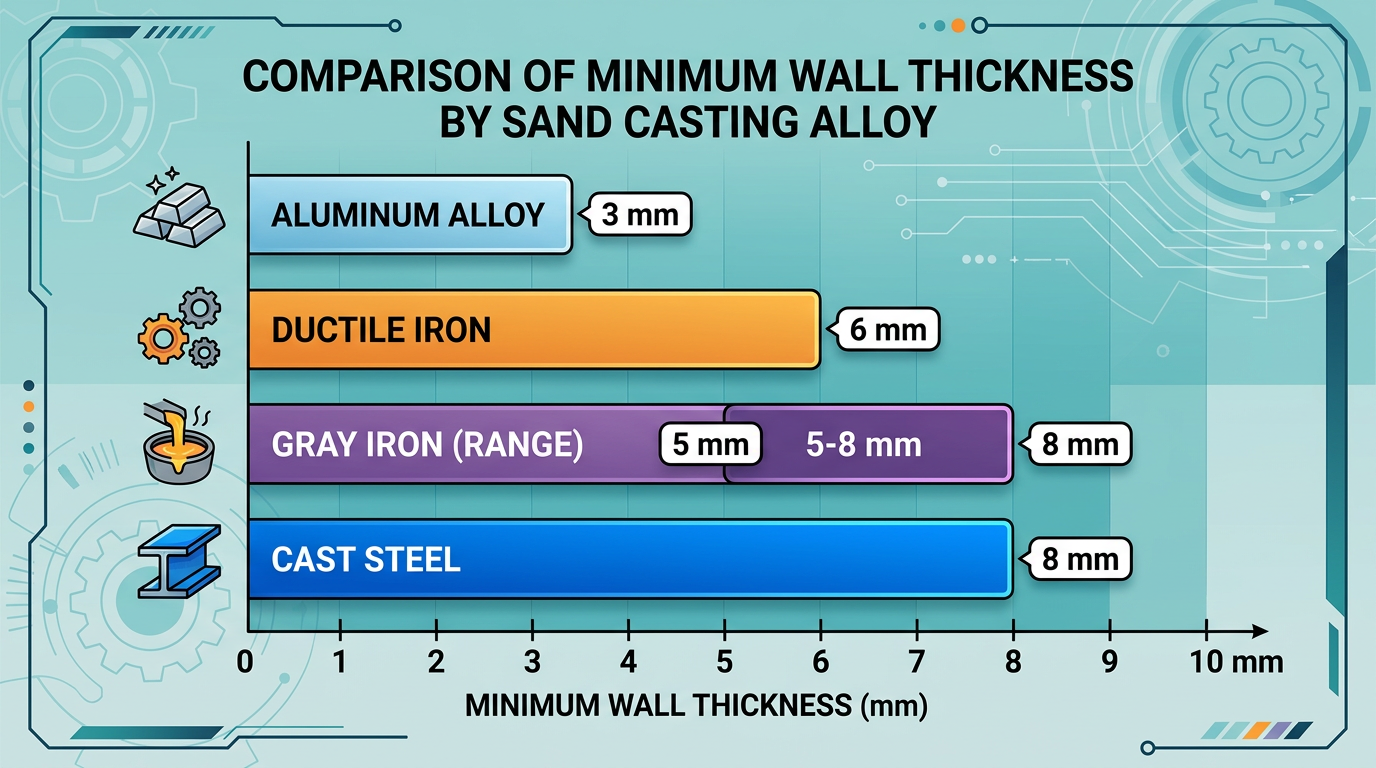
Notice that within gray iron alone, the grade selection changes the minimum wall by a factor of three. Specifying HT250 for vibration damping on a machine base locks you into 8-15 mm minimum walls. Dropping to HT200 — still adequate for many damping applications — opens up 6-8 mm walls and meaningfully reduces material per part.
Ductile iron at 6 mm minimum offers a cost-effective middle ground for structural parts where gray iron lacks the tensile strength but steel’s 8 mm minimum adds unnecessary weight and metal cost.
These numbers are typical ranges, not absolute limits. Every foundry has different equipment and process capabilities. Before finalizing wall thickness on a new design, confirm these values with your specific foundry — a 1 mm difference at the minimum threshold can separate a 95% yield from an 80% yield.
How Thin Walls Increase Cost
Going below the minimum wall thickness for your alloy doesn’t just risk defects — it guarantees them at production volumes. Metal that freezes before it fills the mold cavity produces misruns. Metal streams that meet after partial solidification produce cold shuts. Both are scrapped castings with zero recovery of labor, energy, or mold costs.
One nickel aluminum bronze casting ran at a 13.8% scrap rate before process improvement brought it down to 2.7% — saving $24,420 on a single part number. Wall sections that were marginal for the alloy’s flow characteristics were the primary driver.
Thin-wall castings also require more aggressive gating — more ingates, faster pour rates, sometimes pressurized gating systems. These add tooling complexity and reduce the number of castings per mold. Setup costs for thin-wall sand castings run measurably higher than standard designs, and pattern tooling can take 6-10 weeks to dial in.
Even when thin walls fill successfully, the margin for process variation shrinks. A pour temperature 20 degrees low, or sand permeability slightly off, and your yield drops. That process sensitivity means higher ongoing quality costs — more inspection, tighter process windows, and less room for the normal variation that every foundry lives with.
Moving just slightly above the alloy minimum — staying within the optimal range — improves fillability by 12-32% and cuts reject rates proportionally.
How Thick Walls Increase Cost
Overspecifying wall thickness is the more common and more expensive mistake. The costs stack in four layers.
Material Cost
Every additional millimeter of wall adds metal weight directly to your piece price. Ferrous alloys are priced by the pound, so thicker walls have a linear and immediate cost impact. On a 50 lb casting, a 20% wall thickness increase can add 8-10 lb of metal — roughly $8-15 in material alone before any processing.
Riser Metal and Yield Loss
Thick sections create thermal hot spots that solidify last. Each hot spot needs a riser to feed it during solidification, and the riser’s modulus (volume-to-surface-area ratio) must be at least 1.2x the casting section it feeds. Riser efficiency in sand casting runs only 15-20% — meaning for every pound of riser metal poured, only 0.15-0.20 lb actually feeds the casting. The rest gets cut off, remelted, and poured again.
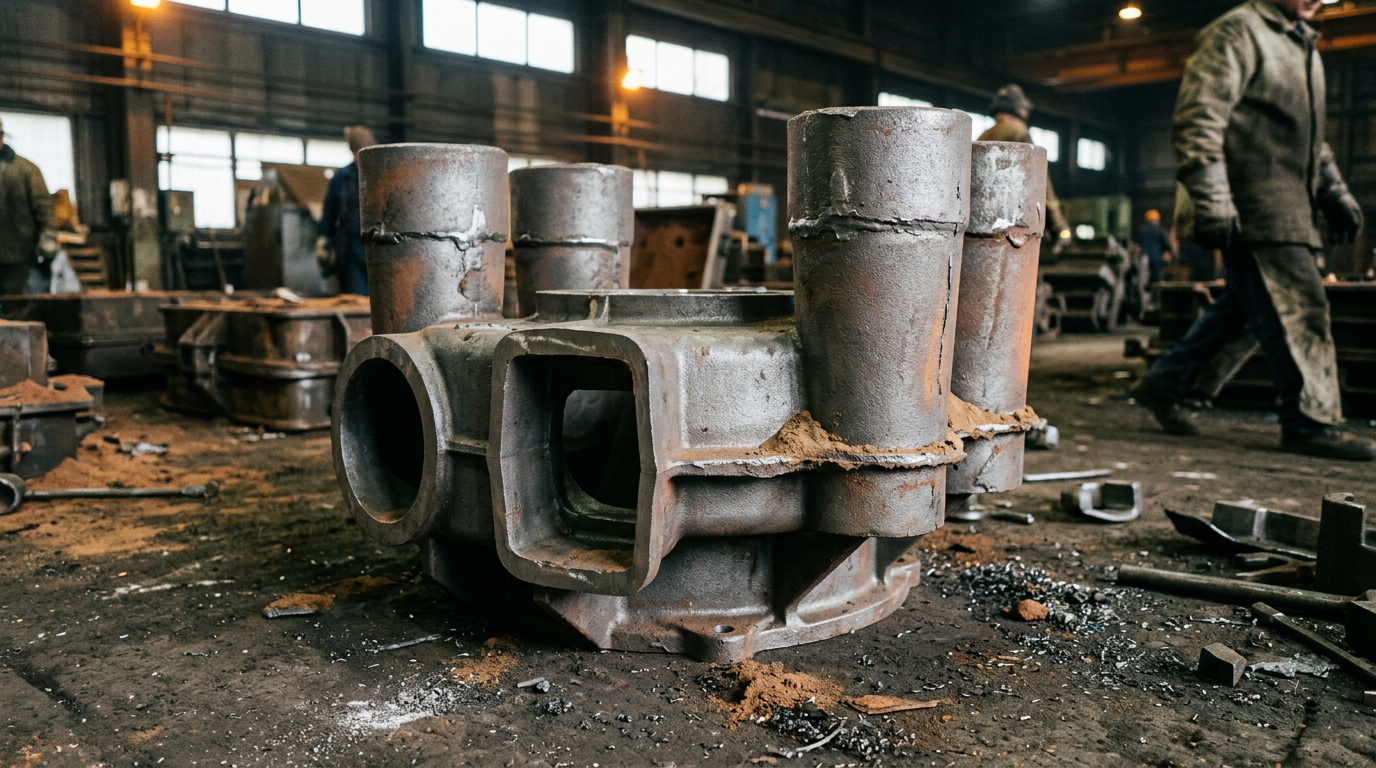
Across 93 steel foundries surveyed, average casting yield was 53.3%. The best foundry hit 72.7%; the worst managed only 33.2%. That 40-point spread is largely driven by part geometry — and wall thickness is the dominant geometric variable.
Cycle Time
Thicker sections take longer to solidify. In sand casting, solidification time scales roughly with the square of the section thickness. Double the wall, and solidification time approximately quadruples. Longer cycle times mean fewer castings per shift, higher labor cost per part, and reduced throughput on the same equipment.
Downstream Rework
When thick sections do produce defects — typically shrinkage porosity at hot spots and wall junctions — the rework costs compound. On a batch of fifty 1,000 lb castings, 91% of grinding time went to defect removal. Some castings required 1-16 hours of repair welding each. At shop labor rates, that turns a defect-prone design into a financial drain that far exceeds the casting’s material value.
The Hidden Cost: Section Transitions and Machining Stock
Uniform wall thickness is cheaper than varied wall thickness, but most real parts can’t avoid section changes entirely. The cost impact depends on how those transitions are designed.
Transition Ratios
When wall thickness transitions exceed a 2:1 ratio, defect risk climbs sharply. The thick section solidifies last, pulling metal away from the thin section and creating shrinkage voids at the junction. The design fix — a wedge transition not exceeding a 1:4 taper — adds material and pattern complexity, but costs far less than scrapping castings with junction porosity.
Draft Angle Material
Designers rarely account for draft as a wall thickness cost driver. Each degree of draft adds 0.017 inches per inch of draw to the casting dimension. On a 6-inch deep pocket with 3 degrees of draft, that’s 0.306 inches of extra material on each wall — material that either stays on the part (adding weight) or gets machined off (adding cycle time and chip disposal costs).
Machining Stock Decisions
Excess wall thickness specified as machining stock multiplies cost twice: once at the foundry (more metal, bigger risers, longer cycle) and again at the machine shop (more passes, longer cycle, more tool wear). Specifying 3 mm of machining stock where 1.5 mm would suffice doubles the machining cost on that surface. When you factor in the total landed cost — casting plus machining plus scrap from both operations — overspecified machining stock is one of the quietest cost multipliers in the supply chain.
The Real Cost Math: How Wall Thickness Moves Per-Part Price
A foundry running 28 casting patterns reviewed wall thickness and section geometry across its product mix. A 2.65% reduction in overall scrap rate delivered $514,000 in annual savings. Not a single heroic redesign — just the cumulative effect of modest wall thickness adjustments across dozens of parts.
The math works because wall thickness touches every cost line simultaneously. Consider a medium-complexity steel casting at 30 lb finished weight:
- At optimal wall thickness: 53% yield (industry average), 3-5% scrap rate, standard riser package, one machining pass on critical surfaces.
- At 25% over-thickness: yield drops closer to 45% (larger risers), material cost up several dollars per part, machining stock adds cost on every extra surface, cycle time up 15-20%.
- At borderline-thin walls: yield looks better on paper (less riser metal), but scrap rate can climb sharply, wiping out any material savings and adding inspection and sorting costs.
The cheapest casting is not the lightest casting. It’s the one sitting in the alloy-specific sweet spot where yield is high, scrap is low, and machining stock is just enough — not generous “just in case.”
Before you send your next RFQ, define your quality requirements on paper and ask your foundry where the cost-optimal wall sits for your alloy and geometry. A 30-minute DFM conversation can save more per part than any amount of supplier negotiation.
Specify Smarter, Not Thicker
Wall thickness is the one design parameter that touches every cost driver in sand casting — material, yield, scrap, cycle time, and machining. Most engineers default to adding material for safety margin, never seeing the compounding cost on the other side.
Three actions that immediately reduce per-part casting cost: match your minimum wall to the actual alloy grade (not the alloy family), keep section transitions below a 2:1 ratio with tapered junctions, and specify machining stock at the minimum your machine shop actually needs — not the generous allowance left over from a previous design.
The foundries that consistently deliver competitive pricing aren’t using cheaper metal or cutting corners on quality. They’re working with customers who design parts that are castable at high yield. That collaboration starts with wall thickness.