A pattern that’s off by half a percent in shrinkage produces castings that miss the machining envelope — and the error scales with part size. I’ve pulled 50-inch aluminum castings that measured 0.144 inches oversize because the shop used textbook shrinkage instead of testing actual contraction. Every decision during pattern construction — type, material, allowances — cascades directly into casting quality and cost.
How Patterns Create the Mold Cavity
The pattern is a physical replica of your finished part, oversized to compensate for metal shrinkage and machining stock. A moldmaker presses it into sand to create the negative cavity, removes it, and that cavity receives molten metal. It’s the first tooling decision in the sand casting process, and every downstream step — gating, risering, shakeout — inherits whatever the pattern gets right or wrong.
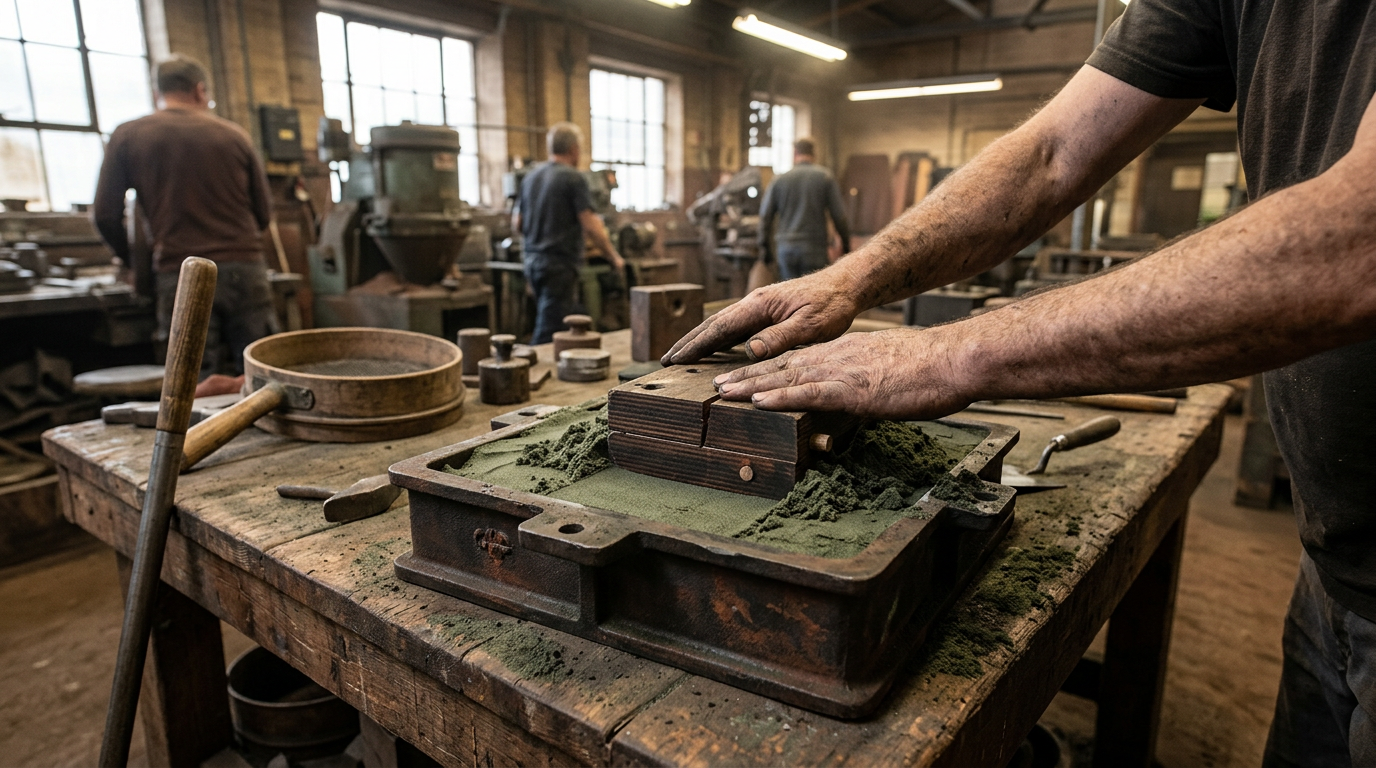
Simple parts with no undercuts can use a one-piece (loose) pattern — press it into one half of the mold and pull it straight out. Most real-world parts need a split pattern that divides along a parting line, with each half sitting in its own flask (cope and drag). Splitting along the right centerline keeps constant cross-sections, simplifies sand packing, and gives you clean extraction every time.
If your part has internal cavities, the pattern also needs core prints — extensions that create seats where sand cores will be placed during mold assembly.
Pattern Types and When Each One Pays Off
A match plate pattern isn’t “better” than a loose pattern. Each type is justified at specific volume thresholds, and specifying the wrong one wastes money in both directions.
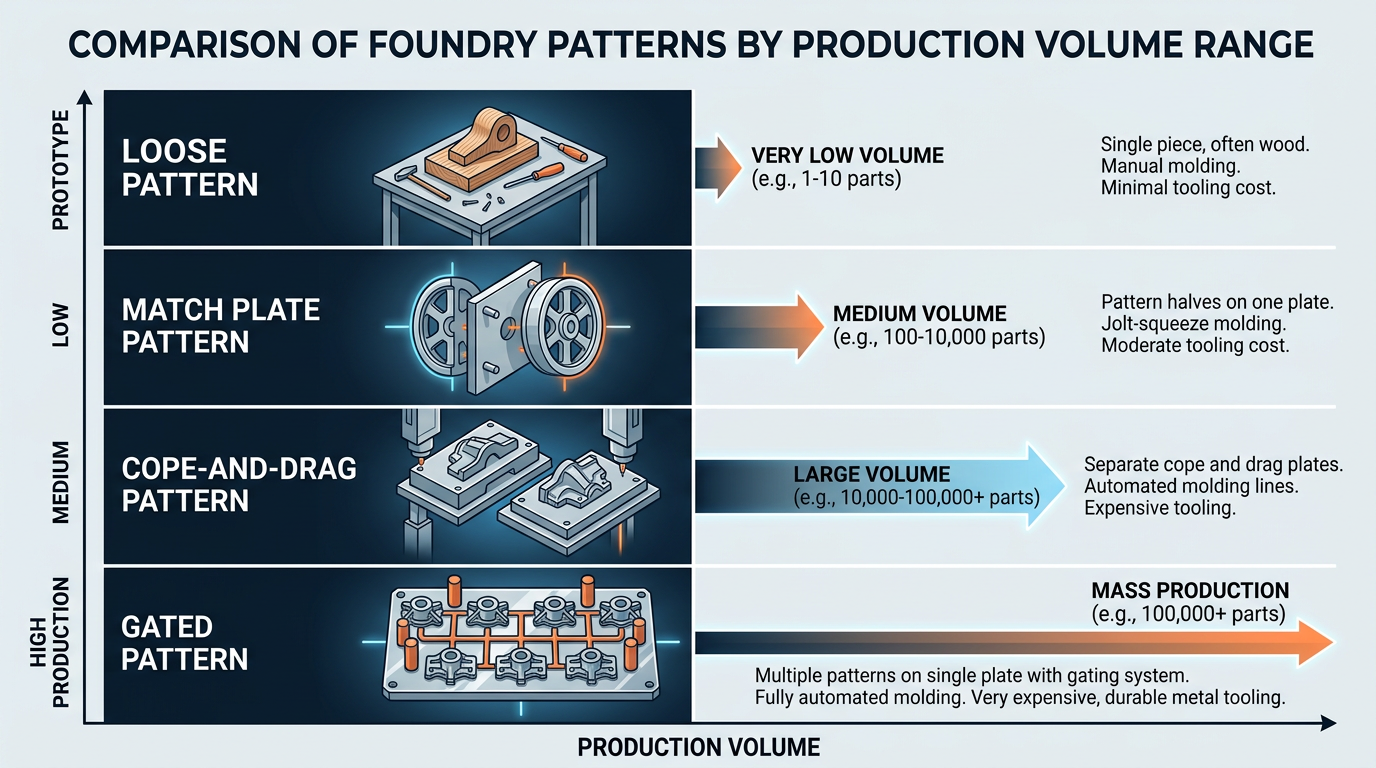
Loose Patterns
A two-piece wood or plastic pattern, hand-placed in the flask. Best for prototypes and short runs under 50 pieces. Cycle times are slow, but tooling cost is minimal — often under $1,000 for simple geometries.
Match Plate Patterns
Both cope and drag halves mounted on a single plate that aligns them automatically. Justified at roughly 100-500 molds per year when you need dimensional consistency between halves. Tooling runs $2,000-$8,000 depending on complexity.
Cope-and-Drag Patterns
Each half mounted on its own plate. Standard for larger castings and no-bake or floor-molding operations where a single match plate won’t fit the mold. Higher tooling cost, but throughput on large parts is unmatched.
Gated Patterns
Multiple part cavities on a single plate with integrated runners and gates. Reserved for high-volume runs of small parts where the upfront investment pays back through multi-cavity pouring.
Pattern Materials
A wood pattern running production volumes wears out of tolerance before you finish the order — I’ve seen loose patterns lose a full thousandth per side after 100 molds. Material choice locks in how many good castings you’ll get before the pattern needs rebuilding.
Wood
The default for prototypes and low-volume work. Mahogany and sugar pine machine cleanly and resist warping better than softwoods. Dense particle-board (craft-wood) holds dimensions under sandpaper better than balsa, forcing intentional sizing rather than accidental material removal. Typical lifespan: 50-200 molds before wear requires repair.
Plastic and Urethane
Urethane tooling board machines to tight tolerances and holds up for 500-2,000 molds without absorbing moisture like wood. Cost runs two to three times a comparable wood pattern.
Metal (Aluminum and Cast Iron)
Production patterns for long-run programs. Aluminum patterns last 5,000-10,000+ molds; cast iron is heavier but nearly indestructible for high-volume green sand lines.
One critical detail when switching from wood to metal: metal patterns require double shrinkage allowance. The metal pattern itself was cast and already shrank once. Apply single shrinkage to a cast aluminum pattern, and every casting it produces comes out undersize. I’ve seen shops miss this on their first metal pattern job — it’s an expensive rework that sets the whole program back weeks.
3D-Printed Patterns
Printed patterns fill a niche: complex geometries at low volumes where traditional lead time or cost can’t be justified. They work for prototyping, but build volume constraints and material limitations make them impractical for production runs.
Pattern Allowances
Five separate adjustments get built into every pattern, and applying them out of order compounds the error on every dimension. The sequence below is what I walk through on every new pattern job.
The Allowance Sequence
Apply in this order: (1) start with final required dimensions, (2) add shrinkage, (3) add machining stock, (4) apply draft, (5) modify for distortion, (6) reduce for shake. Reversing steps two and three inflates machining allowance by the shrinkage factor — small on a 6-inch part, meaningful on a 36-inch one.
Shrinkage Allowance
Every metal contracts as it cools from pouring temperature to room temperature. The values below are starting points by alloy family:
| Alloy | Shrinkage Rate |
|---|---|
| Gray cast iron | 0.7-1.05% |
| Ductile iron | 0-1.0% |
| Cast steel | 2.0-2.1% |
| Aluminum | 1.3% |
| Brass/Bronze | 1.5% |
| Copper | 1.6% |
| Magnesium | 1.3% |
| Lead | 2.5% |
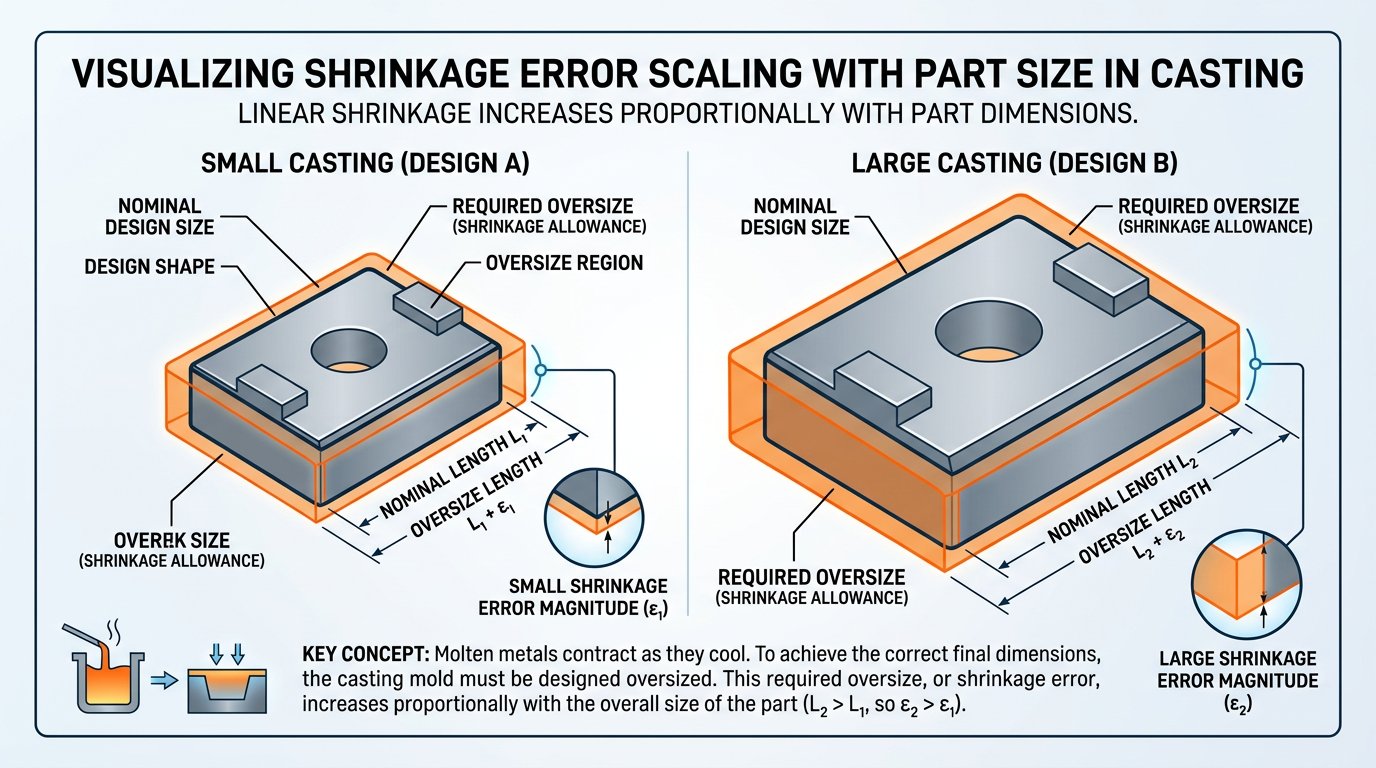
Actual shrinkage varies with section thickness, geometry constraints, and mold rigidity. Craft Pattern and Mold documented a case where they applied standard 1.3% aluminum shrinkage to a large casting. Actual contraction was 1.0%. On a 12-inch feature the error was 0.035 inches oversize — machinable. On the 50-inch feature, that 0.3% difference produced a 0.144-inch error exceeding the machining envelope. Always pour a trial run on new patterns and measure actual shrinkage before production.
Ductile iron is especially unpredictable — the range spans from nearly zero to a full percent depending on graphite nodule count and section modulus.
Machining Allowance
Extra material on surfaces that will be machined to final dimensions:
- Small castings (under ~300 mm): 1.5-3 mm per surface
- Medium castings (300-800 mm): 3-6 mm per surface
- Large castings (over 800 mm): 6-12 mm per surface
Add machining allowance only to surfaces requiring finishing — not every face.
Draft Allowance
Taper on vertical surfaces so the pattern withdraws without tearing the mold. External surfaces need 1-3 degrees; internal surfaces need 2-5 degrees because the sand grips internal features tighter.
On a 100 mm vertical wall with 2-degree draft, the base will be approximately 3.5 mm wider than the top — a change that affects as-cast wall thickness and stress calculations.
Distortion and Shake Allowance
Distortion allowance is pre-distortion — building the opposite error into the pattern to cancel real warping. An L-shaped bracket prone to inward bending gets made with outward-bent arms. No universal table exists; this requires experience with the specific alloy and geometry.
Shake allowance is the one allowance that makes the pattern smaller, not larger. When the moldmaker raps the pattern to loosen it before extraction, the cavity enlarges slightly — typically 0.5-1 mm per 100 mm. On small, precise castings, ignoring shake puts you consistently oversize.
Pattern Mistakes That Cost You Castings
The most common mistake I see in new patterns isn’t wrong dimensions — it’s design decisions that create defects no amount of gating optimization can fix.
Sharp Corners and Hot Spots
Sharp rectangular interior corners create hot spots where metal pools and solidifies last. Shrinkage porosity forms there — voids hiding exactly where stress concentrates. Adding radius to all interior corners ensures uniform metal flow and consistent cooling. Most experienced pattern shops won’t build sharp interior corners regardless of the print, because they know the castings come back as scrap.
Missing or Insufficient Draft
Flat surfaces without adequate draft cause the pattern to drag across the sand during extraction, tearing sand into the mold cavity. Those sand inclusions show up in the finished casting as rough patches that destroy tooling during machining. Internal surfaces are worse: skimping from 3 degrees down to 1 degree can turn an easy mold release into a destroyed cavity.
Using a Core as the Single Datum Point
Designers sometimes reference all critical dimensions from a single core position. Cores shift during mold assembly and pouring. When the datum core moves even slightly, every dimension referenced from it moves too — producing a dimensionally scattered casting no single machining setup can save. Pin your cores to minimize movement, and add machine stock on core-referenced surfaces for correction room during finish machining.
Before You Build: A Pattern Checklist
Pattern quality determines casting quality — no gating system compensates for a poorly designed pattern. Before committing to tooling:
- Match pattern type to production volume. A $6,000 match plate for 20 pieces is as wasteful as running 1,000 pieces off loose patterns.
- Run a DFM review with your foundry before pattern construction. Changes at the CAD stage cost a fraction of what rework costs after the pattern is built.
- Apply allowances in sequence — shrinkage, machining, draft, distortion, shake — not in isolation.
- Radius every interior corner. Flag sharp corners before the pattern shop builds exactly what you drew.
- Budget for a trial pour. Measure the first casting against the print and adjust before production.
The pattern is the most upstream tooling decision in your casting program — every shortcut here multiplies through every mold it stamps out. Get it right once, and you’ve solved the problem for the life of the program.