
A six-piece welded pivot arm hits the fabrication floor — cutting, fitting, welding, grinding, stress-relieving. The same part as a single casting costs 60% less and frees up 71 minutes of shop time per unit. That kind of result sells conversion hard — but I’ve also watched teams spend $10,000 on tooling for a part that only saved 10% per unit on volume that never scaled. The conversion pitch is real. The question is whether your specific part and your annual volume justify the investment.
Every foundry website will tell you castings beat weldments. Few will tell you when they don’t.
Why Conversion Delivers Real Savings
The savings come from three places: eliminated fabrication labor, reduced secondary operations, and improved structural performance.
I worked on a conversion for an oil-market rotational control post — a multi-piece weldment that kept failing at joints and heat-affected zones (HAZ). The welded version experienced distortion during fabrication and stress failures in service. Converting it to a casting cut cost by 38% and delivered more than five times longer life in cycle testing. The weld joints and HAZ that caused failures simply disappeared.
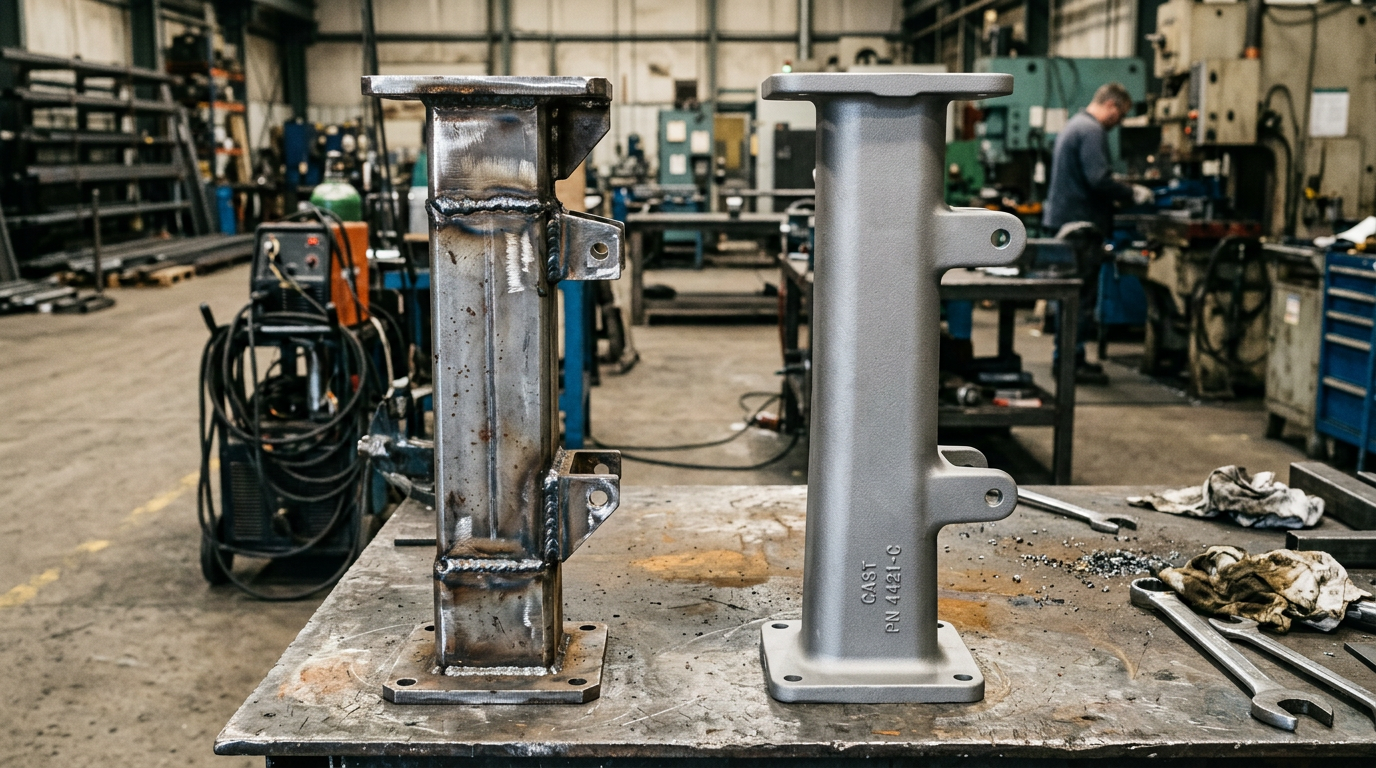
Weld joints concentrate stress. A casting distributes loads through smooth, optimized geometry with uniform (isotropic) material properties in every direction — unlike wrought steel, which has directional grain structure that creates weak axes.
The savings scale with complexity. A carbon steel casting replacing a three-piece weldment saves less than one replacing a 15-piece assembly. One six-piece welded pivot arm for agricultural equipment hit 60% cost reduction after conversion — not just material savings but all the fitting, fixturing, and welding labor that vanished.
Hidden costs drop too. Straightening fixtures alone account for 60% of a fabricated part’s tooling package for low-cost pieces. Every weld introduces a distortion source that demands correction downstream.
What Makes a Good Conversion Candidate
The strongest candidates combine high weld count with enough annual volume to amortize tooling.
High Weld Count and High Volume
The more weld inches in an assembly, the stronger the conversion case. Parts with five or more subcomponents assembled through extensive welding carry enough fabrication overhead to justify tooling investment. Monarch Industries converted a family of agricultural tillage mounts — 17 weldment part numbers comprising 136 subcomponents — into three castings, averaging 30% cost reduction across the family.
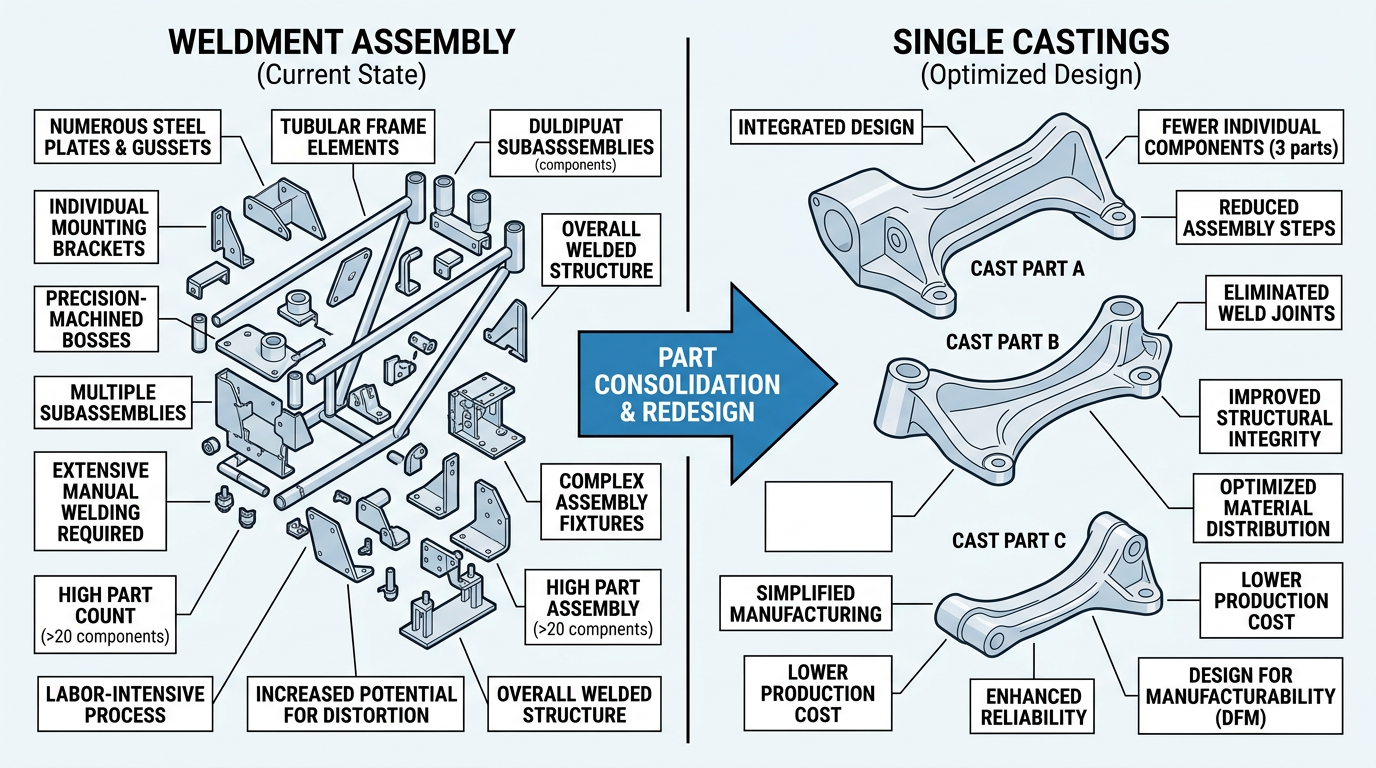
Mark Hildebrand at Monarch put it directly: the volume has to be enough annually to justify the tooling. A part running 500 units per year amortizes a $6,000 sand casting pattern quickly. That same pattern on a 50-unit run may never pay back.
Recurring Quality Problems
Weldments experiencing repeated distortion, dimensional inconsistency, or in-service failures at joints are signaling that the design has outgrown the fabrication method. When reject rates climb or assembly fit problems persist across multiple production runs, the root cause is often inherent to the multi-piece welded approach — not the welder’s skill. These parts convert well because the casting solves a performance problem alongside the cost equation.
When to Keep Welding
Conversion is not universally beneficial, and the wrong candidate wastes real money.
- Low annual volume. If you’re producing fewer than 100-200 units per year of a simple part, weldment fabrication almost certainly costs less. Pattern tooling, even at $6,000 for sand casting, needs volume to amortize. I’ve seen engineering teams push conversion on 75-unit annual runs because the per-piece math looked good on paper — until the tooling cost spread across three years of modest orders turned the “savings” into a loss.
- Simple geometry. A two-piece welded bracket with a single straight weld doesn’t carry enough fabrication overhead to offset tooling. Conversion shines on complexity. If your part can be described in one sentence and welded in under 10 minutes, keep welding it.
- Prototype and short-run production. Weldments win decisively when you need design flexibility. Cutting a new profile from plate and welding a modified bracket takes days. Modifying a casting pattern and running a new mold takes weeks. For products still iterating through design changes, locking into tooling is premature.
- Field repair requirements. Equipment that gets repaired in the field by welding damaged sections back together needs to stay weldable. A casting that cracks in service requires replacement, not repair. Agricultural, mining, and construction equipment often values this repairability over per-unit cost optimization.
A well-engineered weldment, designed with modern finite element analysis, can match a casting’s structural performance. The decision is economic and logistic, not metallurgical.
Tooling Cost Is a Calculation, Not a Barrier
The industry treats tooling as either a deal-killer or a non-issue. Neither framing helps you make a decision. Tooling is a calculable investment with a breakeven point.
For a moderately complex part (roughly softball-sized with multiple features), expect these ranges:
- Sand casting pattern: approximately $6,000
- Investment casting tooling: approximately $10,000
- Die casting tooling: approximately $26,000
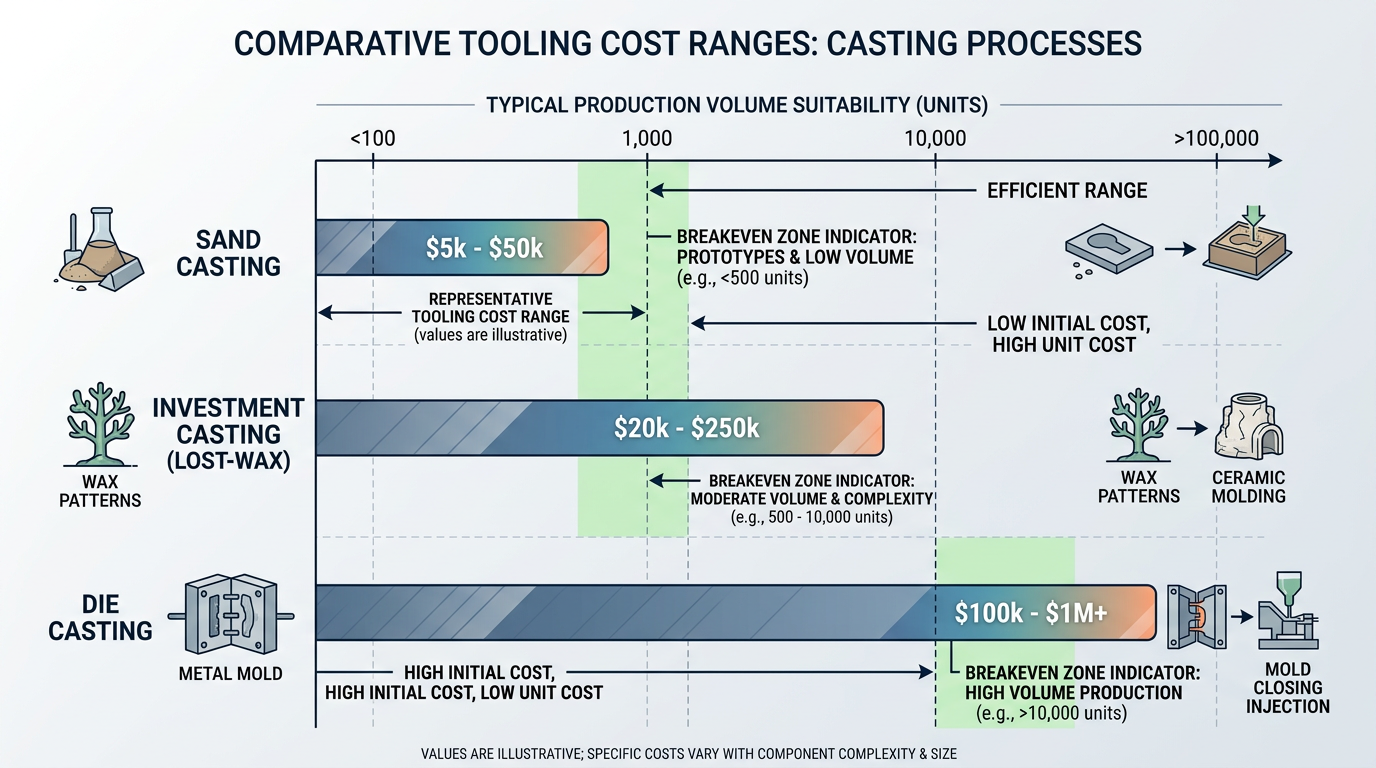
Sand casting has the lowest tooling barrier, making it the most accessible entry point for mid-volume ferrous conversions. Ductile iron castings in particular offer a cost-effective alternative to steel when full steel properties aren’t required — and the tooling economics are identical.
Dotson Iron Castings ran more than 50 mold-filling and solidification simulations to convert a truck cab suspension mount to ductile iron — and achieved only 10% system cost savings. That’s a real, positive return, but it took heavy engineering investment. Compare that with the 60% savings on the pivot arm, and you see why blanket “20-50% savings” claims mislead.
When you factor in the total landed cost — piece price plus assembly labor, inspection, rework, scrap, and inventory carrying cost for subcomponents — the breakeven volume often drops lower than pure piece-price math suggests.
Design Changes You Should Expect
Conversion is not a process swap. It’s a redesign.
The casting material is not necessarily the fabrication material. One conversion achieved a 30% weight reduction despite using an alloy with 30% lower strength than the original weldment material. The geometry optimization made possible by casting — variable wall thickness, integrated ribs, smooth load paths — more than compensated for the material property difference.
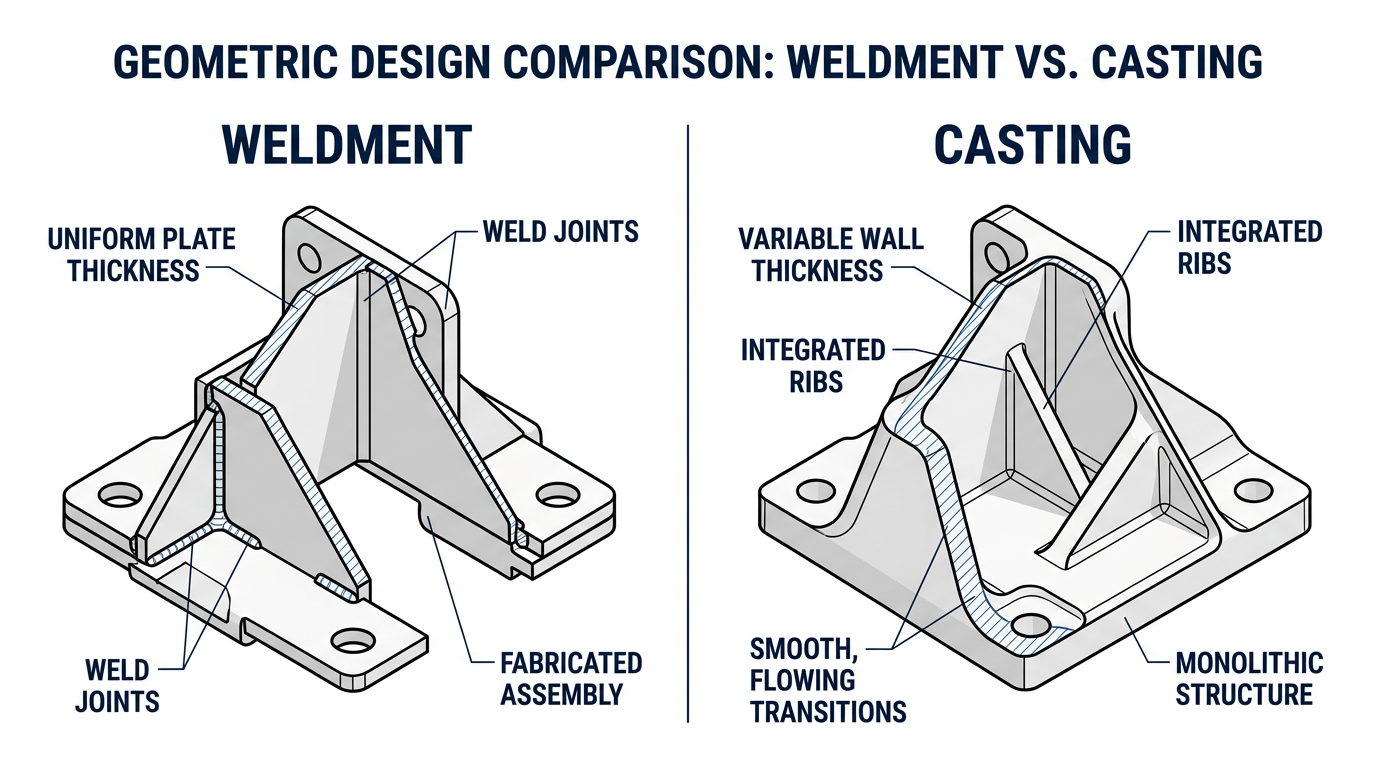
Expect to rethink three areas:
- Wall thickness and section transitions. Weldments use uniform plate stock. Castings allow material only where stress demands it, but require gradual section changes to avoid shrinkage defects.
- Draft angles and parting lines. Every cast surface needs draft for pattern withdrawal. Features that were machined or welded freely now need to account for moldmaking constraints.
- Integrated features. Conversion’s biggest opportunity: bosses, brackets, mounting pads, and stiffening ribs that required separate weld-on components become part of the casting geometry. This is where the real part count reduction — and cost savings — originates.
Before you RFQ, define your quality requirements on paper. A casting supplier can’t quote accurately against a weldment drawing; they need a functional specification that allows geometry optimization.
Making the Business Case
The question isn’t cast vs. fabricated — it’s what does your volume justify.
Start with three numbers: annual volume, current fabrication cost per unit (including all labor, not just material), and estimated tooling investment from a foundry quote. If the per-unit savings times annual volume recover tooling cost within 12-18 months, you have a strong candidate. If payback stretches beyond three years, keep welding unless structural problems force the change.
I’ve seen procurement teams save 20% on piece price and lose 40% on rework because they compared casting unit cost against weldment material cost instead of total landed cost. The 10-to-60% range across documented conversions tells you results depend entirely on candidate selection.
One more factor: roughly 25-30% of conversion lead time is internal purchasing decision-making, not manufacturing. The timeline objection is partly self-inflicted.