
Pick up a sand casting and a die casting side by side. Run your thumb across both surfaces. The sand casting feels gritty, textured — like fine sandpaper. The die casting is smooth, almost polished. That tactile difference is real, but it’s also the single most misleading test you can run.
Surface roughness tells you what happened to the outside of the part. Parting line geometry and gate witness marks tell you how the part was made. I’ve watched QA inspectors reject perfectly good sand castings because a machinist cleaned the surfaces smooth, while the parting line evidence sat right there in plain sight. Before you call it sand cast — or rule it out — learn to read the marks that matter.
Why Surface Roughness Is Your Least Reliable Clue
A typical green sand casting measures Ra 12.5-50 micrometers. Die castings sit at Ra 0.8-3.2 micrometers. On paper, those ranges don’t overlap, and surface feel seems like an easy call.
Here’s where that falls apart.
Shell-molded sand castings achieve Ra 1.6-3.2 micrometers — the same range as investment castings (Ra 1.6-6.3 micrometers). Resin-bonded fine sand reaches Ra 3-6 micrometers, again overlapping with investment work. Apply a mold coating, and that surface improves another 48-64%. The same sand casting process produces wildly different surface textures depending on what sand and coatings the foundry used.
I’ve handled castings from two different foundries running identical patterns. One poured with green sand and no coating — rough enough to file your nails on. The other used resin-bonded sand with a zircon wash — smooth enough that a new inspector assumed it was investment cast. Both came out of sand molds. Both had parting lines. Only one inspector thought to check.
Treat surface texture as a screening tool, never as a verdict.
Reading the Parting Line
The parting line is the single most reliable indicator of sand casting — and the one most inspectors undervalue.
Every sand mold splits into two halves: the cope (top) and drag (bottom). Where those halves meet, the casting carries a visible seam. That seam reads like a signature. A sand casting parting line has character — slight irregularity, maybe a whisker of flash, a barely perceptible mismatch between halves. A die casting parting line is sharp, precise, and geometrically clean because the steel die halves mate with toolroom accuracy.
What to Measure
Sand casting parting line mismatch should not exceed 0.020 inch, with seam flash extending approximately 0.015 inch. Measure with a dial indicator or feeler gauge at several points along the line. Inconsistent mismatch — tighter in one area, wider in another — confirms sand mold deflection and an expendable mold process.
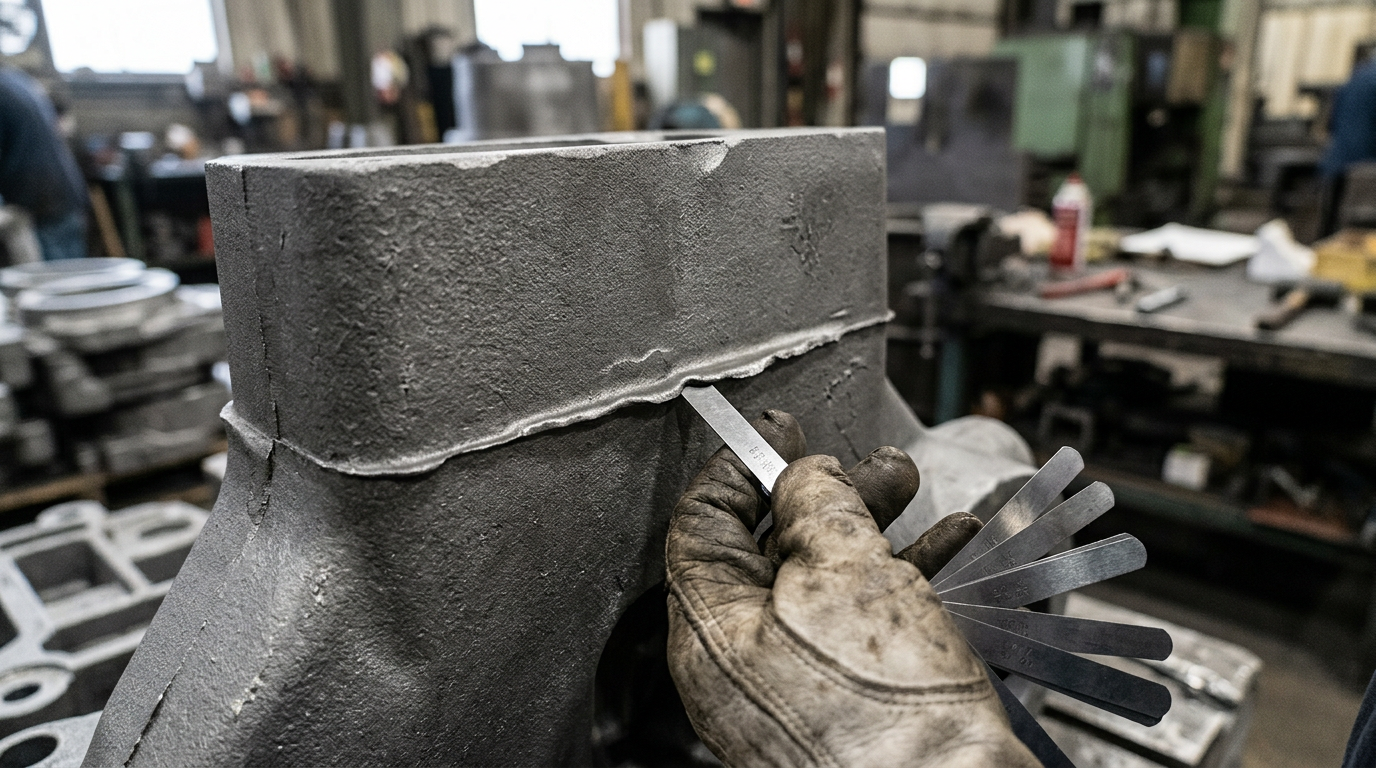
Die casting flash is thinner, more uniform, and appears as a sharp fin rather than a soft lip. Investment castings have minimal or no visible parting line at all.
Cope and Drag Asymmetry
Experienced pattern makers place the face with the greatest surface detail in the drag because metal fill is smoother at the bottom of a gravity-poured mold. Inclusions and gas porosity segregate toward the cope at the top. If one face is noticeably cleaner than the opposite face, you’re looking at cope-versus-drag asymmetry — a marker unique to sand and gravity-poured castings. Die castings, filled under high pressure, don’t exhibit this top-bottom difference.
Most inspectors walk right past this clue. Once you know to look for it, you’ll start reading mold orientation from the casting itself.
Gate and Riser Witness Marks
After the parting line, check for evidence of where metal entered and where risers fed shrinkage during solidification.
Gate Marks
The foundry breaks or cuts the gating system away after shakeout, leaving a witness mark: a slightly raised or depressed area, usually at the parting line, with rougher texture than the surrounding surface. Look for grinding or sawing artifacts.
Die casting gates are smaller with a clean, machined appearance. Investment casting gates can appear anywhere because the wax assembly isn’t constrained by a parting plane.
Riser Pads
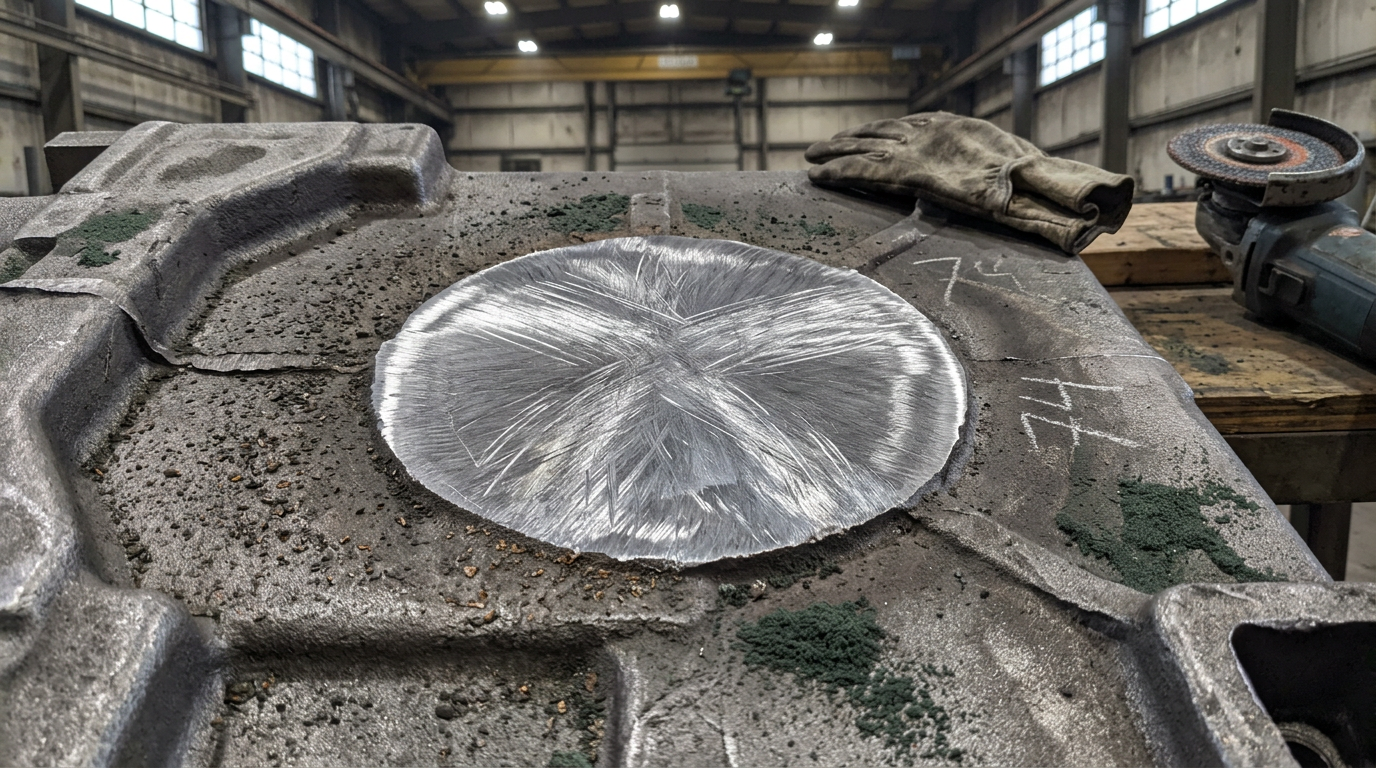
Risers leave larger, circular witness marks on the cope side. After removal, the pad is ground flush or left slightly proud. Finding a riser pad is strong confirmation of sand or gravity-pour process — die castings don’t use risers at all.
Draft Angle Evidence
Run your fingers along any vertical wall. Sand castings carry 1-5 degrees of draft on surfaces perpendicular to the parting plane — necessary for pulling the pattern from compacted sand without tearing the mold. A standard is about 1.5 degrees (3/16 inch per foot). Die castings also have draft but typically less. Investment castings need none because the ceramic shell is destroyed during removal. Noticeable taper combined with parting line evidence confirms an expendable mold process.
The 5-Point Identification Checklist
Stop after the first confirming marker and you’ll misidentify castings. Cross-check against all five, and ambiguity disappears.
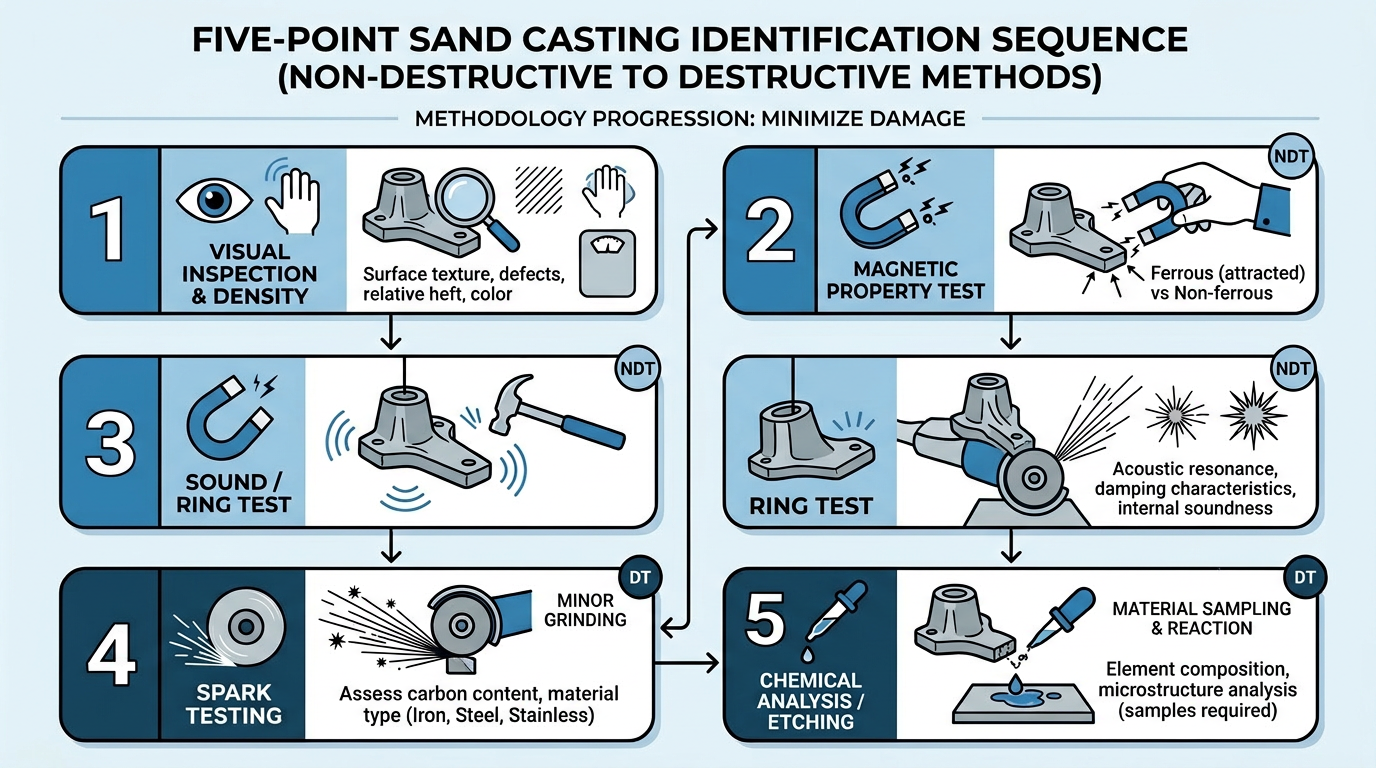
1. Parting Line Character
Find the seam where mold halves met. Sand casting: slightly irregular, soft flash lip, possible mismatch up to 0.020 inch. Die casting: sharp, precise, uniform. Investment casting: absent or barely visible.
2. Gate and Riser Evidence
Locate where metal entered and where risers fed the casting. Sand casting: rough witness marks at or near parting line, riser pads on the cope face. Die casting: small, clean gate marks only. Investment casting: gate locations unconstrained by parting plane.
3. Surface Texture (As-Cast Areas Only)
Check unmachined surfaces. Green sand: gritty, Ra 12.5-50 micrometers with visible sand grain imprint. Shell mold or resin sand: smoother, potentially overlapping with investment casting range. Ignore machined faces entirely.
4. Dimensional Tolerance and Wall Thickness
Sand castings fall within ISO 8062 tolerance grades CT9-CT13. Die castings hit CT4-CT6. If you can measure critical dimensions against nominal, the tolerance band narrows the options fast. Wall thickness adds another clue: sand castings have a practical minimum of about 5-6 mm in steel. Die castings achieve walls under 1 mm.
5. Material and Microstructure Clues
Gray iron castings reveal flake graphite on a fresh fracture surface — a dull, gray break. Ductile iron shows a brighter, more fibrous fracture from spheroidal graphite nodules. A polished cross-section under magnification reveals coarser grains and larger dendrite arm spacing compared to die casting’s fine-grained, rapidly cooled microstructure.
Reserve destructive testing for disputes or critical applications. Markers 1-4 are sufficient for most procurement verification.
When the Evidence Is Hidden
Machined castings strip away surface clues. A fully machined sand casting can look identical to a fully machined die casting on every external face.
Check areas the machinist couldn’t reach — internal cavities, bolt bosses, ribs, and fillets. Foundries leave these surfaces as-cast because machining them adds cost with no functional benefit. Even one square inch of untouched surface gives you a sand grain imprint, a draft angle, or a parting line remnant.
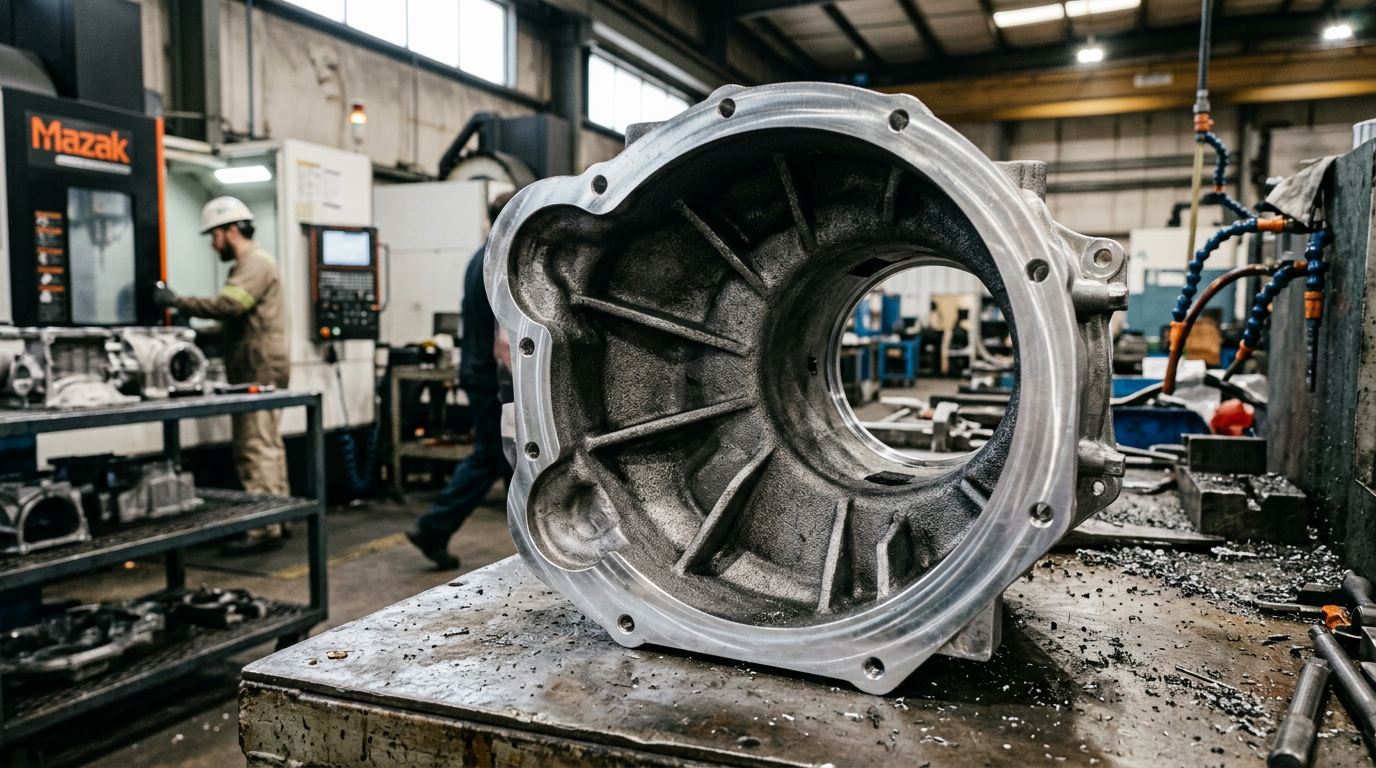
If every external surface is machined, compare machining allowance. Sand castings typically carry 2-5 mm of stock removal per face versus 0.5-1 mm for investment castings. Oversized as-cast dimensions on a drawing point toward sand casting.
Coated or painted castings hide surface texture but rarely hide parting lines. Flash residue beneath paint, a slight ridge at the mold split, or wall thickness asymmetry at the parting plane all survive surface coatings.
When none of these methods work, escalate to cross-sectional metallography. But in 15 years of inspection work, I’ve needed that step fewer than a dozen times.
Start With the Parting Line
Forget surface roughness as your lead indicator. Find the parting line first. Its shape, flash character, and regularity narrow the process faster than any surface texture measurement. Then confirm with gate and riser evidence. Add dimensional tolerance if you need a third data point.
The inspectors who misidentify castings stop at “it feels rough” or “it feels smooth.” The ones who get it right every time read the parting line, check for riser pads, and let the geometry tell the story — whether the casting is raw, machined, coated, or sitting on your desk with no paperwork at all.