
ASTM maintains over 80 specifications that touch steel and iron castings, but a typical sand casting purchase order only references about 15 of them. The challenge is knowing which 15. Most standards references online are alphabetical catalogs — useful if you already know the designation number, useless if you’re trying to build a complete quality specification from scratch. What engineers actually need is a standards map organized by lifecycle stage: material specification first, then testing methods, then acceptance criteria. That’s the structure here.
Before you RFQ, define your quality requirements on paper. An incomplete specification is an open invitation for quality disputes — and the foundry isn’t the one who pays for ambiguity in a purchase order.
Material Specification Standards by Alloy Family
Four alloy families account for the vast majority of ferrous sand castings, and each has its own set of ASTM material specification standards. The material spec is the document that defines chemical composition limits, mechanical property minimums, and heat treatment requirements for a given alloy.
Carbon Steel
ASTM A216 covers carbon steel castings for pressure-containing service — valve bodies, pump housings, fittings. Three grades handle most applications: WCA (60 ksi tensile, 30 ksi yield), WCB (70 ksi tensile, 36 ksi yield), and WCC (70 ksi tensile, 40 ksi yield). WCB is the workhorse grade for general industrial service.
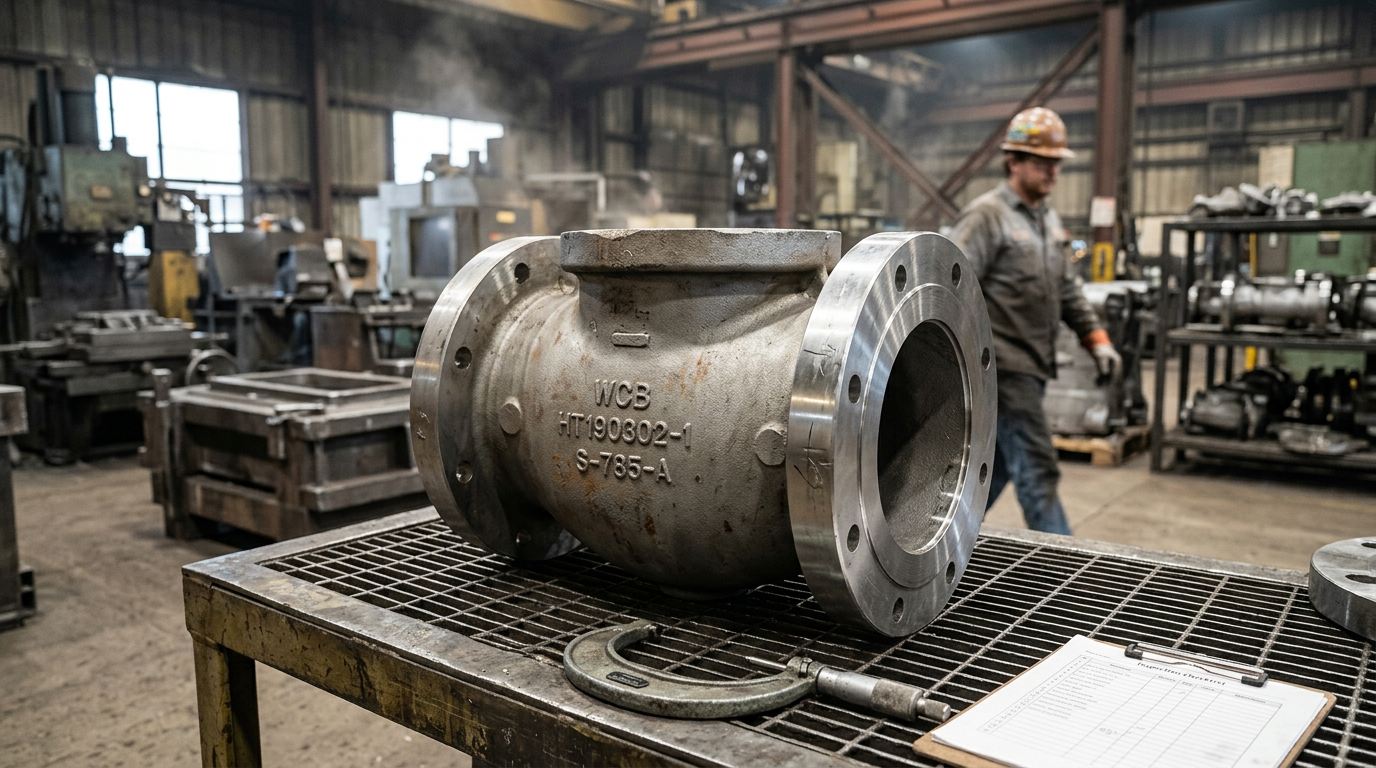
ASTM A27 covers general-purpose steel castings without the pressure-service requirements. If your casting doesn’t contain pressure, A27 gives you a wider selection of grades at lower cost.
ASTM A352 covers low-temperature carbon and alloy steel castings — specify this when service temperatures drop below -20F. Grade LCB is the low-temperature counterpart to A216 WCB.
Stainless Steel
ASTM A351 covers austenitic stainless steel castings for pressure service. CF8 (304 equivalent) and CF8M (316 equivalent) are the most commonly specified grades. CF3M adds low-carbon chemistry for welded applications requiring intergranular corrosion resistance.
ASTM A743 and A744 cover corrosion-resistant and iron-chromium-nickel castings for general and severe service respectively. When the application isn’t pressure containment but demands corrosion resistance — pump impellers, process equipment — these are the specifications to reference.
For duplex stainless applications, ASTM A890 and A995 cover the cast equivalents of 2205 and 2507 alloys. These are less common in general industrial work but critical for seawater, chemical processing, and high-chloride environments.
Ductile Iron
ASTM A536 is the single standard for ductile iron castings, with grades defined by their mechanical properties: 60-40-18, 65-45-12, 80-55-06, 100-70-03, and 120-90-02. The naming convention is tensile strength-yield strength-elongation. Grade 65-45-12 covers most structural and pressure applications.
Gray Iron
ASTM A48 covers gray iron castings, classified by minimum tensile strength: Class 20 through Class 60 (in ksi). Class 30 and Class 35 handle the majority of machine bases, housings, and brackets. Class 40 steps up for applications needing higher strength with acceptable trade-offs in machinability.
Testing and Inspection Standards
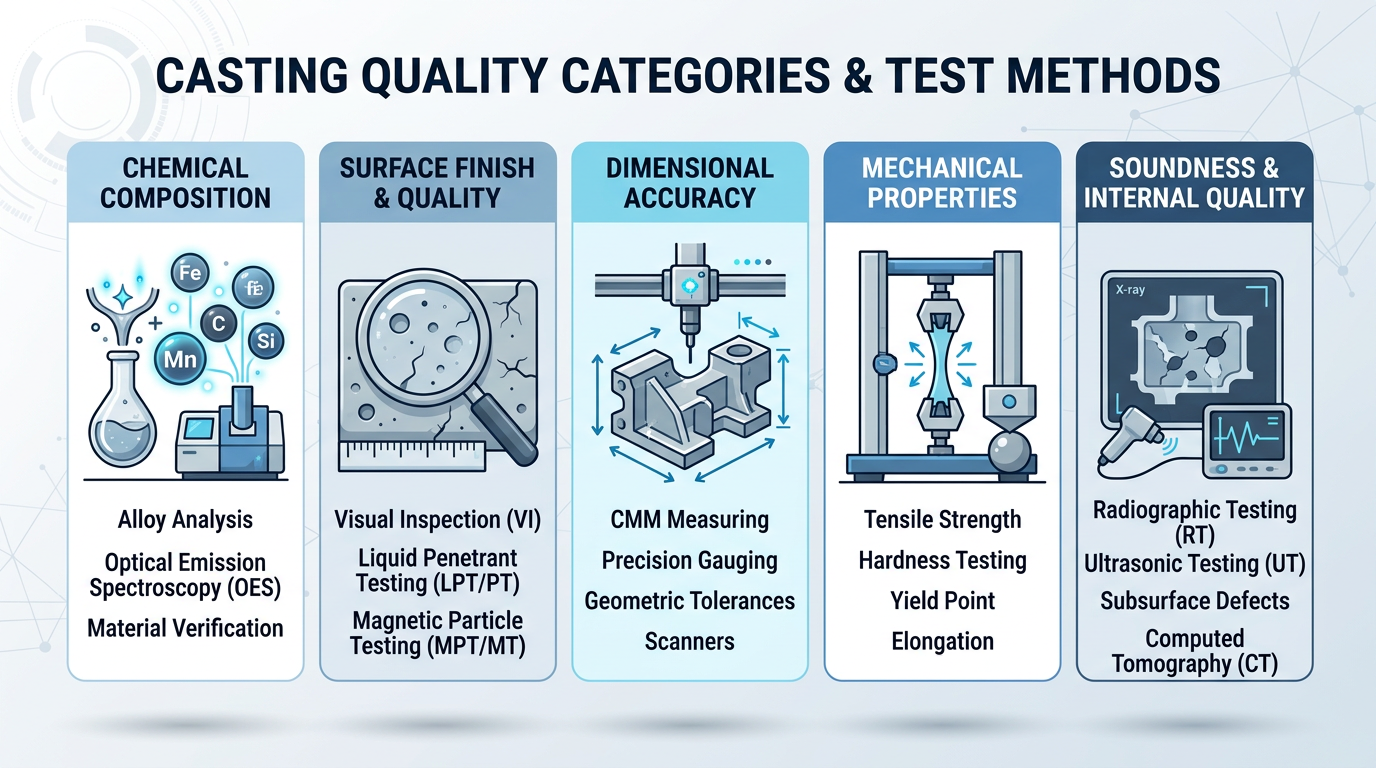
Material specification tells the foundry what to melt. Testing standards tell both parties how to verify the casting meets those requirements. Five quality categories apply to sand castings — chemical composition, surface finish, dimensional accuracy, mechanical properties, and internal soundness — and each maps to specific ASTM test method standards.
Chemical Analysis
ASTM E415 (optical emission spectrometry) is the standard method for verifying chemical composition of steel and iron castings. Every reputable foundry runs spectrometry on every heat — this is table-stakes quality control. ASTM A751 covers the broader chemical analysis methods referenced by most material specifications.
The chemistry check happens before pouring, so it’s the one quality gate where correction is still possible. If the ladle sample falls outside composition limits, the foundry adjusts the melt. After pouring, there’s no fix.
Mechanical Testing
ASTM A370 defines test methods and procedures for tension testing, hardness testing, and impact testing of steel and iron products. When your material specification calls for minimum tensile strength or Charpy impact values, A370 is the standard that governs how those tests are conducted.
One detail that catches procurement teams: mechanical test specimens are typically cast separately from the production casting, using test coupons attached to the same heat. Specifying “integral test bars” (machined from the actual casting) costs much more and is only justified for critical applications.
Non-Destructive Testing
NDT methods detect flaws without destroying the casting. Each method targets different defect types, and the purchaser decides which to require. An NDT indication is not automatically a defect — it only becomes a rejectable condition when it exceeds the acceptance criteria the purchaser specified.
- Radiographic Testing (RT) per ASTM E94/E2698: Detects internal voids, shrinkage, and porosity. Best for volumetric inspection of thick sections. Reference films per ASTM E446 (steel), E186 (heavy-wall steel), or E802 (iron).
- Ultrasonic Testing (UT) per ASTM E114/A609: Detects internal flaws in heavy sections where radiography is impractical. Particularly useful for large structural castings.
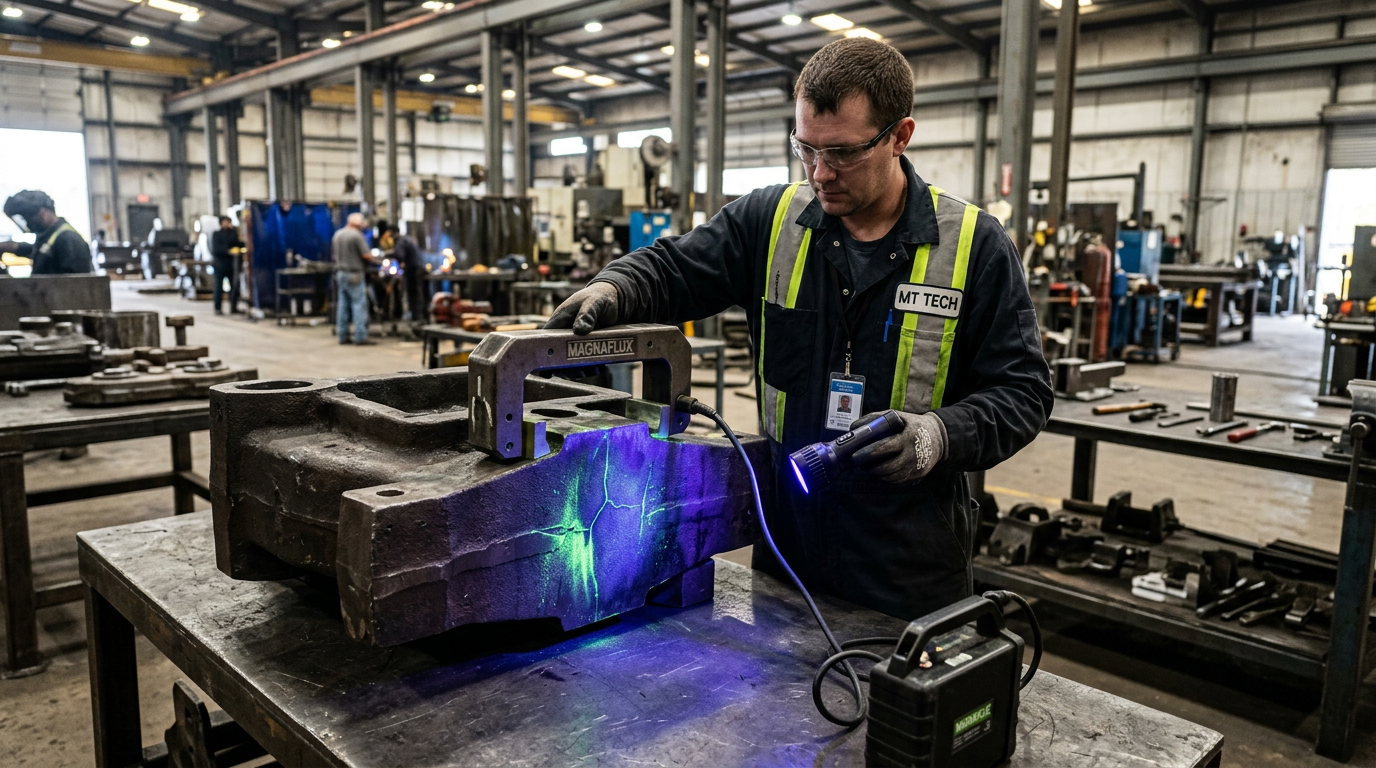
- Magnetic Particle Testing (MT) per ASTM E709: Detects surface and near-surface discontinuities in ferromagnetic materials (carbon steel, ductile iron, gray iron). Does not work on austenitic stainless steels.
- Liquid Penetrant Testing (PT) per ASTM E165: Detects surface-breaking discontinuities on any material, including non-magnetic stainless steels where MT cannot be used.
I’ve seen procurement teams specify MT on CF8M stainless castings — austenitic stainless is non-magnetic, so the test physically cannot work. Know what each method detects and what materials it applies to before you write it into the PO.
Acceptance Criteria Standards
Testing reveals indications. Acceptance criteria standards define how severe those indications can be before the casting gets rejected. This is where most specification gaps live — engineers specify the test but forget to specify the acceptance level.
Surface Acceptance
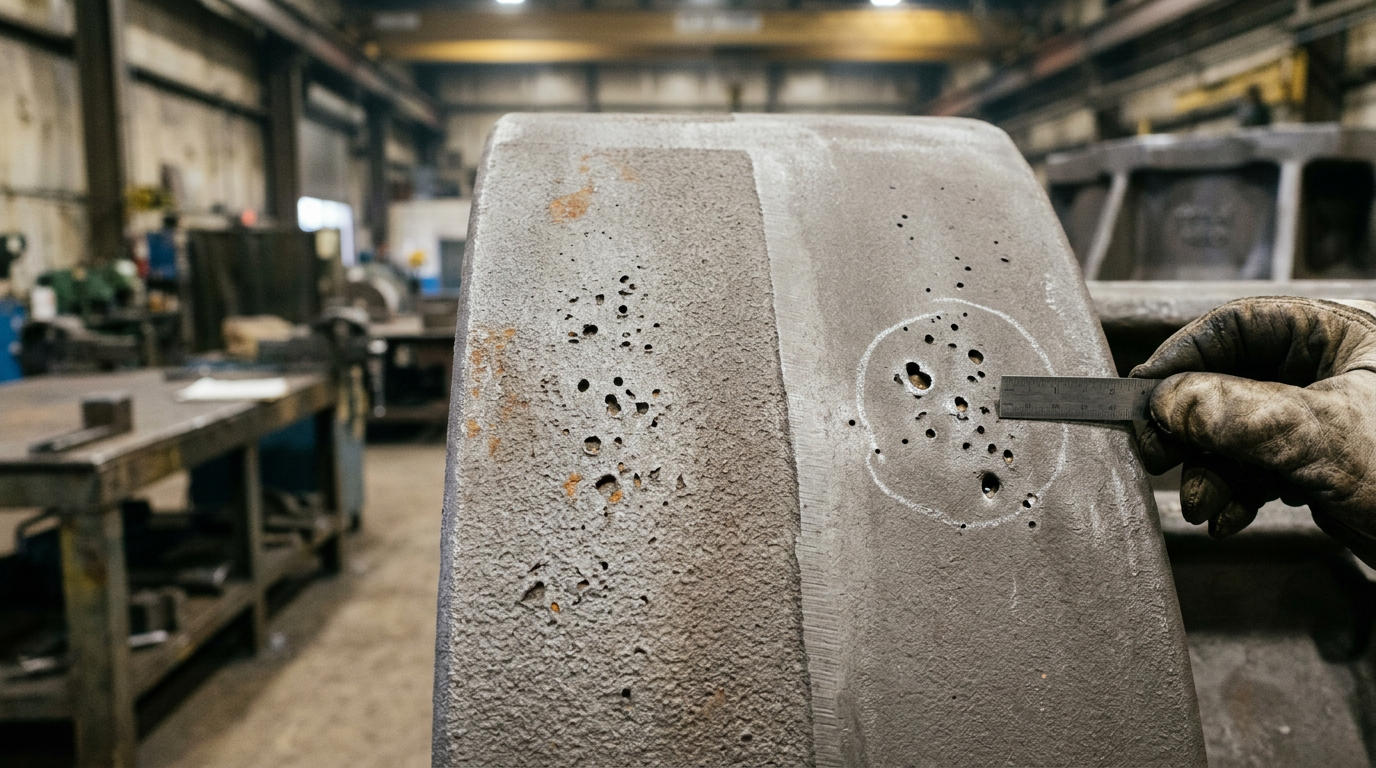
ASTM A802/A802M defines visual surface acceptance standards for steel castings using four levels (I through IV). Level I is the most restrictive; Level IV is the most permissive. Each level sets maximum allowable severity for surface features including texture, inclusions, porosity, shrinkage, and fusion discontinuities.
The catch: if your purchase order says “visual inspection per A802” without specifying a level, you and the foundry will disagree on what’s acceptable. Always specify the level. For cosmetic surfaces, Level I or II. For buried or machined surfaces, Level III or IV saves cost without sacrificing function.
Radiographic Acceptance
ASTM E446 provides reference radiographs for steel castings up to 2 inches thick. ASTM E186 covers heavy-wall steel castings (2-12 inches). For iron castings, ASTM E802 provides the reference radiographs. Each set defines severity levels for shrinkage, gas porosity, and inclusions.
Specify the maximum acceptable severity level per defect type per zone. Critical areas (high-stress regions, pressure boundaries) warrant tighter limits than non-critical zones. Zoned radiographic requirements prevent over-inspection of the entire casting while protecting the areas that matter.
Dimensional
Dimensional tolerances for sand castings are covered by industry guidelines rather than a single ASTM standard. The key point: casting dimensional errors are subtractive — once metal is removed during machining, you cannot add it back. Specify datum references and critical dimensions on the casting drawing with GD&T per ASME Y14.5 to prevent disputes.
How ASTM Standards Interact
ASTM casting standards don’t exist in isolation — specifying one standard automatically invokes others, and several critical requirements default to OFF unless the purchaser explicitly turns them on.
ASTM A781/A781M is the general requirements standard for steel castings. When you specify A216 WCB, A781 automatically applies as the umbrella document. It governs melting practice, repair welding procedures, marking requirements, and — critically — supplementary requirements.
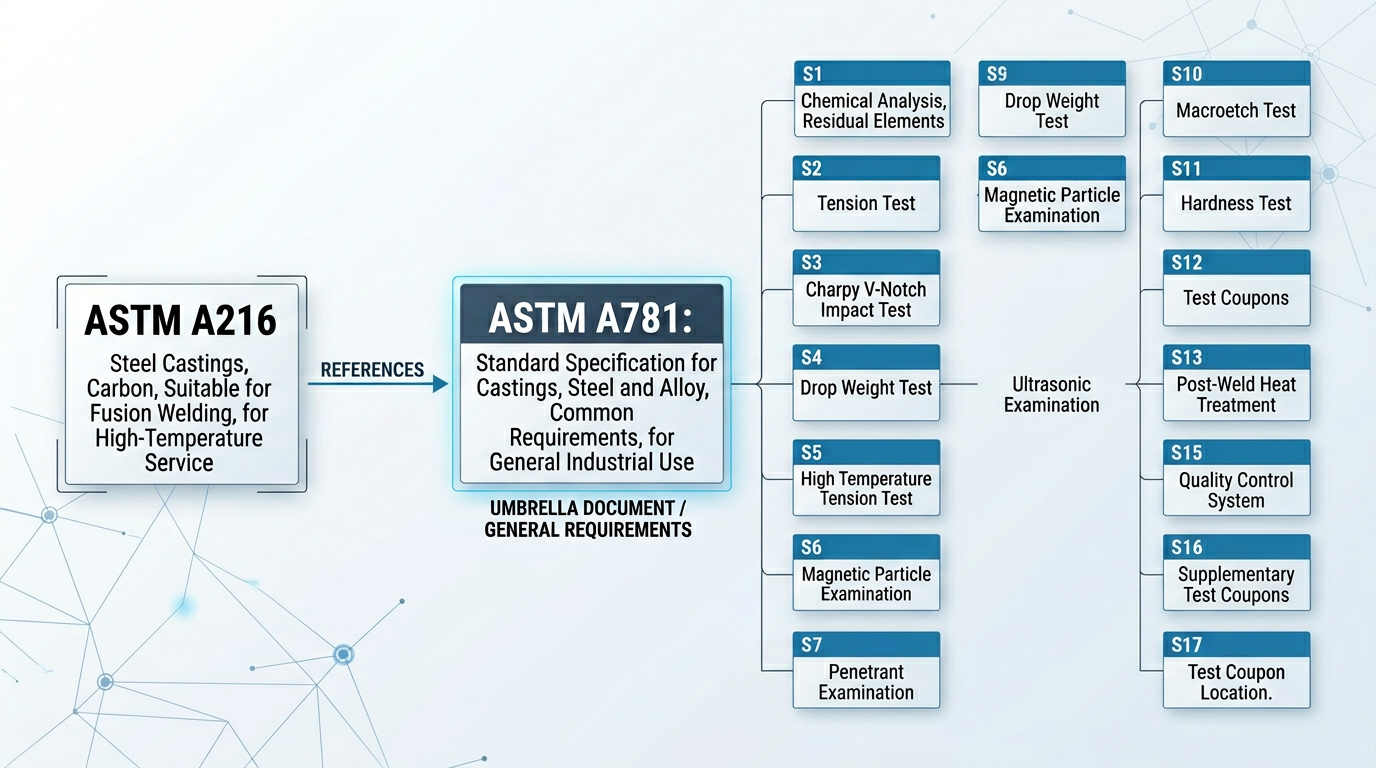
A781 contains 22 supplementary requirements (S1 through S22). Every one of them defaults to “not required” unless the purchaser specifies it in the purchase order. Examples:
- S1: Product analysis (chemical verification on the actual casting, not just ladle analysis)
- S5: Radiographic examination
- S5.1-S5.2: RT acceptance criteria and extent of examination
- S11: Magnetic particle examination
- S14: Ultrasonic examination
- S17: Impact testing at specified temperature
I’ve seen procurement teams save 20% on piece price and lose 40% on rework because they specified “A216 WCB per ASTM” and assumed that included radiographic inspection. It doesn’t. Unless you write “S5” on the purchase order, you get no RT — and no basis for rejection if internal porosity shows up during machining.
Writing a Complete Casting Specification
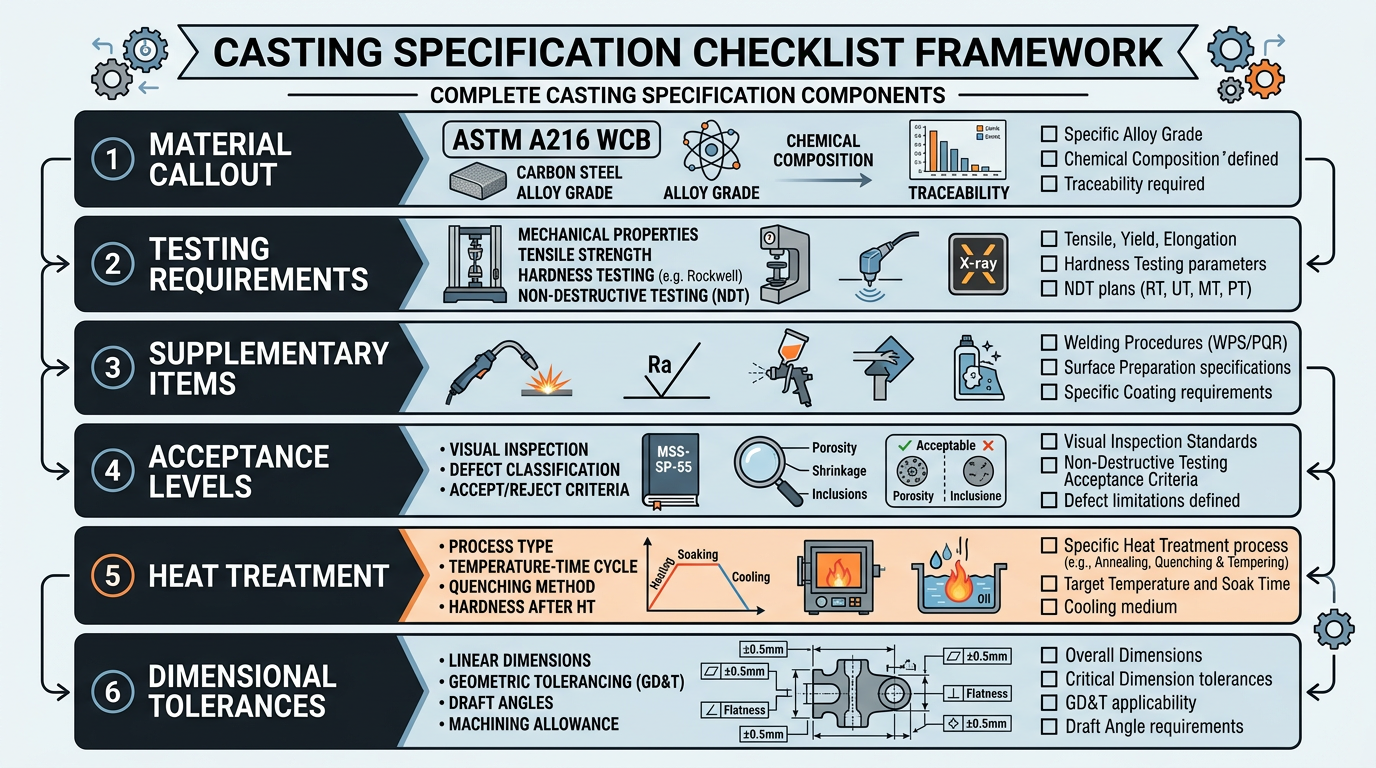
A specification gap in the purchase order doesn’t save money — it shifts risk. The foundry quotes based on what’s written. Anything not written is not included. Here’s what a complete ferrous sand casting specification covers:
- Material call-out: Reference the specific ASTM standard and grade. “ASTM A216 WCB” — not “carbon steel” or “equivalent to WCB.”
- Testing requirements: List each required test method with its ASTM designation. For NDT, specify both the test method standard (E94 for RT, E709 for MT) and the acceptance criteria standard (E446 severity levels, A802 surface level).
- Supplementary requirements: Call out specific A781 supplementary items by number. Don’t specify all 22 — that inflates cost with no proportional quality benefit. Match supplementary requirements to application criticality.
- Acceptance criteria with levels: Every inspection method needs an acceptance level. “Radiography required” is incomplete. “RT per ASTM E94, acceptance per E446 severity level 2 maximum for shrinkage and gas, level 3 for inclusions in Zone A” — that’s a specification a foundry can quote accurately and both parties can enforce.
- Heat treatment: Specify the condition (normalized, normalized and tempered, quenched and tempered) when the material standard offers options. A216 WCB requires heat treatment, but the specific cycle affects final properties.
- Dimensional tolerances: Reference the casting drawing with GD&T, critical dimensions identified, and datum structure defined.
When you factor in the total landed cost of a casting — including rework, disputes, and delays caused by specification ambiguity — spending an extra hour writing a thorough PO is the highest-ROI quality investment in the entire procurement cycle.
Putting the Standards Map to Work
The lifecycle framework — material specification, testing methods, acceptance criteria — gives you a complete picture for any ferrous sand casting. Pick your material specification by alloy family and service condition, select testing methods appropriate to the defect types that matter for your application, and define acceptance criteria with explicit severity levels.
One pattern I see repeatedly across industries: engineers specify materials carefully but leave testing and acceptance criteria vague, assuming the foundry will “do the right thing.” Foundries produce to specification. If the specification is silent on radiographic inspection, you get no radiographic inspection. If it’s silent on surface acceptance level, Level IV (the most permissive) is a defensible interpretation.
Write the complete specification once, reuse it as your baseline, and adjust per casting criticality. That single document eliminates more quality disputes than any audit or inspection program.