
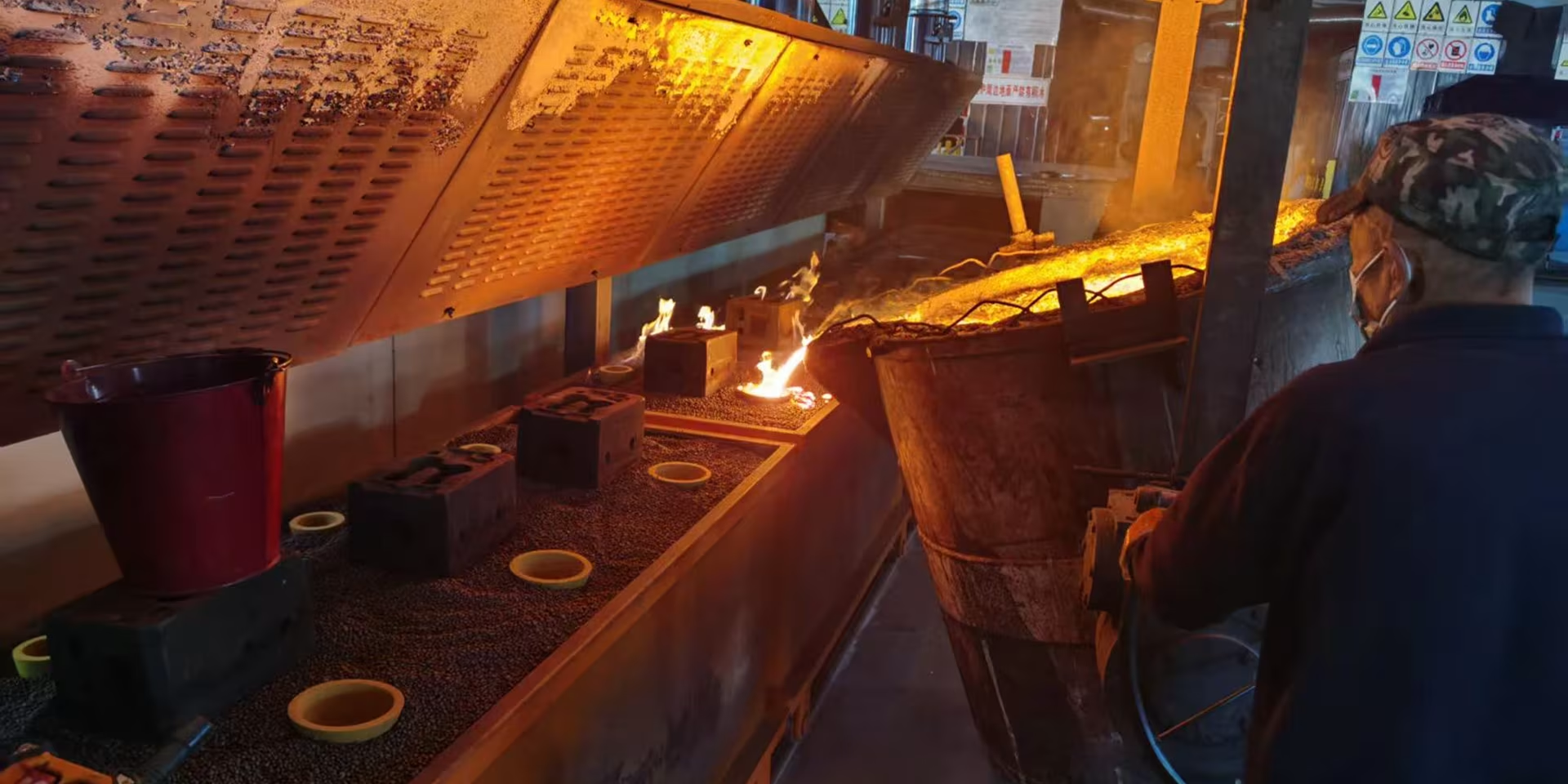
Ductile Iron Castings Manufacturer
Kurt Foundry is a ductile iron castings manufacturer and sand casting factory producing high-strength, fatigue-resistant ductile (nodular) iron parts to your drawing. A cost-effective alternative to steel, delivered ready to assemble.
How Our Ductile Iron Sand Casting Factory Works
Producing high-quality ductile iron requires exact control over the nodularization process to guarantee structural integrity.

1. CAD Design
Every project starts with 3D CAD modeling and DFM review, engineering precise gating and riser systems before any tooling is cut.
2. Mold Preparation
Using high-precision patterns, we produce exceptionally rigid sand molds that maintain tight dimensional tolerances for heavy iron castings.
3. Iron Melting
Raw material is melted in our furnace under tightly controlled temperature and charge composition to build a clean, consistent iron base.
4. Carbon Equivalent Testing
Before treatment, molten iron is sampled and tested to confirm carbon equivalent falls within the target range for the specified grade.
5. Nodulizing
The crucial nodularization step: a controlled magnesium-based nodulizer is introduced to transform graphite flakes into solid spheres, giving the iron its ductility.
6. Iron Pouring
Treated molten iron is poured into the prepared sand molds under controlled temperature and timing to fill every cavity cleanly.
7. Cooling
Castings cool under controlled conditions inside the sand mold before shakeout, allowing the microstructure to fully solidify without internal stress.
8. CNC
Castings are shot-blasted and fully CNC machined in-house — drilling, milling, boring, and turning to final print dimensions.
9. Sampling Inspection
Batch samples undergo spectrometric analysis, nodularity assessment, and mechanical testing to confirm every part meets ASTM specifications.
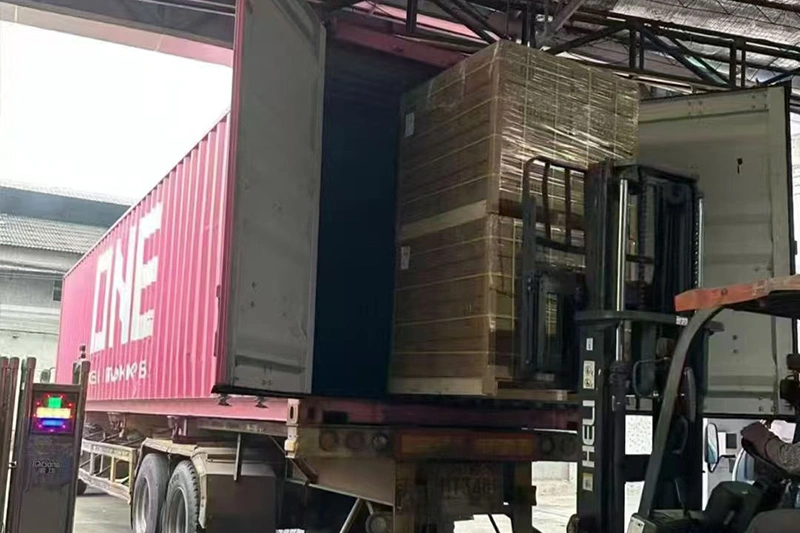
10. Shipping
Parts are cleaned, rust-proofed, and export-packed to withstand ocean freight, then consolidated and shipped via DDP/FOB logistics to North America.
Our Nodulizing Equipment
Nodulizing is the one step that turns ordinary iron into ductile iron. Get the magnesium dosing or timing wrong, and the graphite never fully spheroidizes — the casting quietly loses strength and ductility. Our nodulizing station keeps dosing and timing precise on every heat, so nodularity never drifts.
- Controlled magnesium dosing on every heat
- Consistent treatment timing to prevent Mg fade
- Nodularity verified before pouring, not just after
The Perfect Balance of Strength and Machinability.
Also known as nodular iron, ductile iron castings bridge the gap between gray iron and cast steel — magnesium-treated for spheroidal graphite that resists cracking. Kurt Foundry casts custom parts from standard ferritic to high-strength pearlitic grades, wherever weight and cost matter more than raw steel strength.
Common Ductile Iron Casting Grades
Our in-house metallurgy lab ensures precise nodularity and chemical composition. Below are the most frequent cast ductile iron grades we pour.
| Standard / Grade | Tensile Strength (MPa) | Yield Strength (MPa) | Elongation (%) | Common Applications |
|---|---|---|---|---|
| ASTM A536 60-40-18 | ≥ 414 | ≥ 276 | ≥ 18 | Pressure containing parts, valve bodies, high-shock components. |
| ASTM A536 65-45-12 | ≥ 448 | ≥ 310 | ≥ 12 | Machinery frames, heavy-duty gearboxes, automotive suspension. |
| ASTM A536 80-55-06 | ≥ 552 | ≥ 379 | ≥ 6 | Crankshafts, gears, heavy machinery structural brackets. |
| ASTM A536 100-70-03 | ≥ 689 | ≥ 483 | ≥ 3 | High-strength applications requiring excellent wear resistance. |
| DIN EN 1563 EN-GJS-500-7 | ≥ 500 | ≥ 320 | ≥ 7 | European standard equivalent for general engineering components. |
What Does a Ductile Iron Casting Cost?
Ductile iron casting prices typically run $2–$15 per kg, depending on how much finishing work the part needs and how many pieces you order. Use the ranges below as a starting point — your exact quote will depend on the drawing.
Shot-blasted and dimensionally inspected, delivered as a raw or lightly finished casting for your own downstream machining.
Complete 5-axis CNC machining, drilling, and tapping — ready for immediate assembly on arrival.
Larger order volumes reduce the per-kg price. The final quote depends on part geometry, tolerance requirements, and machining scope.
Ductile Iron Casting Applications
We supply precision-machined ductile iron castings to heavy equipment manufacturers worldwide.
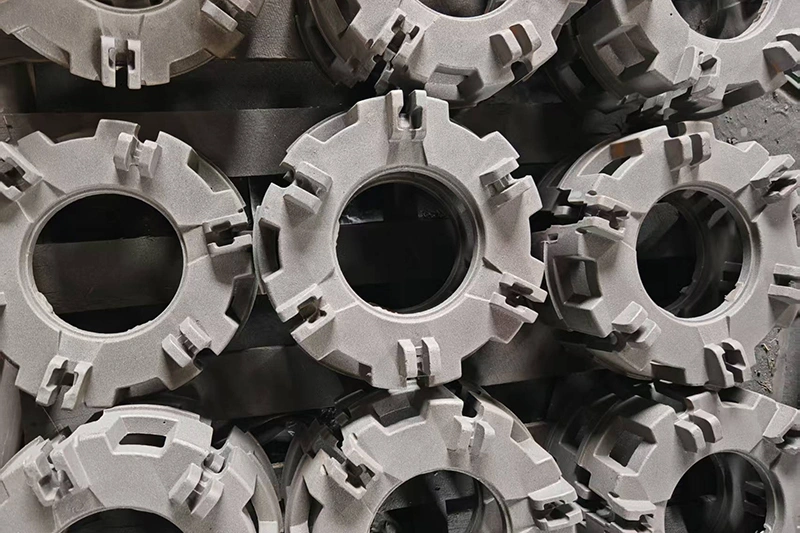
Clutch Housings
Machined clutch housings demand tight bore tolerances and a dense, void-free casting to handle repeated torque and vibration loads without cracking at the mounting features.
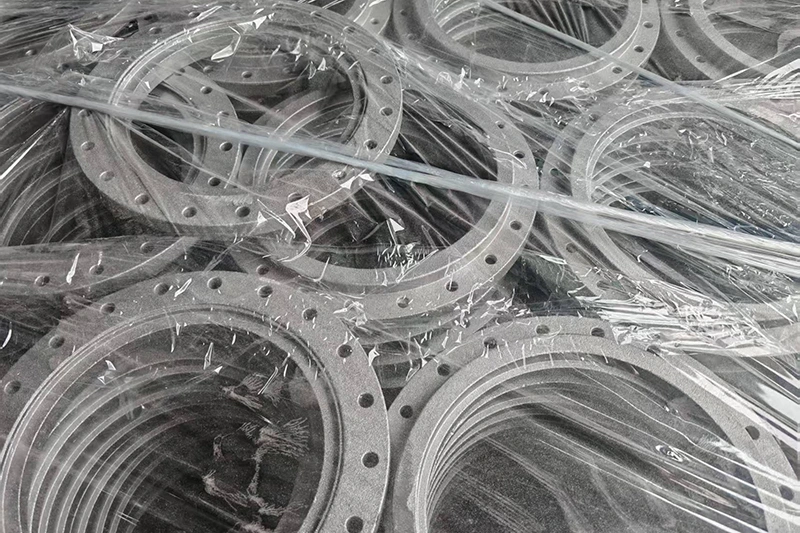
Bearing Housings
Ductile iron’s dimensional stability keeps bolt-hole patterns and bore seats precise across production runs, ensuring a consistent fit for rotating shaft assemblies.
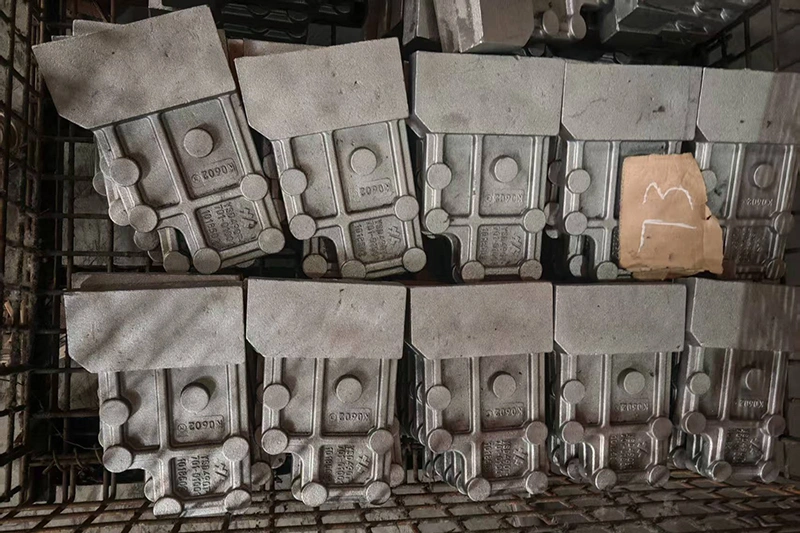
Mounting Brackets
Structural brackets combine complex rib geometry with high impact resistance, standing up to shock loading in heavy equipment and machinery frames.
Industries That Rely on This Material:
Ductile Iron vs. Gray Iron vs. Cast Steel
Choosing the right base material early avoids costly redesigns later. Here is how ductile iron compares on the properties engineers care about most.
| Property | Gray Iron | Ductile Iron | Cast Steel |
|---|---|---|---|
| Tensile strength | Low | Medium-high | High |
| Impact resistance / ductility | Low (brittle) | High | High |
| Vibration damping | Excellent | Fair | Fair |
| Machinability | Excellent | Very good | Fair |
| Castability / cost | Lowest cost | Moderate cost | Highest cost |
| Typical use case | Machine bases, brake discs | Valve bodies, gearboxes, suspension | Extreme-load structural parts |
Non-Destructive Testing & Nodularity Control
Internal soundness matters as much as surface finish. Every batch is verified through multiple, complementary inspection methods.
Magnetic Particle Inspection
Detects surface and near-surface flaws in ferromagnetic castings before machining begins.
Dye Penetrant Testing
Low-cost method for exposing fine surface cracks and porosity on finished machined faces.
Ultrasonic Testing (UT)
Sound-wave inspection locates internal shrinkage or density variation deep inside thick-wall sections.
Radiographic (X-Ray) Inspection
Full internal imaging for pressure-critical or safety-critical parts on customer request.
Nodularity Assessment
Metallographic sampling confirms graphite nodule count and shape, reported against the customer’s minimum nodularity requirement.
CMM & Spectrometric Verification
Coordinate measuring machines confirm tolerances; spectrometry verifies chemical composition on every heat.
What Our Clients Say
“Since shifting our ductile iron casting procurement to your team, the overall quality of our final products has seen a significant upgrade. The internal structure of your castings is incredibly dense, completely resolving the porosity and shrinkage issues we faced with previous suppliers. Most impressively, the tensile and yield strengths consistently exceed our testing standards, and the dimensional accuracy is spot-on. This has drastically reduced our machining scrap rate and operational costs. For critical components requiring high strength and fatigue resistance, you are the most professional and reliable casting partner we’ve worked with.”
“Finding a foundry that can guarantee strict quality consistency across large-volume orders while delivering on time has always been a challenge in this industry—until we started working with you. Your extensive expertise in ductile iron has saved us immense communication time. From initial mold development and sampling to mass production, you not only offer competitive pricing but also maintain an incredibly low defect rate. Even when faced with our occasional urgent order adjustments, your team always responds swiftly and delivers on schedule. Highly recommended to any enterprise seeking a premium ductile iron supplier!”
Our Foundry in Numbers
The equipment, output and certification behind every quote we send.
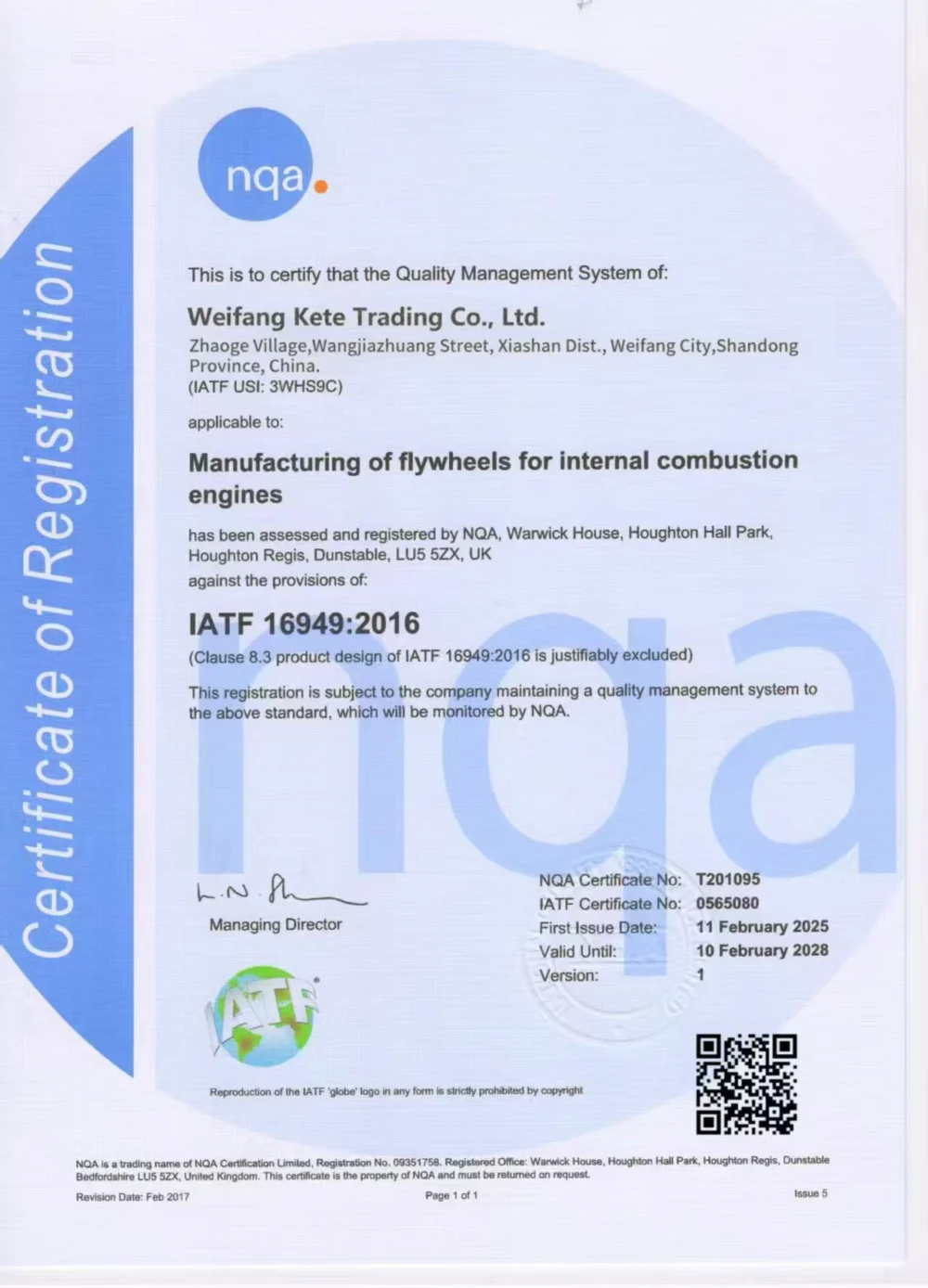
Featured Work: Engine Flywheels
Flywheels for internal combustion engines are the product line our IATF 16949 certification covers. We cast them in gray and ductile iron, then CNC machine and dynamically balance them in-house.
See our custom flywheels →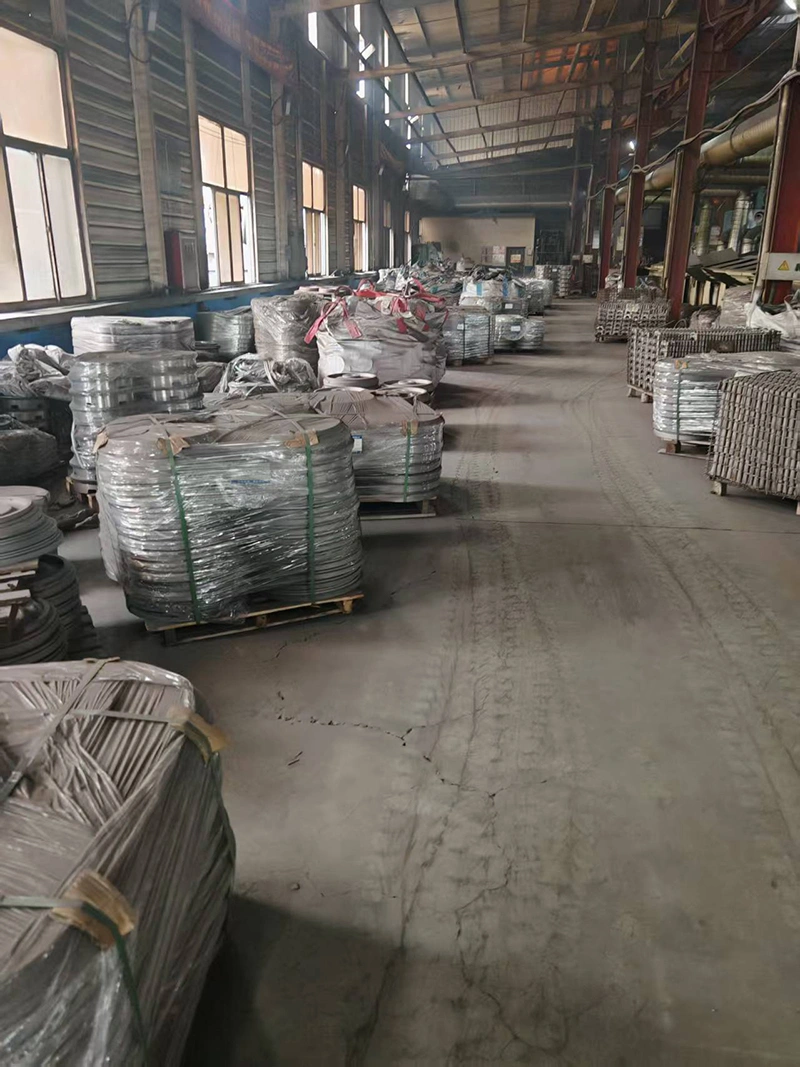
Why Choose Us as Your Ductile Iron Castings Manufacturer?
By keeping the entire production process—from tooling design and pouring to precision CNC machining—under one roof, we eliminate supply chain risks and deliver completely finished components.
- Direct Factory Pricing – Cost-Effective Alternatives to Steel
- Consistent Nodularity Control via In-House Metallurgy
- Comprehensive Material Test Reports (MTRs) Provided
- Seamless DDP/FOB Logistics to North America
- Dedicated English-Speaking Engineering Support Line
Why Buy Ductile Iron Castings from a China Foundry
Most of our customers are OEMs and distributors in the USA and Canada. When they source ductile iron castings overseas, the first two questions are what the part really costs landed at their dock, and how long it takes to get there. Here is how we answer both.
Your Total Landed Cost, Quoted Up Front
Every quote can be issued FOB, CIF or DDP. Under DDP (Delivered Duty Paid) the price already covers ocean freight, US or Canadian customs clearance, import duties and tariffs, and trucking to your loading dock. The number you compare against a domestic foundry is the real landed cost, and you do not need an import license.
| Included in the price | FOB Qingdao | CIF your port | DDP your dock |
|---|---|---|---|
| Pattern, casting & CNC machining | ✓ | ✓ | ✓ |
| Inspection & material certificates | ✓ | ✓ | ✓ |
| ISPM-15 export crating | ✓ | ✓ | ✓ |
| Ocean freight & insurance | You arrange | ✓ | ✓ |
| Customs clearance, duties & tariffs | You arrange | You arrange | ✓ |
| Inland trucking to your facility | You arrange | You arrange | ✓ |
Drawing to Dock: Typical Timeline
- DFM review & quoteWithin 48 hours of receiving your drawing.
- Pattern & toolingTypically 3–4 weeks.
- First-article sampleWith an inspection report, for your engineering approval.
- ProductionAbout 4–6 weeks after sample approval, depending on machining.
- Ocean freight from QingdaoRoughly 2–3 weeks to West Coast ports, 4–5 weeks to the East Coast.
- Customs & deliveryHandled by our logistics team under DDP terms.
Repeat orders skip the tooling stage. Your pattern stays at our foundry at no storage cost.
No Import License Needed
Under DDP, our logistics team handles customs entry, duties and tariffs. The parts arrive like a domestic delivery.
Customs-Ready Paperwork
Commercial invoices, packing lists and material certificates are prepared to match every shipment.
English-Speaking Engineers
Specs, DFM feedback and logistics are discussed directly with our engineering team, not through a trading agent.
One Supplier, Finished Parts
Casting, CNC machining and inspection happen in-house, so one purchase order covers a ready-to-assemble part.
Ductile Iron Casting FAQs
The primary difference lies in the graphite structure. Gray iron has graphite flakes, making it brittle but good at dampening vibration. Ductile iron is treated with magnesium to form spherical (nodular) graphite, which gives it much higher tensile strength, impact resistance, and ductility (the ability to bend without breaking).
In many cases, yes. Ductile iron offers a yield strength comparable to many cast carbon steels but is easier to cast and machine, resulting in a lower overall part cost. It is an excellent upgrade for parts that are too stressed for gray iron but don’t strictly require the weldability of carbon steel.
Our sand casting foundry is equipped to handle custom ductile iron components ranging from 1 kg up to 1,000 kg (2 to 2,200 lbs) per single piece, making us ideal for heavy machinery components.
Ductile iron has excellent machinability, generally superior to carbon steel of equivalent hardness. The graphite nodules act as a natural lubricant during the cutting process, which extends tool life and allows for faster machining speeds.
We perform pre-pour spectrometric analysis, thermal analysis to check nodularity, and post-pour mechanical testing (tensile/yield/elongation). Depending on the part’s criticality, we also apply magnetic particle, dye penetrant, ultrasonic (UT), or radiographic (X-ray) inspection, plus metallographic nodularity assessment.
Yes, Kurt Foundry provides fully integrated manufacturing. We cast the ductile iron parts and utilize our in-house 5-axis CNC machining centers to drill, mill, bore, and turn the castings so they are ready for immediate assembly upon delivery.
Ready to Quote Your Iron Casting Project?
Upload your 2D/3D CAD drawings directly below. Our foundry engineers will provide a comprehensive DFM review and a competitive B2B quote within 48 hours.
Accepted formats: STEP, IGES, PDF — up to 50MB
Get Your Free Quote Now