Sand casting produces roughly 70% of all metal castings worldwide. The blank you receive from a foundry arrives rough — gate stubs, parting line flash, and sand texture still attached. Your tolerances, surface finish, and machining stock are all locked in during the production sequence from pattern to shakeout, and each stage gives you specific DFM leverage if you know where to push.
Pattern and Core Preparation
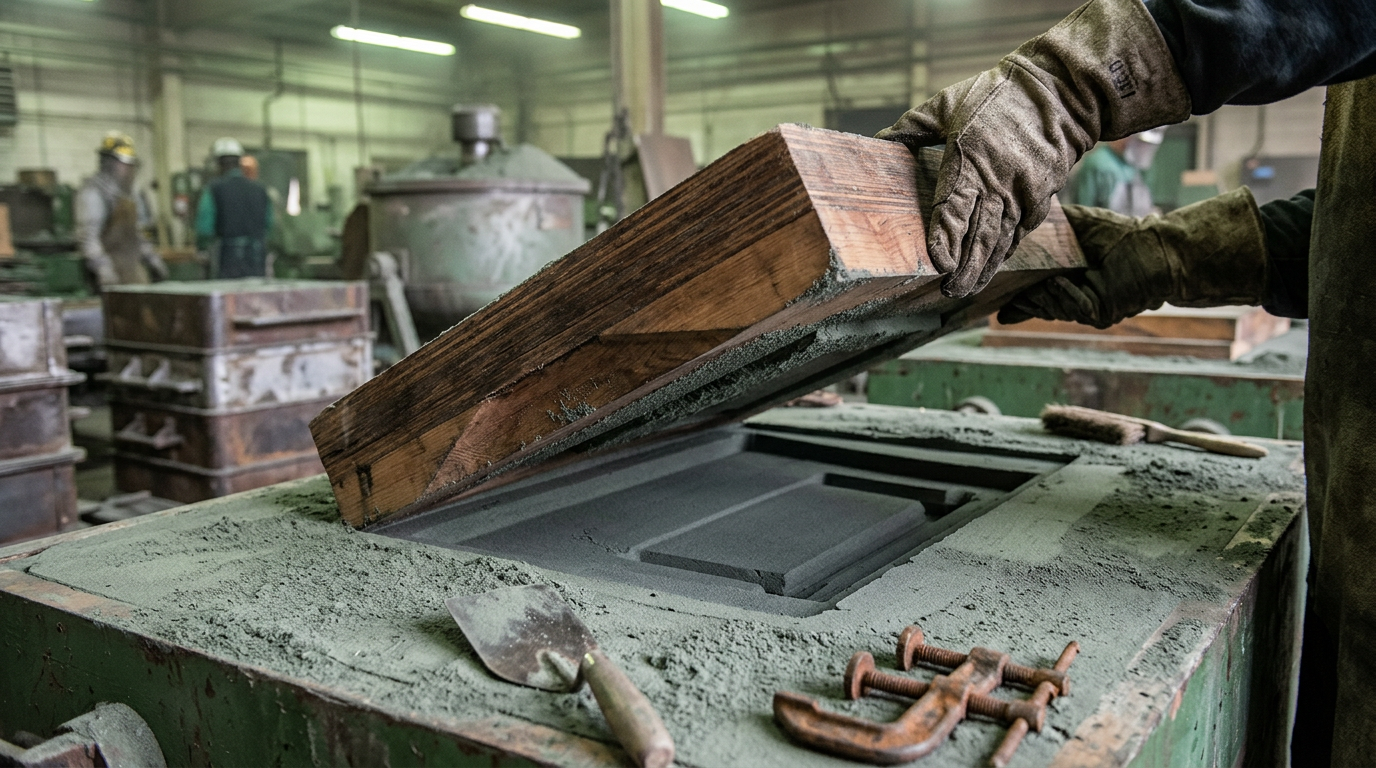
Every sand casting starts with a pattern — a physical replica of the finished part, oversized to compensate for metal shrinkage. Shrinkage is not one number you add uniformly. Metal contracts in three distinct phases: liquid contraction as the melt cools to its freezing point, solidification shrinkage as it transforms from liquid to solid (roughly 6% by volume for aluminum), and solid-state contraction as the casting cools to room temperature. Pattern allowance only compensates for that last phase. The first two require proper gating and riser design — no amount of pattern scaling fixes inadequate feeding.
For Al-Si alloys, expect 1.2-1.6% linear shrinkage built into the pattern. Draft angles — typically 1-3 degrees on vertical surfaces — let the pattern pull cleanly from the sand without tearing the mold cavity. Skip the draft, and your foundry either adds it for you (changing your dimensions) or fights broken mold edges on every pull.
If your part has internal passages, the foundry builds sand cores separately and sets them into the mold before closing. Before you finalize that drawing, check whether your internal geometry actually needs a core or can be machined from solid — cores add cost and tolerance uncertainty.
Molding and Gating
The mold is built in two halves: the cope (top) and drag (bottom), packed with sand around the pattern. Where these halves meet creates the parting line — a feature visible on every blank you receive. Parting line location is not cosmetic. It determines where flash forms, where dimensional variation is highest, and where machining fixtures will reference.
The gating system — sprue (vertical entry channel), runners, and gates — controls how metal fills the cavity. Good gating design prevents 70% of casting defects. Too fast, and turbulent flow traps air and erodes sand into the casting. Too slow, and metal freezes before filling thin sections. Risers — reservoirs of extra metal at thick sections — feed shrinkage as the casting solidifies. Every gate and riser leaves a stub on the blank that must be cut after shakeout.
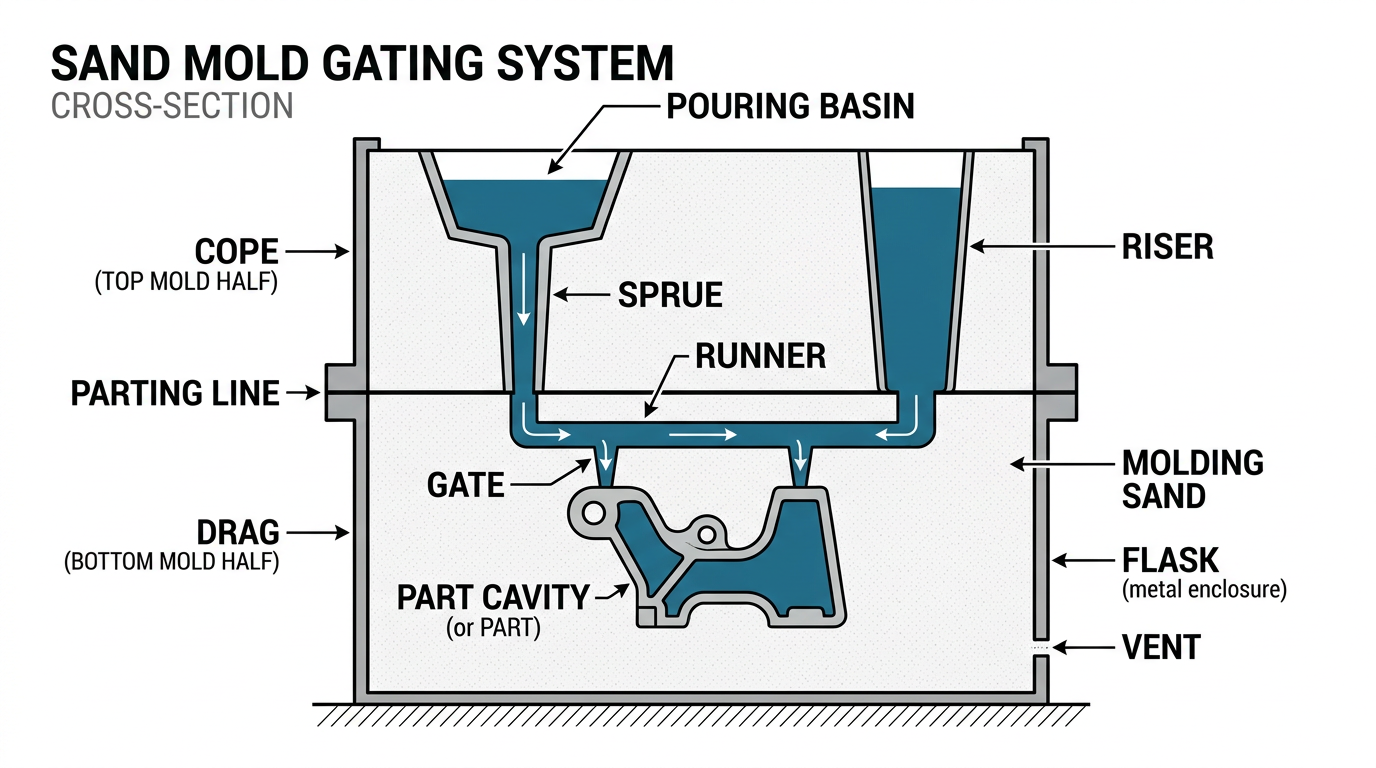
I have seen more blanks rejected from bad gating than from wrong alloy selection. If your foundry asks to move a gate location, listen — they are protecting your part quality.
Pouring and Cooling
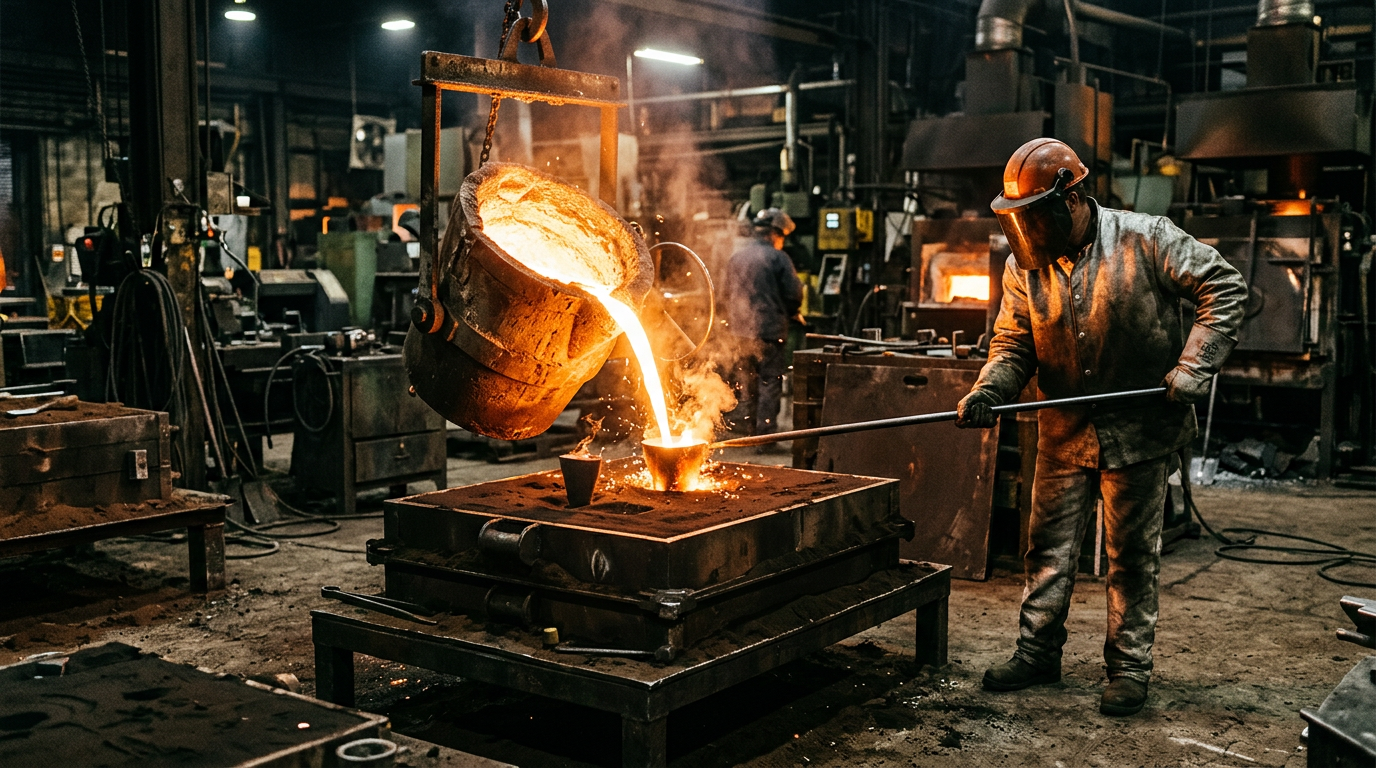
Gray iron pours below 1300 degrees C. Aluminum alloys pour considerably lower. The exact temperature matters because metal poured too hot absorbs hydrogen from moisture in the sand, creating gas porosity — small round voids just below the surface that show up only after machining.
Once the mold is full, cooling rate determines both microstructure and dimensional stability. Controlled cooling inside the sand mold is the professional standard. Some hobby guides recommend quenching freshly cast parts in water to speed handling. For ferrous castings, this causes thermal shock cracks and locked-in residual stress. Even for aluminum, rapid quenching distorts thin sections and generates internal tension that fights your machining later.
Cycle times for small-to-medium parts run 5-30 minutes from pour to shakeout. Large or thick-section castings can take hours.
Shakeout and Cleanup
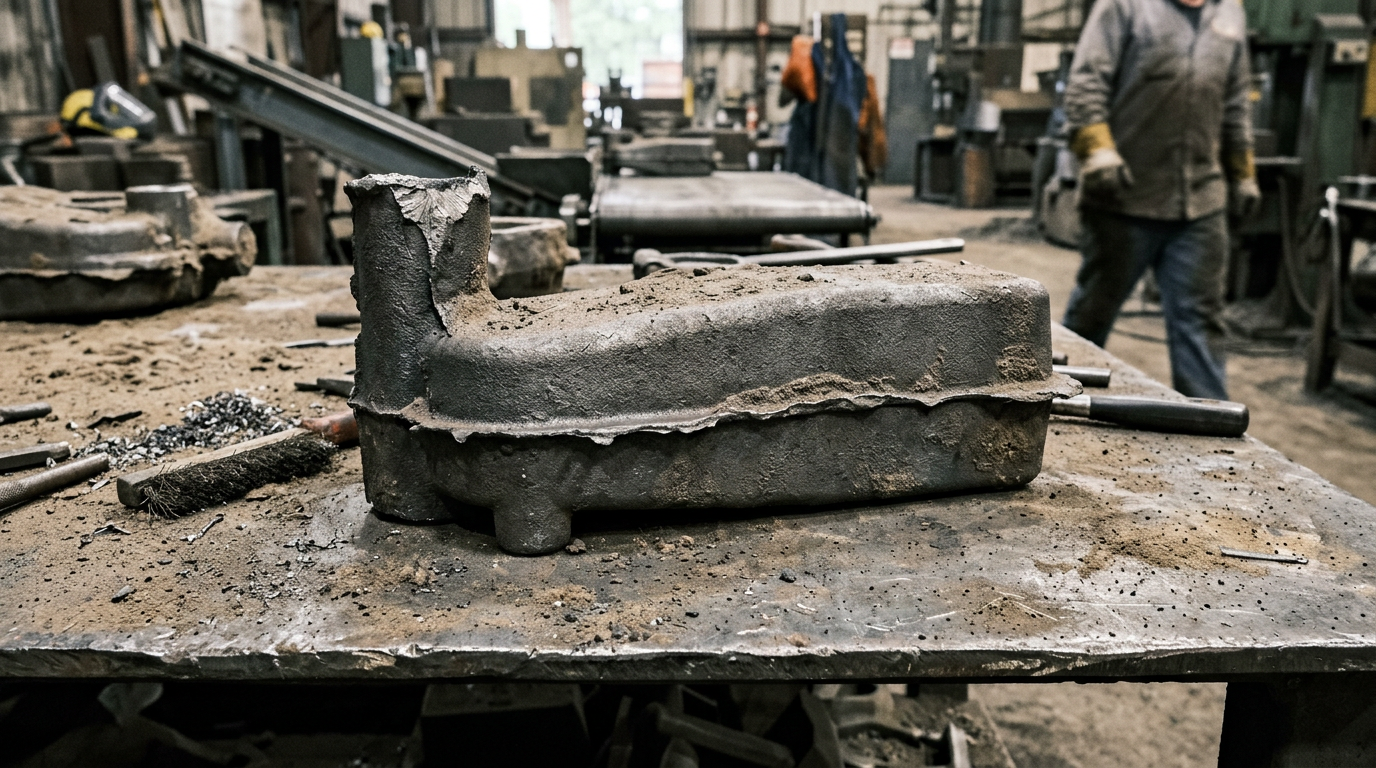
Shakeout is exactly what it sounds like — the sand mold is broken apart to free the casting. What comes out is not a finished part. The blank carries gate stubs, riser pads, parting line flash (thin metal fins where the cope and drag did not seal perfectly), and an as-cast surface with sand texture embedded in it.
Gate stubs and risers get cut off with saws or grinders. Flash gets chipped or ground. The remaining surface is shot-blasted. Surface finish on as-cast faces typically runs 250-500 Ra microinches — far rougher than any machined surface.
Most defects trace back to three root causes: moisture in the sand (gas porosity), inadequate riser feeding (shrinkage cavities with jagged internal surfaces), or temperature problems during pour (cold shuts where two metal fronts meet without fusing, or hot tears from uneven cooling). When you receive a blank with defects, work backwards from the riser — the answer is usually there.
Common Spec Mistakes That Add Cost
The most common mistake I see from design engineers is specifying tolerances tighter than the process can deliver. Standard sand casting achieves CT8-12 tolerance class per ISO 8062, with CT9 typical. Anything tighter than CT8 on an as-cast feature means you are paying for machining whether you intended to or not. Specify as-cast tolerances where the function allows, and call out machined surfaces explicitly — 2 mm is a common machining allowance on medium-diameter features.
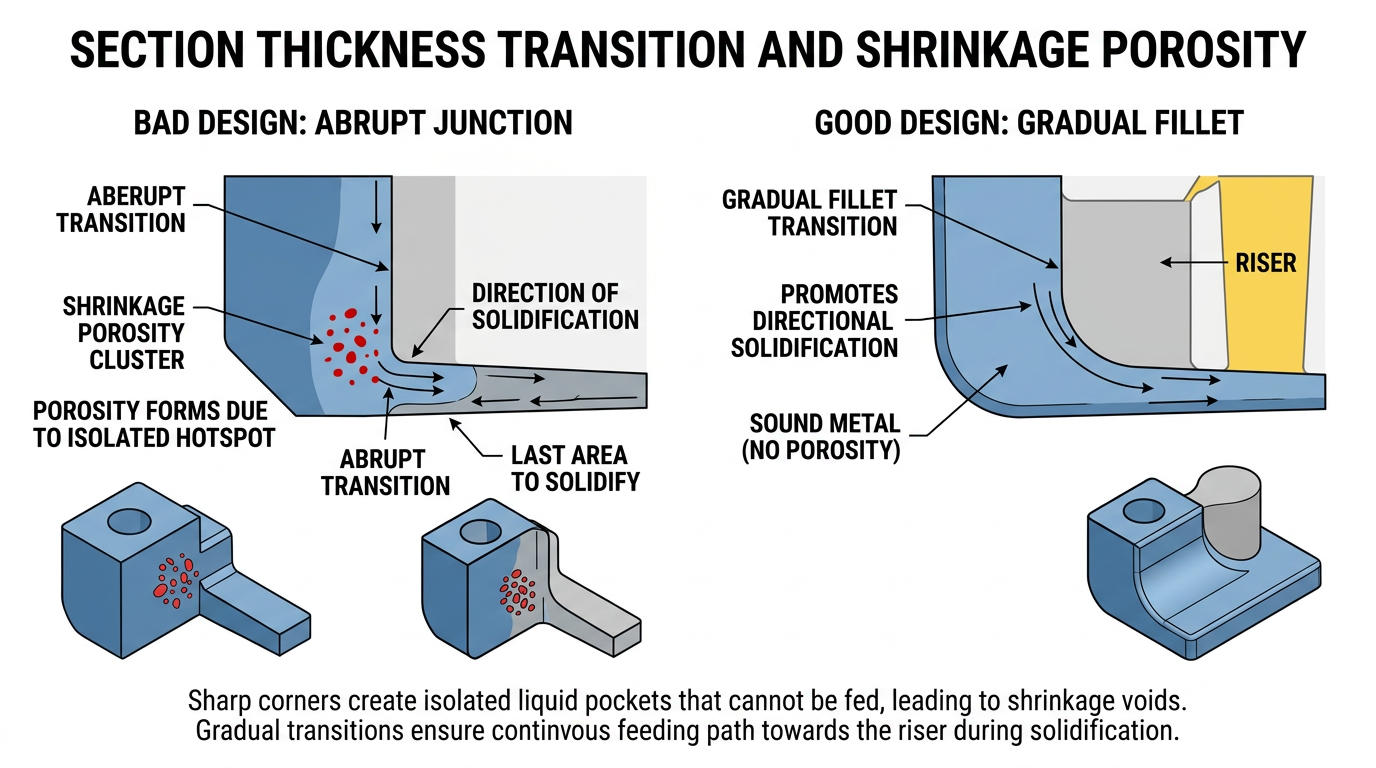
Second: ignoring section thickness transitions. Aim for gradual wall transitions with less than a 1:4 thickness ratio. A thick boss next to a thin wall cools at different rates, pulling shrinkage porosity into the junction.
Third: placing critical features across the parting line. Dimensional variation is always worst at the parting line due to cope-drag alignment tolerance. Move critical datums to one mold half whenever possible.
Your DFM Checklist Before Ordering a Blank
Specify as-cast tolerances at CT9 or wider on non-machined surfaces, and add explicit machining stock on features that need precision. Check that all vertical surfaces have at least 1 degree of draft. Keep section thickness ratios below 1:4, and use generous fillets at every wall junction. Confirm that your critical dimensions sit on one side of the parting line, not across it.
One step most engineers skip: talk to the foundry before releasing the drawing. A 15-minute conversation about parting line location and gating access saves weeks of sample iteration and thousands in pattern revisions.