Gray iron’s compressive strength reaches 3-4x its tensile strength — a property inversion that makes it the dominant choice for machine bases and engine blocks, yet disqualifies it from any application with significant tensile loading. That single fact illustrates why listing “cast iron” as a sand casting material, without distinguishing gray from ductile, leads engineers to specify the wrong alloy.
Sand casting handles the widest range of metals of any casting process, from aluminum at 1220 F to high-alloy steel above 2800 F. But the process earns its keep with ferrous metals — iron and steel — where pouring temperatures and casting weights exceed what die casting and permanent mold can deliver.
Cast Iron: Gray Iron vs Ductile Iron
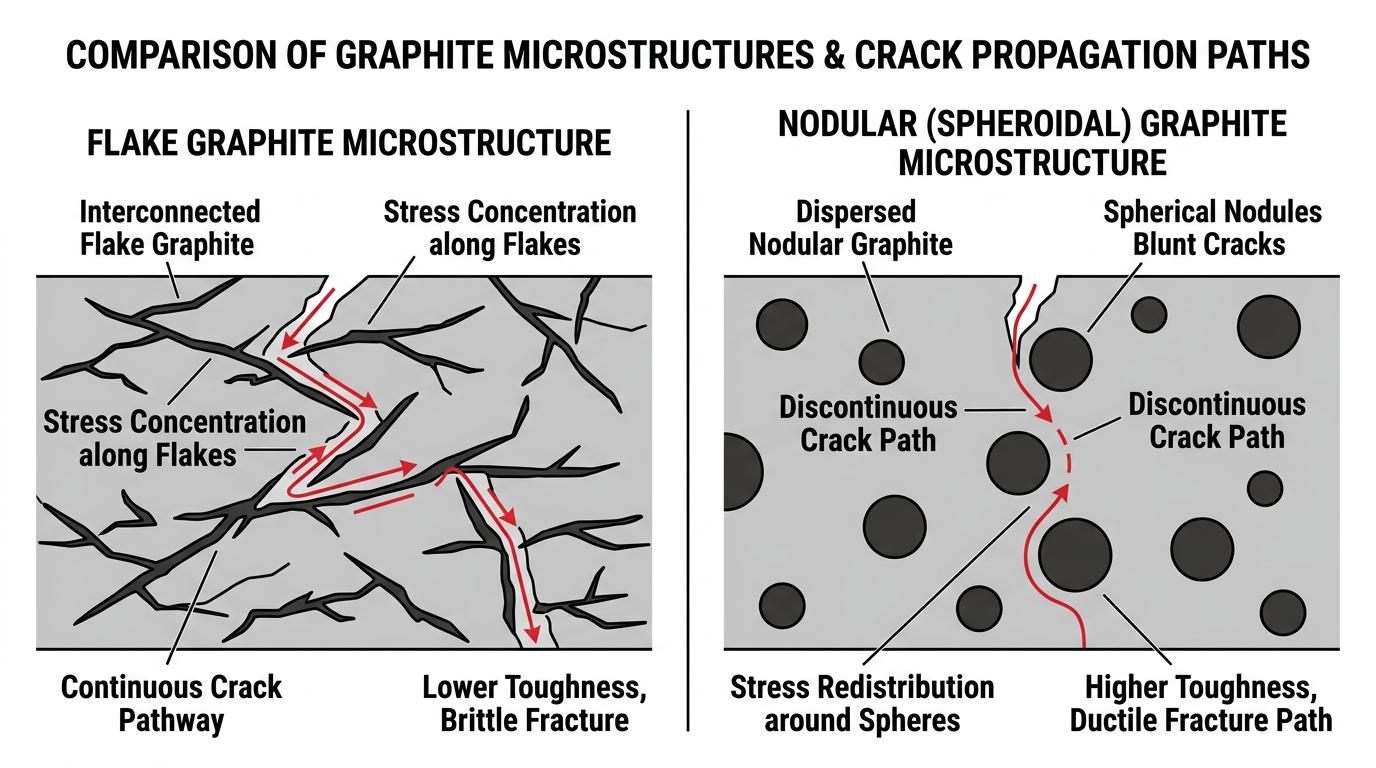
The 2% carbon threshold separates steel from iron, but within cast iron, the shape of the graphite precipitates during solidification determines everything. Gray iron contains flake graphite; ductile iron contains nodular (spheroidal) graphite. These are not interchangeable materials — the graphite morphology creates fundamentally different mechanical behavior.
Gray Iron (ASTM A48)
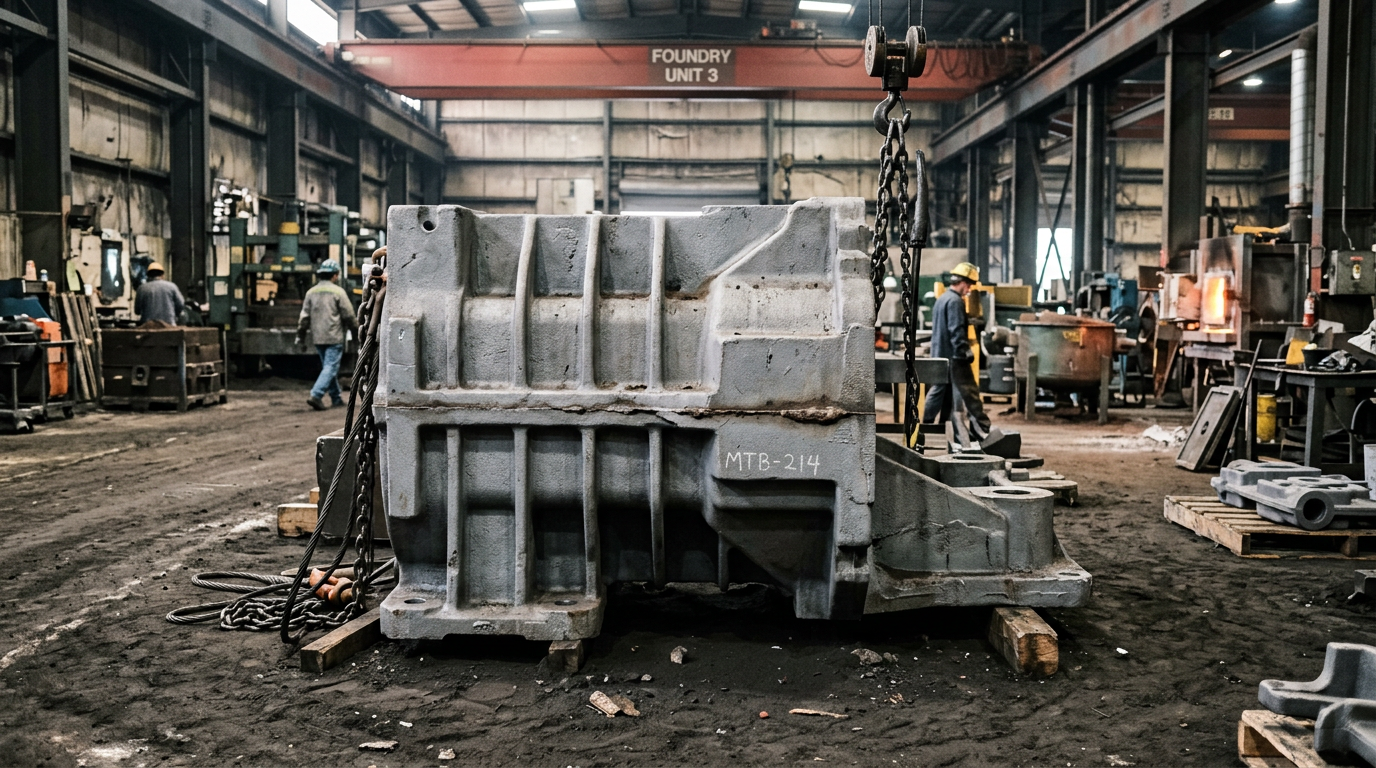
ASTM A48 Class 30 delivers 30,000 psi tensile strength with 174-210 BHN hardness, while Class 40 pushes to 40,000 psi tensile with 183-285 BHN. Those tensile numbers look modest until you flip the loading direction: Class 30 compressive strength hits 109 ksi, and Class 40 reaches 150 ksi. That 3-4x compressive-to-tensile ratio is why gray iron castings dominate machine tool bases, brake drums, and pump housings — applications where compressive loads and vibration damping matter more than tensile capacity.
Thermal conductivity of 30 Btu/hr-ft-F and a melting range of 2050-2120 F make gray iron the easiest ferrous alloy to cast. The flake graphite structure provides natural lubricity and outstanding machinability.
One specification trap: gray iron strength depends critically on section thickness. Thinner sections cool faster and develop higher strength, while heavy sections cool slowly and test weaker. Specifying “Class 30” without defining the test bar diameter or the actual casting cross-section invites surprises at incoming inspection.
Ductile Iron (ASTM A536)
ASTM A536 grades encode their own properties directly in the name. Grade 65-45-12 means 65 ksi tensile, 45 ksi yield, 12% elongation. Grade 60-40-18 delivers 60,000 psi tensile with 18% elongation and compressive strength of 429 ksi — more than enough for dynamic loading, impact, and fatigue applications where gray iron fails.
The grade range spans from 60-40-18 (maximum ductility, full ferritizing anneal) through 80-55-06 and 100-70-03 (quench and temper) up to 120-90-02 (highest strength, lowest elongation). Grade 65-45-12 and 80-55-06 can often ship as-cast, eliminating heat treatment cost entirely.
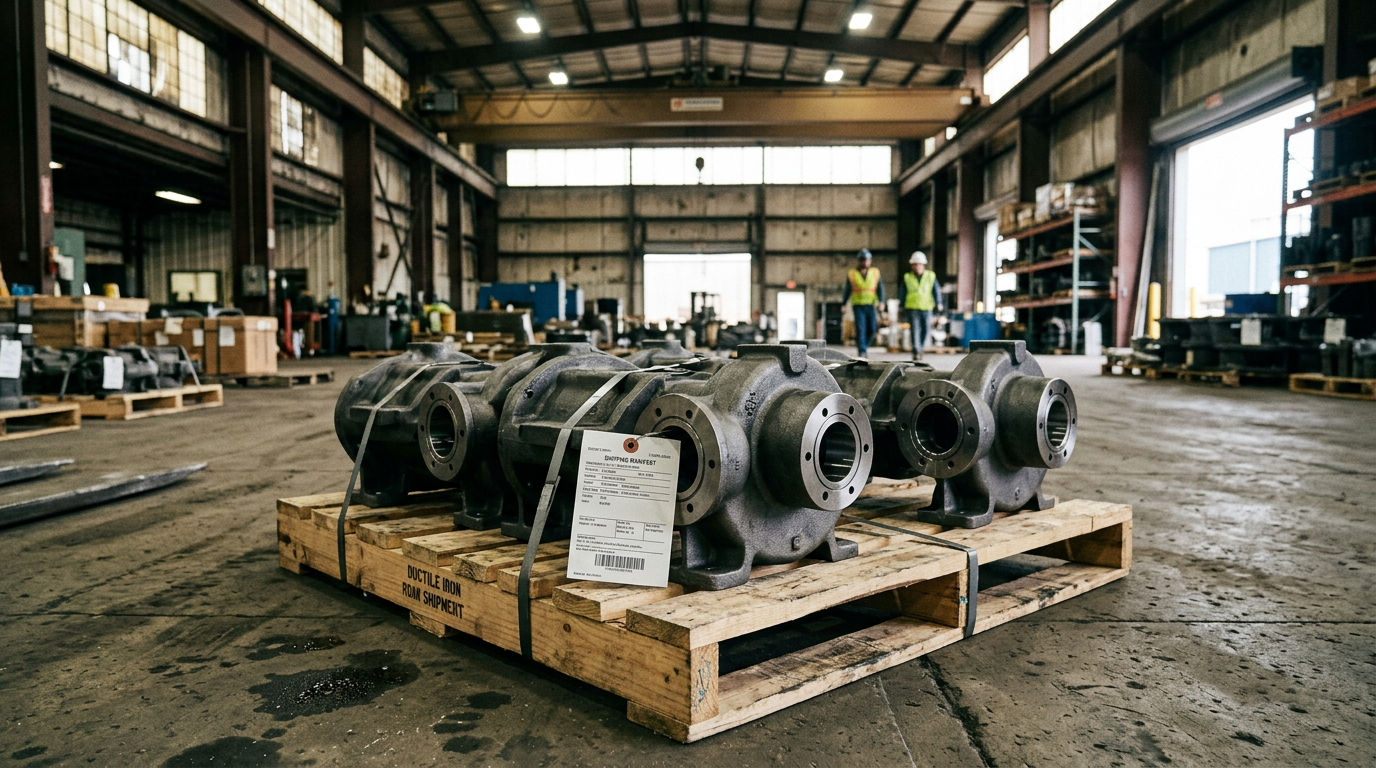
Ductile iron castings meet the 60-40-18 impact requirement of 12J at -20 C per ISO 1083, making them suitable for cold-weather infrastructure — manhole covers, pipe fittings, suspension components — where gray iron’s zero impact resistance is a liability. For most structural applications that don’t require corrosion resistance or weldability, ductile iron delivers steel-like performance at iron prices.
Cast Steel: Carbon and Stainless Grades
When ductile iron’s strength or corrosion resistance falls short, cast steel fills the gap — at higher cost and greater casting difficulty. Steel’s lower carbon content (below 2%) means higher pouring temperatures, greater shrinkage, and tighter process control.
Carbon Steel (ASTM A216)
ASTM A216 WCB is the most commonly specified carbon steel casting grade: 70-95 ksi tensile, 36 ksi yield minimum, 22% elongation minimum. Composition limits of 0.30% C max, 1.00% Mn max, and 0.60% Si max provide good weldability — critical for carbon steel castings used in valve bodies, pressure-containing housings, and structural components welded into larger assemblies.
All A216 castings require heat treatment: annealing at 890-910 C or normalizing at 870-890 C. No exceptions. WCB carries a service temperature ceiling of 1200 F (649 C); above that, you need high-alloy grades outside A216’s scope.
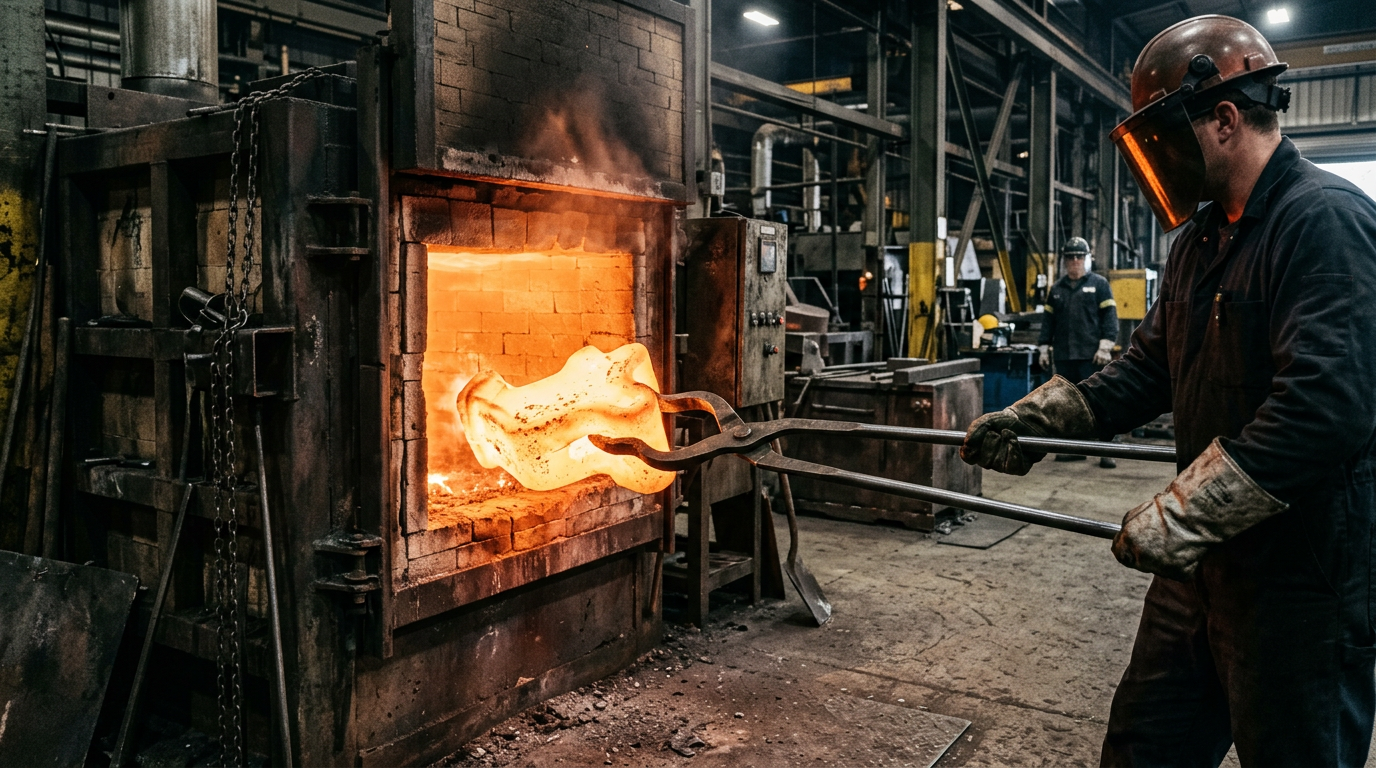
A216 covers three grades — WCA (lower strength, highest ductility), WCB (workhorse), and WCC (slightly higher strength with more manganese). For 80% of carbon steel casting applications, WCB is the correct starting point.
Stainless Steel (ASTM A351)
ASTM A351 CF8M — the cast equivalent of wrought 316 stainless — delivers 70 ksi minimum tensile, 30 ksi minimum yield, and 30% minimum elongation with 217 HB hardness. The key composition: 18-21% chromium, 9-12% nickel, and 2-3% molybdenum. That molybdenum is what makes CF8M different from CF8 (the 304 equivalent), providing resistance to chloride pitting and crevice corrosion in chemical processing, marine, and food-grade environments.
Heat treatment requires solution annealing at 1900 F (1040 C) minimum followed by water quench — a rapid cool that preserves the austenitic structure and prevents carbide precipitation at grain boundaries.
Stainless steel castings cost two to three times more than carbon steel. Specify stainless only when the service environment demands corrosion resistance that carbon steel with coatings cannot deliver.
Non-Ferrous Sand Casting Alloys
Most high-volume aluminum casting has moved to die casting and permanent mold, where faster cycle times and tighter tolerances justify the tooling investment. Sand casting aluminum is the exception — reserved for large parts, low volumes, or prototypes where permanent tooling cost is not justified.
Bronze alloys (tin bronze, aluminum bronze, manganese bronze) remain common in sand casting for bearings, bushings, and marine hardware. Copper alloys fill electrical and thermal conductivity niches.
Before specifying any non-ferrous sand casting, confirm your foundry has experience with that alloy family. A steel foundry and an aluminum foundry are different operations with different equipment, sand systems, and metallurgical expertise.
What the Data Sheet Won’t Tell You
Property tables give you minimums. Foundry reality adds variables that change material selection decisions.
I’ve seen engineers specify gray iron Class 30 for a mounting bracket, confirm the tensile strength meets their FEA model, and sign off. Six months later, brackets are cracking in service. The FEA modeled tensile loading, but the actual installation introduced impact loads during assembly — exactly the condition where gray iron’s flake graphite acts as a crack propagator. Ductile iron would have handled it at nearly the same cost.
The cost hierarchy also defies intuition. Gray iron is the cheapest casting alloy by material cost per pound. Ductile iron costs more per pound. But the finished part cost often comes out roughly equivalent, because ductile iron’s superior machinability and lower scrap rates reduce post-casting operations. I’ve run the numbers across hundreds of jobs — when you factor in machining time, scrap rate, and rework, ductile iron’s premium shrinks to near zero on most parts under 50 pounds.
Shrinkage behavior varies by alloy family, and each material’s contraction pattern is non-uniform. Liquid contraction, solidification shrinkage, and solid-state contraction occur in three distinct phases, each affected differently by part geometry. Applying a single uniform shrinkage factor produces out-of-tolerance parts, especially on steel castings where total shrinkage is substantially higher than iron.
How to Choose the Right Alloy
Before you specify the grade, understand the service conditions. The selection sequence should be: loading type, environment, then cost — not the reverse.
| Service Condition | Recommended Alloy Family | Starting Grade |
|---|---|---|
| Compressive/static loading, vibration damping | Gray iron | A48 Class 30 |
| Dynamic/impact/fatigue loading | Ductile iron | A536 65-45-12 |
| High tensile + weldability required | Carbon steel | A216 WCB |
| Corrosive or high-temperature environment | Stainless steel | A351 CF8M |
| Low-volume, large aluminum parts | Aluminum alloy | Per application |
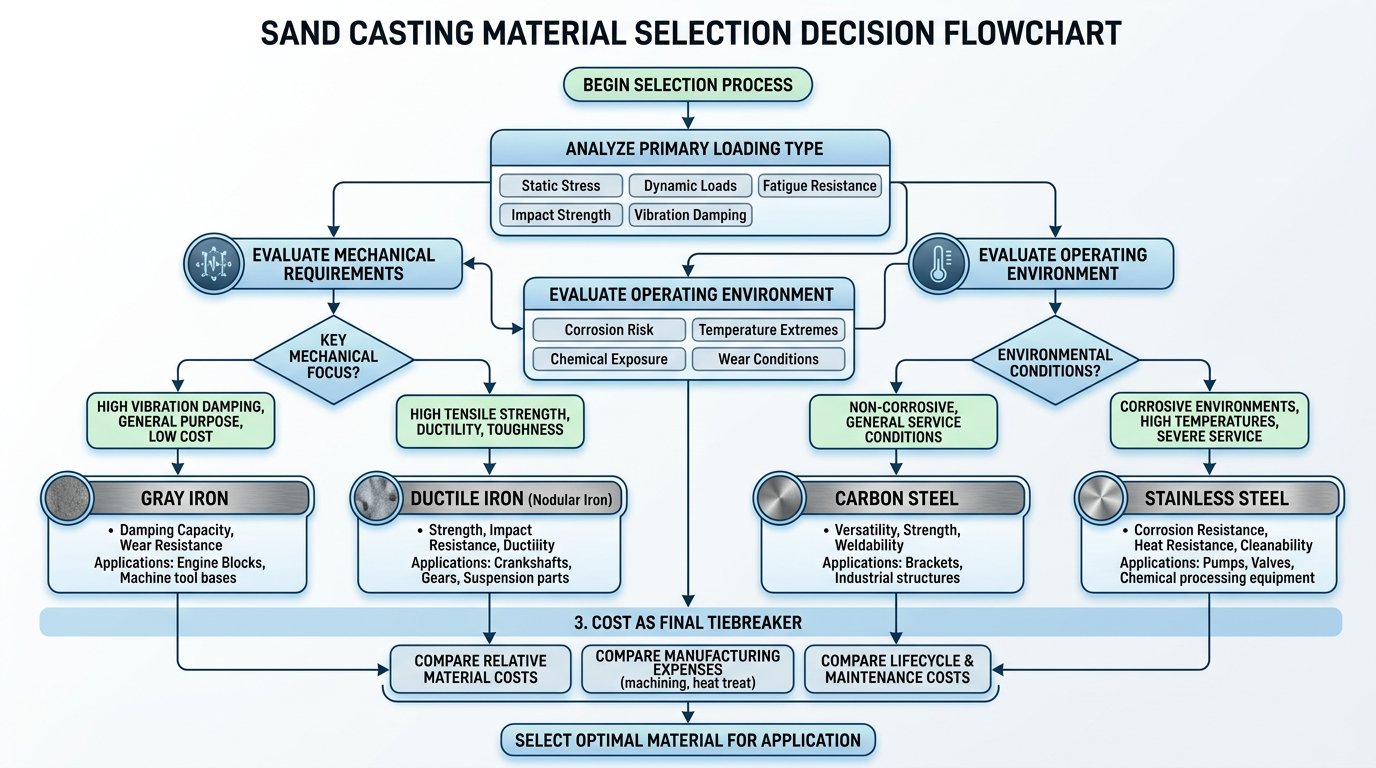
Start with gray iron. It is the lowest-cost, most castable option. If gray iron’s tensile strength or impact resistance is insufficient, move to ductile iron — not steel. The jump from ductile iron to carbon steel adds considerable cost and introduces mandatory heat treatment, higher shrinkage, and tighter process control. Justify that jump with specific service requirements, not habit.
The ASTM spec gives you minimums, but here’s what actually matters: match the alloy to the dominant loading mode, confirm the service environment, and then let cost break the tie. Material selection is 80% of casting success — get it right, and the foundry process follows.
Conclusion
Specify the alloy family based on loading and environment first, then select the ASTM grade. If you are deciding between gray iron and ductile iron, request test bars cast from the same heat as your parts — catalog minimums do not capture the section-thickness sensitivity that determines real-world performance. The most expensive casting mistake is not picking the wrong grade. It is specifying a material before defining the service conditions it must survive.