
The first question I get from procurement teams planning a casting project is some version of “how long will this take?” The answer they usually find online — three to five weeks — sets them up for a missed milestone. That number assumes existing tooling, a simple alloy, and zero hiccups. The real timeline depends on whether you’re placing a first order or a repeat, what alloy you’re pouring, and how complete your design package is when you send the RFQ.
Phase-by-Phase Timeline
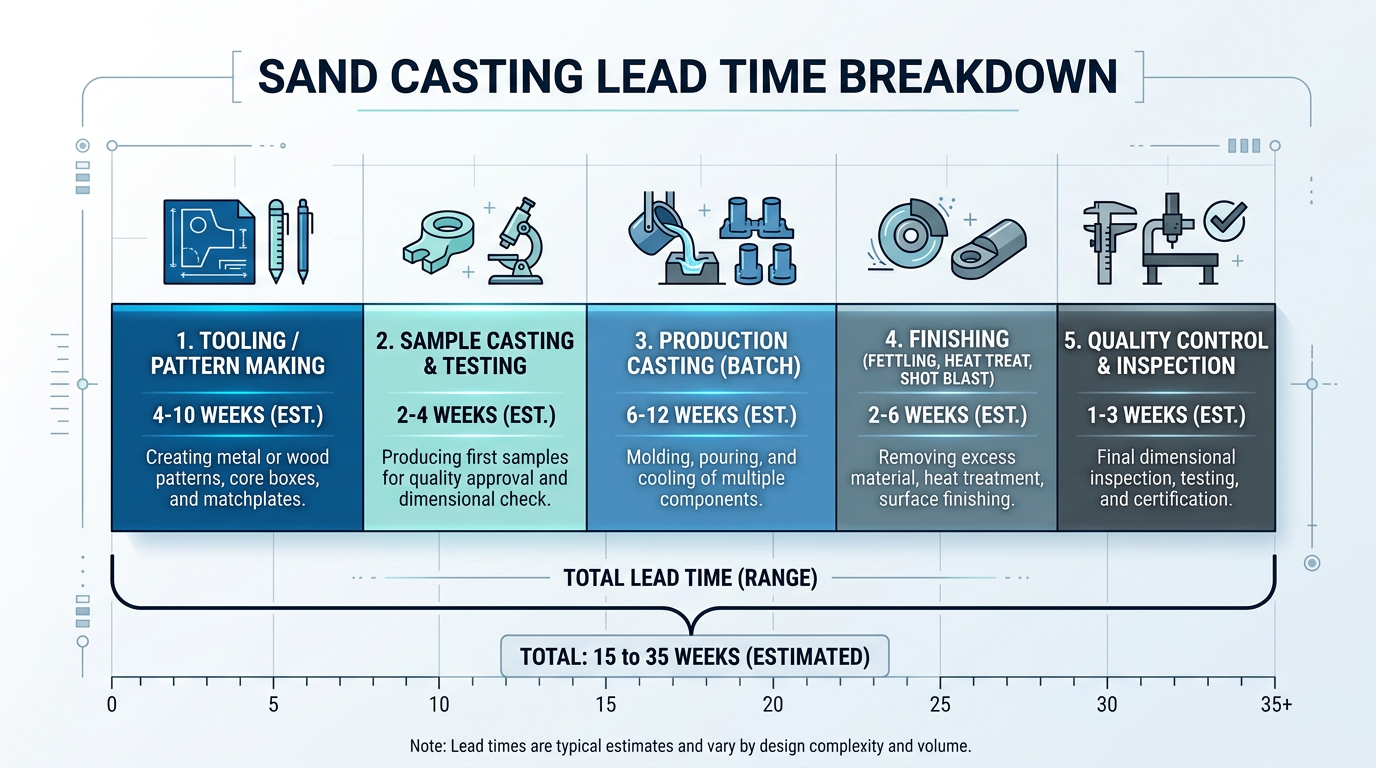
Total sand casting lead time runs four to eight weeks after design and tooling approval. Here is where that time actually goes.
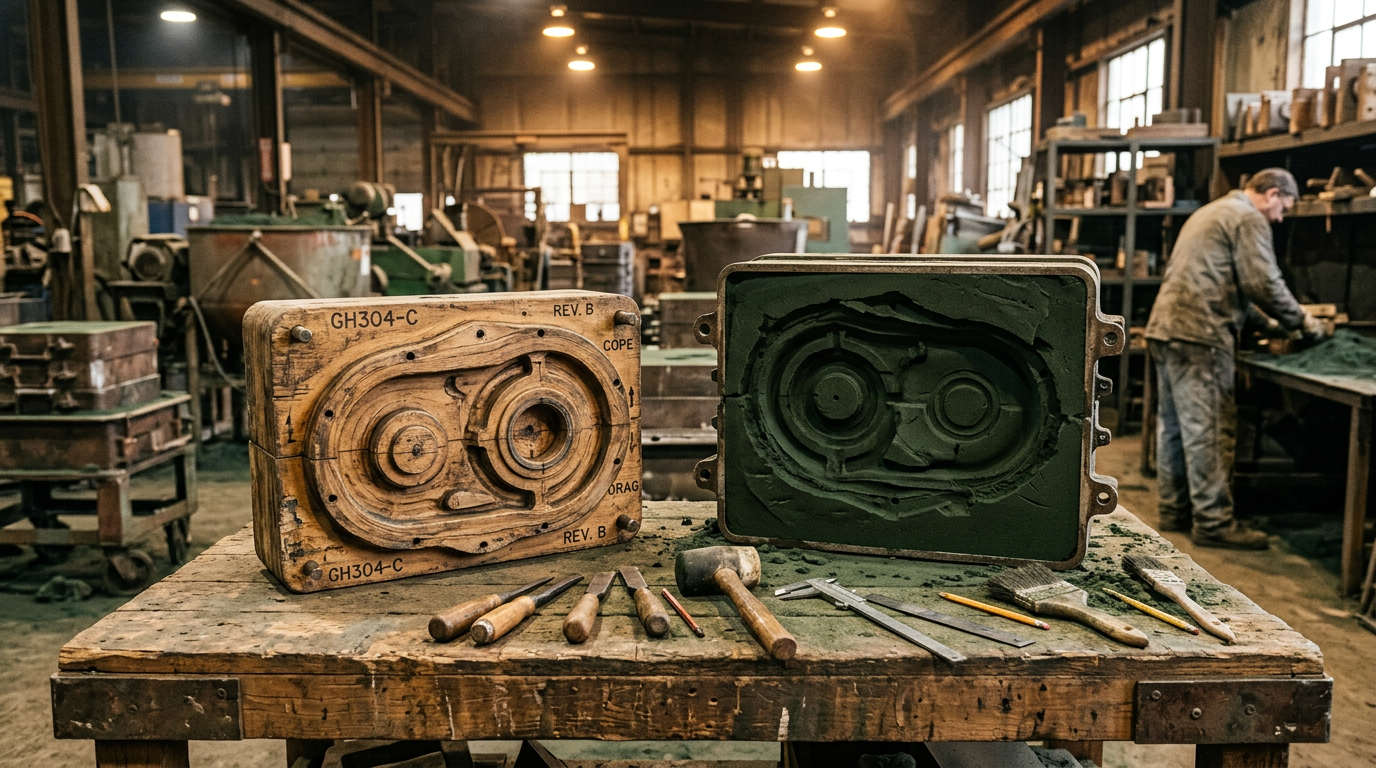
Tooling and Pattern Making
Pattern fabrication is the longest single phase: 10 to 15 working days for a standard pattern, longer for complex core assemblies. A pattern with multiple loose pieces or intricate core boxes pushes toward the upper end. Modifying an existing pattern rather than building from scratch cuts this to five to eight days.
Production Casting and Finishing
Production casting takes 7 to 14 working days depending on order volume and part complexity. The pour itself is fast — hours, not days. Cooling is the variable: a small bracket solidifies in 30 minutes, while a large machine base section needs several hours before shakeout can begin. Post-processing — grinding, heat treatment, machining, coating — adds another 5 to 10 working days.
Inspection, Packing, and Shipping
Final QC and packing typically takes two to three working days: dimensional checks, NDT if specified, and documentation review. Shipping is the phase nobody includes in their project plan — domestic freight adds three to seven business days, and international logistics can stretch to four weeks.
| Phase | Working Days |
|---|---|
| Tooling/Pattern | 10-15 |
| Sample/First Article (T1) | 5-7 |
| Production Casting | 7-14 |
| Post-Processing/Finishing | 5-10 |
| QC and Packing | 2-3 |
| Total (after design approval) | 20-40 |
First Orders vs Repeat Orders
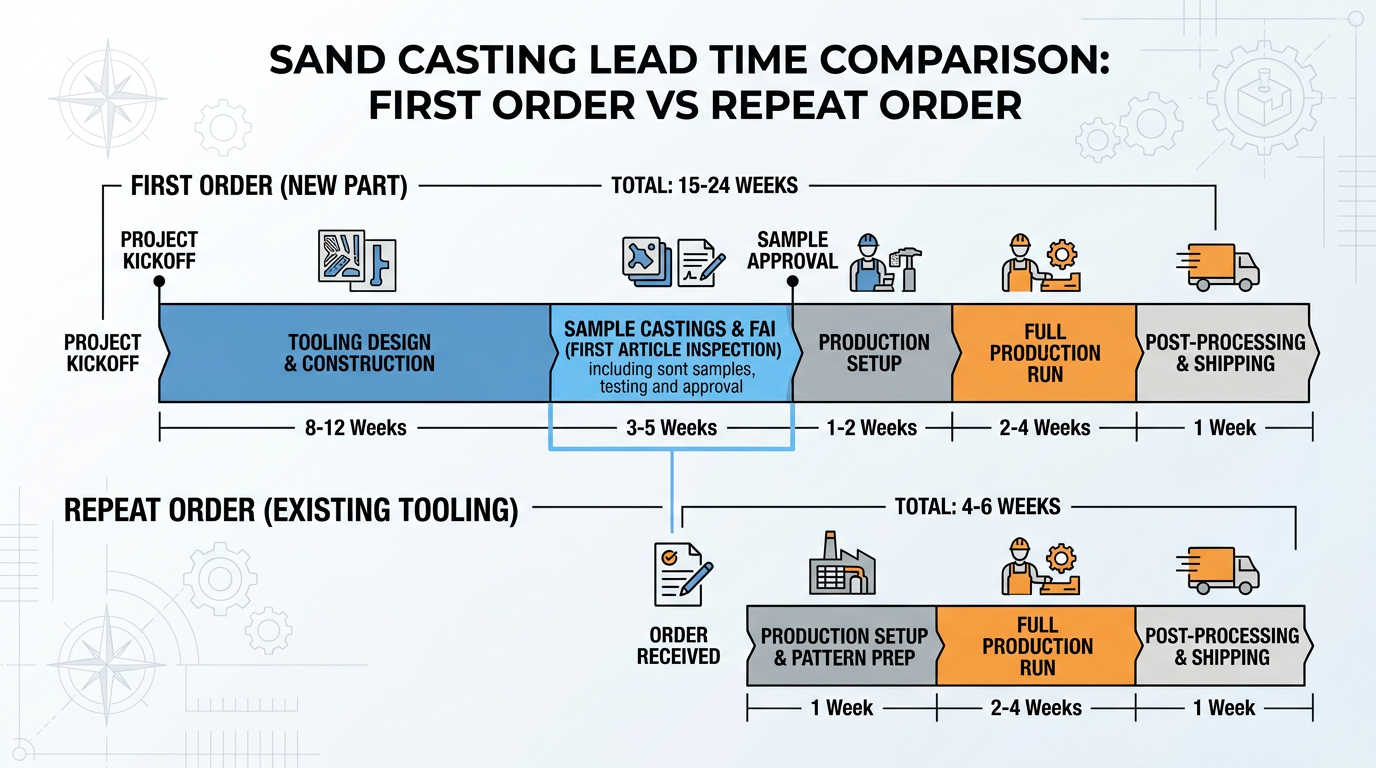
A first order with new pattern tooling takes 6 to 12 weeks for first-article approval — two to three times longer than the repeat-order number most foundry websites quote.
That 6-to-12-week window includes pattern design, fabrication, sample casting, dimensional verification, and design iterations. Each iteration — and there’s almost always at least one — adds another cycle. I’ve seen first-order timelines stretch past 14 weeks when carbon steel castings required multiple sample runs to dial in shrinkage compensation.
A repeat order on existing tooling? Three to five weeks. The pattern is on a shelf, the foundry already knows the gating and risering, and first-article approval is a formality. That’s the number most marketing pages quote — they just don’t mention it only applies to reorders.
When you factor in the total landed cost, the first-order premium isn’t just the tooling invoice. It’s the 6 to 12 weeks of schedule time you need to plan around.
What Buyers Get Wrong About Sand Casting Timelines
The biggest blind spot is treating lead time as alloy-agnostic. It isn’t. Ductile iron castings pour and finish on a straightforward schedule — standard heat treatment, routine inspection. Stainless steel adds days for specialized heat treatment cycles and more extensive testing. Carbon steel with impact requirements needs Charpy testing and potentially radiography. The alloy you specify changes your delivery date, and most buyers don’t ask about this until they’re already behind schedule.
The second gap: incomplete specs at RFQ. Every missing tolerance, undefined surface finish, or ambiguous material callout creates a back-and-forth cycle that delays your start date. I’ve seen procurement teams save 20% on piece price and lose 40% on rework and schedule delays because the drawing package wasn’t production-ready.
Before you RFQ, define your quality requirements on paper. A complete drawing package with material spec, tolerances, and inspection criteria can shave two to three weeks off your timeline by eliminating the engineering clarification loop.
How to Compress Your Casting Lead Time
The fastest way to shorten your timeline is to eliminate pre-production back-and-forth. Three actions make the biggest difference:
- Provide a complete drawing package with material grade, tolerances, surface finish, and inspection criteria. This alone can cut two to three weeks of clarification.
- Engage the foundry during design, not after. Castability feedback on draft angles, wall thickness, and parting line location prevents pattern rework cycles that each add five to seven days.
- Ask about pattern technology. Some foundries use 3D-printed patterns that cut tooling time by more than 60% — from seven weeks down to two and a half weeks in documented cases. Not every foundry offers this, but those that do can sharply cut first-order timelines.
One more lever: choose a foundry with in-house machining. When casting and machining happen under one roof, you eliminate coordination lag, shipping, and re-inspection between separate vendors — saving a week or more on total project time.
Planning Your Next Casting Project
Set milestones around the actual order type: 6 to 12 weeks for a first order with new tooling, 3 to 5 weeks for repeat runs. Pad by two weeks if you’re working with stainless or high-spec carbon steel. The most productive thing you can do before sending an RFQ is finalize your drawing package — complete specs compress every downstream phase and give you standing to hold suppliers to realistic delivery commitments.