
On a recent order of fifty 1,000-lb steel castings, 91% of all grinding time went to remediating casting defects — not finishing, not deburring, but fixing problems that should never have reached the cleaning room. That rework cost starts with not knowing which defects demand action and which ones you can accept.
Not every discontinuity is a defect. ASTM E1316 is clear: a feature only becomes a “defect” when it exceeds your specification requirements. Shrinkage, porosity, inclusions — these are solidification characteristics until your acceptance criteria say otherwise. The 7 defect types below drive the vast majority of casting rejections, ordered by the frequency I see them cause scrap decisions.
Shrinkage Porosity
Shrinkage forms wherever liquid metal solidifies last without adequate feed metal to compensate for volumetric contraction. The telltale sign: angular, dendritic cavity walls — distinct from the smooth, round voids of gas porosity.
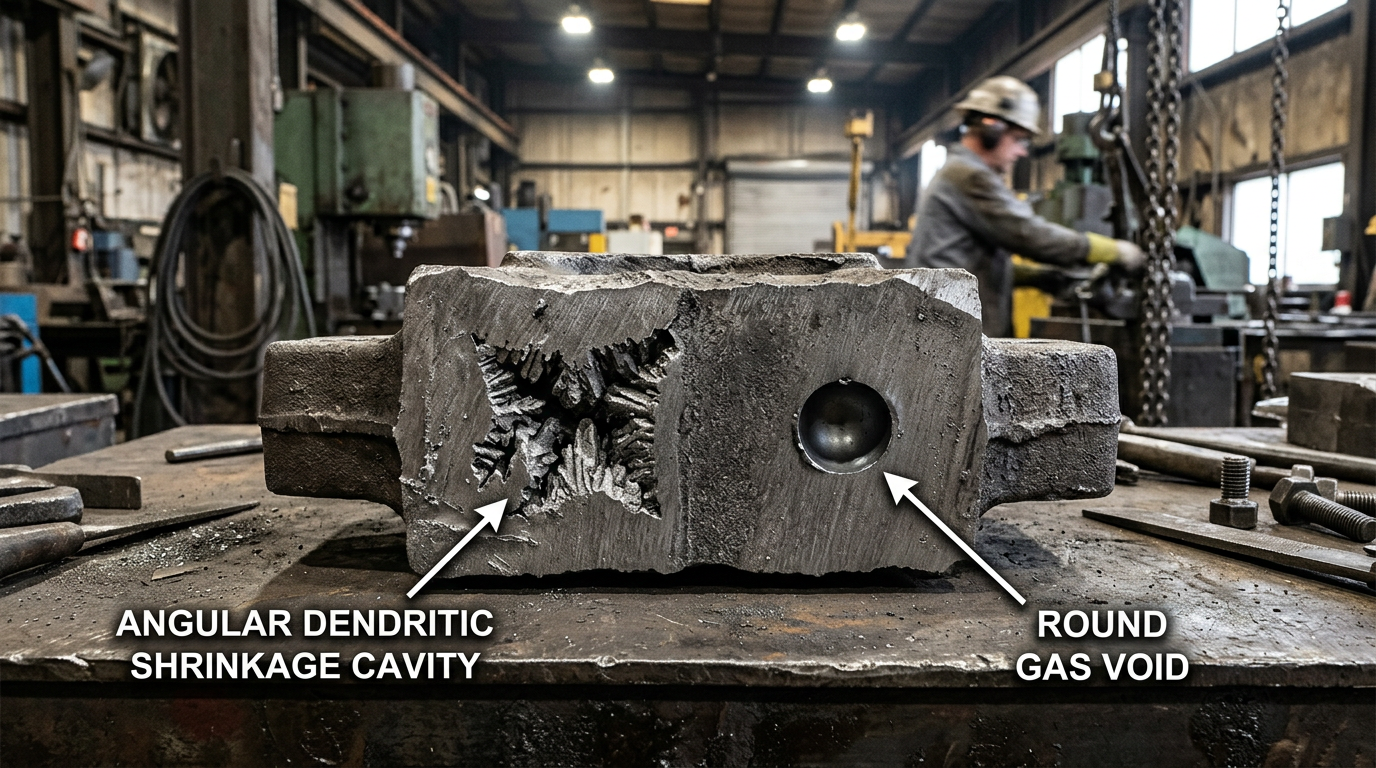
Carbon steel and stainless grades are the worst offenders. Carbon steel shrinks roughly 3-4% by volume during solidification, and alloys with wide freezing ranges (like CF8M stainless) develop sponge-type microporosity that hides inside thick sections. Gray iron, by contrast, benefits from graphite expansion that partially self-feeds thin sections.
Prevention starts with gating and risering design. The riser must solidify after the casting section it feeds, and the feed path must remain open throughout solidification. Sand type directly controls the solidification front direction. Stainless Foundry & Engineering improved scrap by 1.5% on a CF8M pattern with over 50,000 successful pours just by adjusting riser sleeve type and cope height.
ASTM A802 classifies shrinkage under Category B, with four severity levels. Level I shrinkage on a carbon steel pressure-containing casting is a different conversation than Level III on a structural bracket. Specify what you need — don’t default to the tightest level your spec allows.
Gas Porosity
Round, smooth-walled voids mean gas — dissolved hydrogen, nitrogen, or oxygen that couldn’t escape before the metal solidified. Surface blisters, subsurface blowholes, and clustered pin holes near the surface are all variants of the same mechanism.
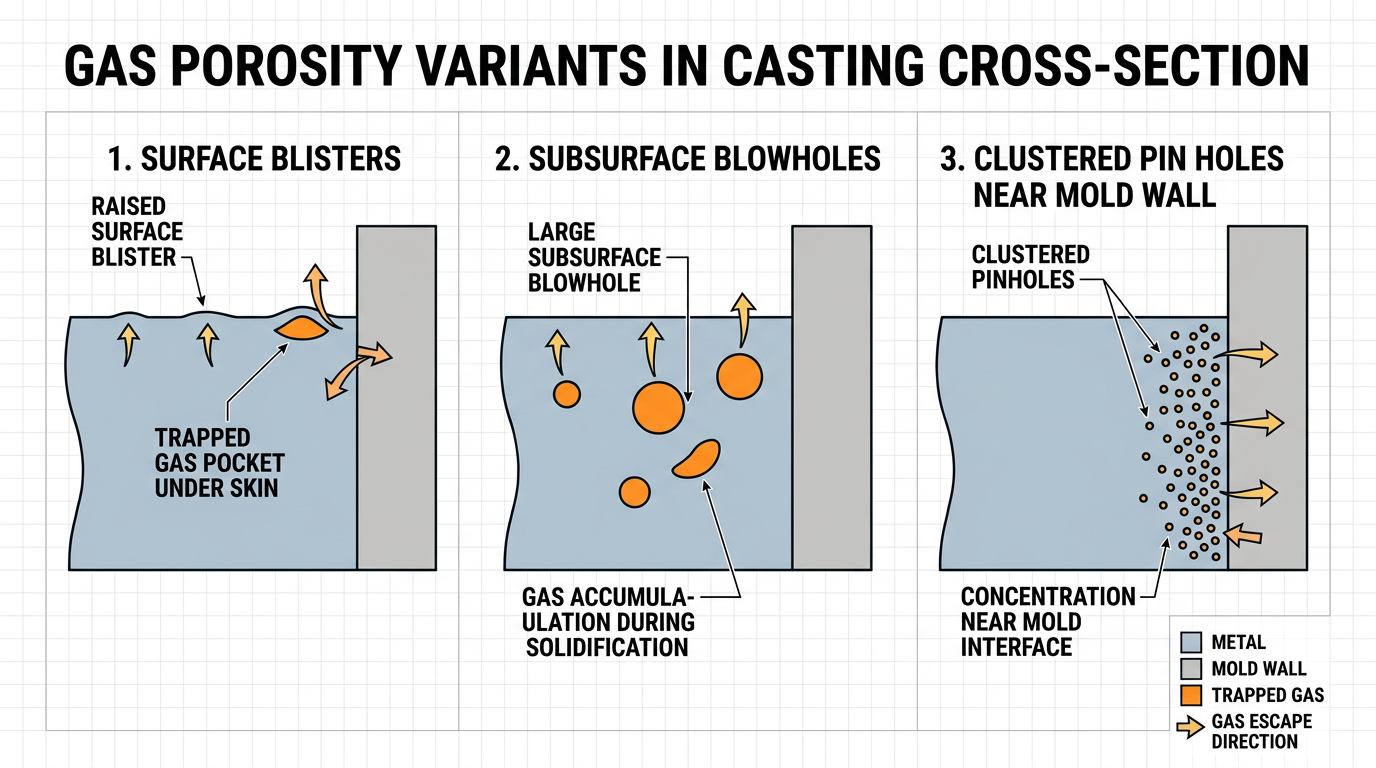
The root cause chain starts with moisture. Damp sand, wet ladles, humid ambient air, inadequately dried cores — all introduce hydrogen into the melt. I’ve tracked seasonal porosity spikes in Midwest foundries to nothing more than summer humidity. Winter brings its own problem: temperature swings trap condensation on mold surfaces that evaporates during pour.
Detection depends on location. Surface gas porosity shows up with visual inspection or penetrant testing (PT). Subsurface voids require radiography (RT). Ultrasonic testing struggles with individual gas holes — a casting can pass Level 2 UT acceptance and still reveal porosity when the machinist opens up a bore.
Control every moisture source: sand moisture content, ladle and mold preheat, core baking schedules, and mold venting. Gate overflow chutes should not exceed 60% of the inner gate’s cross-sectional area to maintain proper gas escape velocity.
Sand and Slag Inclusions
Sand holes, slag pockets, and non-metallic inclusions account for a disproportionate share of foundry scrap. In valve casting production, sand inclusions combined with porosity drive over 80% of total waste.
Mold and core quality accounts for 40-50% of overall foundry scrap — making sand system control the single most impactful defect prevention point in any foundry. Loose sand from broken mold edges, eroded cores, or poorly mixed binder systems gets trapped as the metal fills.
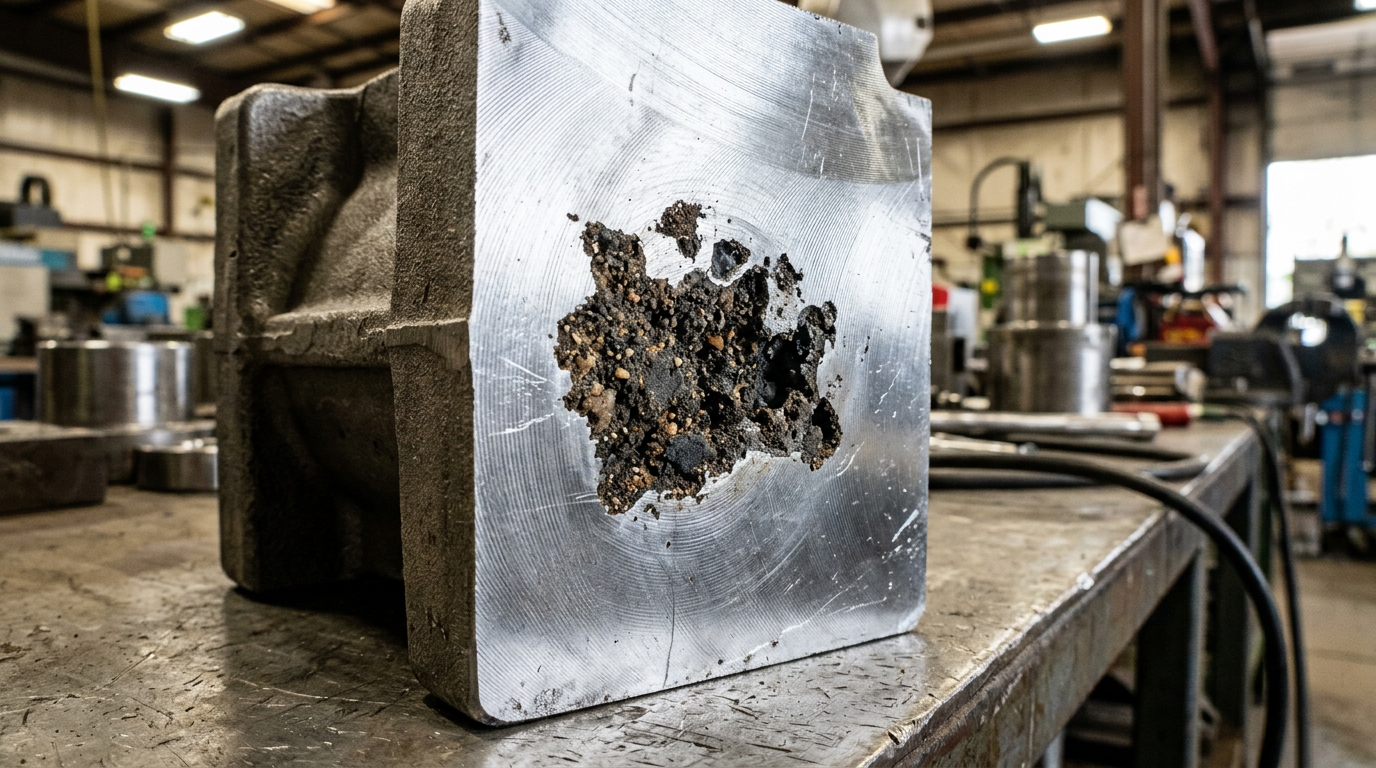
Slag inclusions come from inadequate skimming or gating that fails to trap oxidation products. Ceramic foam filters catch most slag, but they cannot compensate for a melt poorly deoxidized in the ladle.
For critical castings, specify RT inspection — inclusions show as irregular dark spots with density differences distinct from shrinkage or gas. ASTM E446 covers castings up to 2 in. wall thickness; E186 handles 2-4.5 in.; E280 extends to 12 in.
Hot Tears
Hot tears form during final solidification when the metal has contracted enough to generate tensile stress but hasn’t developed enough strength to resist it. They appear as ragged, oxidized cracks at section transitions, sharp internal corners, or where cores restrict contraction.
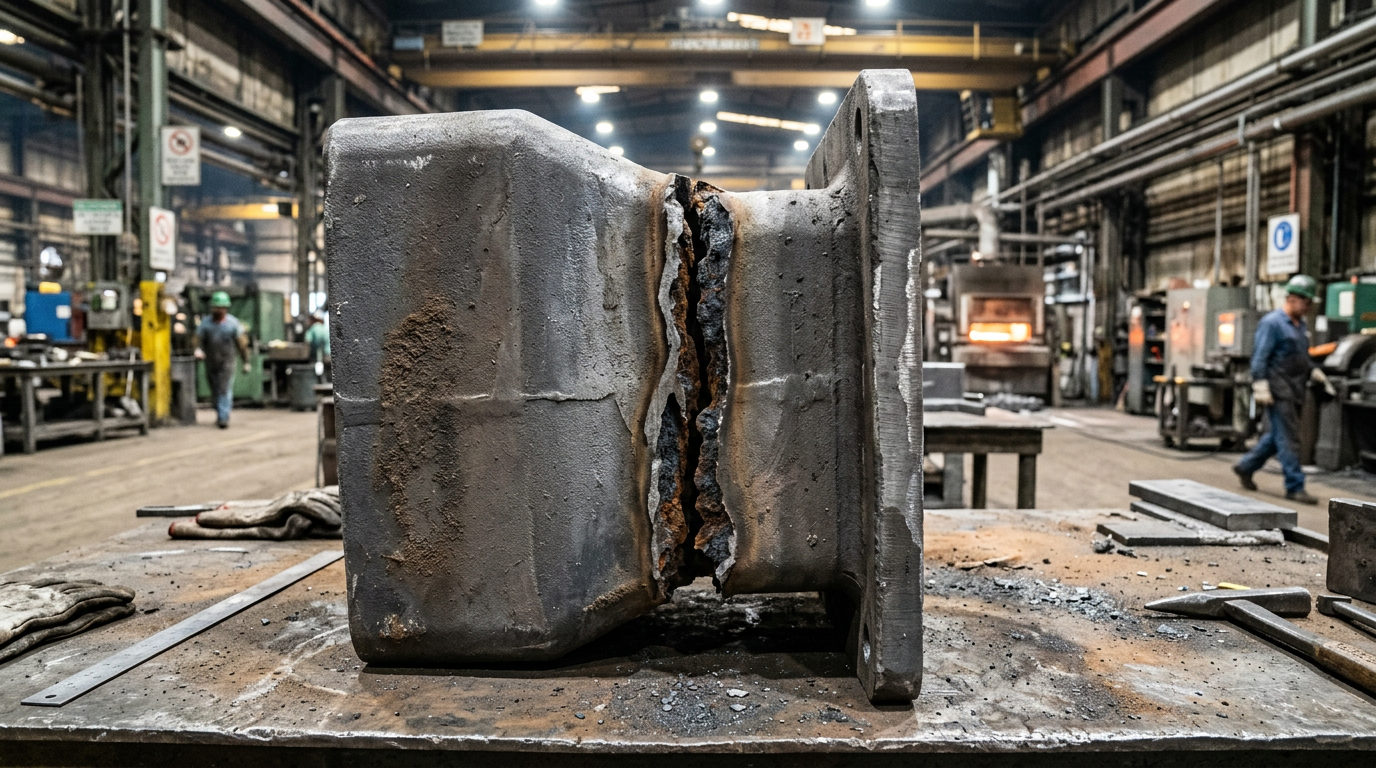
Carbon steel is particularly susceptible because of its high solidification shrinkage and relatively low hot strength. Ductile iron performs better — graphite nodules relieve stress concentration — but poorly designed junctions still tear.
Any surface-breaking tear should be repaired regardless of your acceptance standard. Hot tears are stress concentrators that propagate under cyclic loading. Design prevention means generous fillets (minimum 1/4 of wall thickness), uniform section transitions, and collapsible core materials that yield as the casting contracts.
Misruns and Cold Shuts
A misrun means the metal solidified before reaching the mold extremities. A cold shut forms when two metal fronts meet but fail to fuse, trapping oxide film at the interface.
Both trace to insufficient superheat, excessively long flow paths, or inadequate gating capacity. Carbon steel needs higher pouring temperatures than gray iron for equivalent wall thickness. Increase gate area or redesign the part to reduce maximum flow length. Misruns are always rejectable — there is no acceptance level for an incomplete casting.
Metal Penetration
Metal penetration produces a rough, fused sand-metal surface where liquid metal infiltrates between sand grains — a sandpaper skin that no amount of shot blasting removes.
High pouring temperature and low sand refractoriness allow physical penetration. In steel castings, manganese and iron oxides react with silica sand to form low-melting-point fayalite that wicks metal deeper into the mold wall.
Use finer sand grain size, apply refractory coatings (zircon or alumina washes), and keep pouring temperature at the minimum that ensures complete fill. Penetration is cosmetic on non-machined surfaces but structural when it reduces effective wall thickness.
Mold Shift and Warpage
Mold shift produces a visible offset between cope and drag. Warpage appears as dimensional distortion during cooling or heat treatment.
Shift is a mold assembly problem — worn flask pins, loose core prints, inadequate clamp pressure — completely preventable with tooling maintenance.
Warpage is more insidious. Unequal cooling rates create residual stress that distorts the casting during cooling or subsequent heat treatment. Long, thin sections and asymmetric geometries are highest-risk. Stress-relief heat treatment before machining catches most warpage before it becomes a tolerance failure.
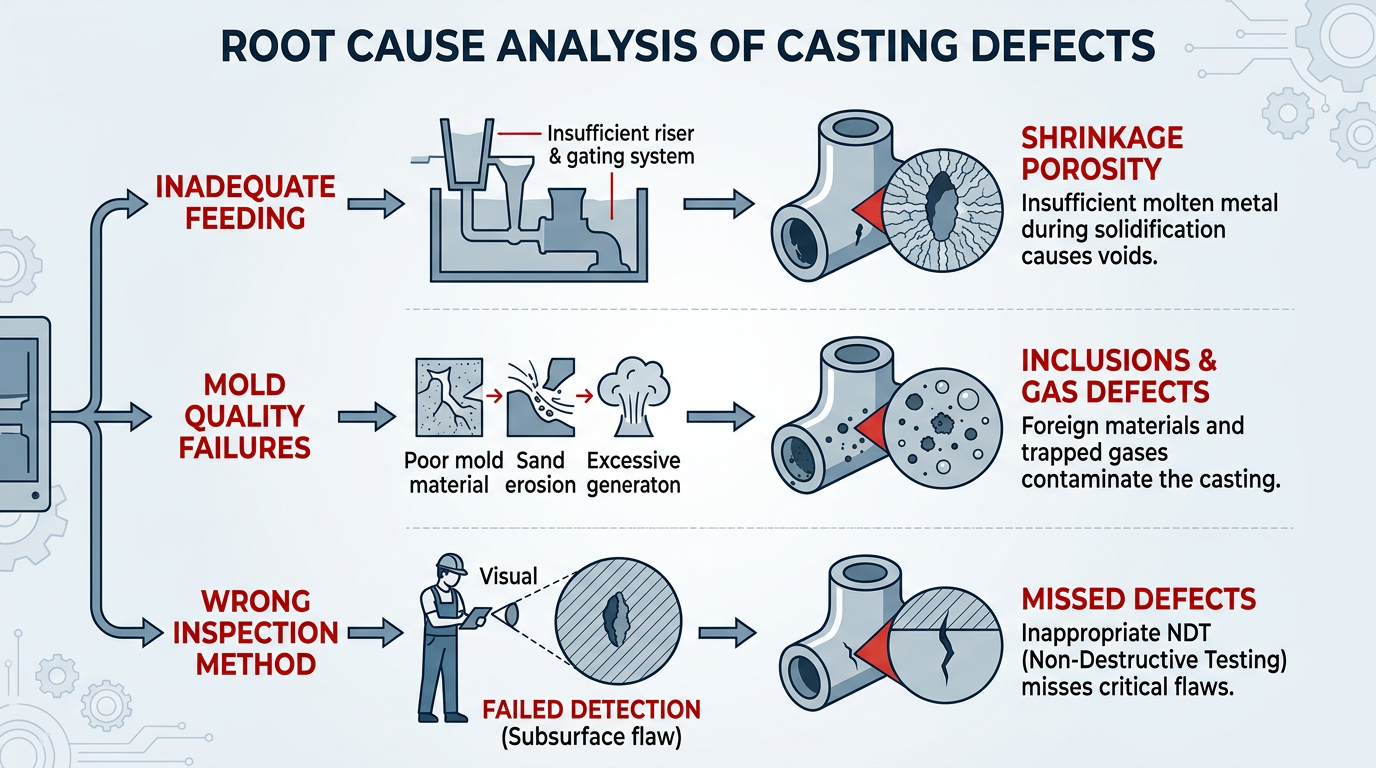
The 3 Process Failures Behind Most Casting Rejections
Every defect in this list traces back to one of three systemic failures. I’ve seen these patterns in foundries that skip root cause analysis and just keep adjusting parameters.
Inadequate Feeding Design
Shrinkage, the single largest rejection driver, is a gating and risering problem. On a valve body or pump housing running high scrap, redesigning the gating system alone will often pull the rate down. No alloy change, no equipment upgrade, just better engineering of feed paths and directional solidification.
Mold and Core Quality Failures
Sand inclusions and gas porosity share a common upstream cause: sand system failures. Moisture control, binder ratios, compaction uniformity, core baking — when any of these drift, defect rates climb. A foundry-wide initiative targeting 28 pattern numbers achieved a 2.65% overall scrap reduction, translating to $514,000 in annual savings.
Wrong Inspection Method
Castings that pass UT and RT but reveal porosity during machining are not inspection failures — they’re method selection failures. UT cannot reliably detect individual gas holes. If your critical surfaces will be machined, combine RT for subsurface detection with PT or MT for surface-breaking indications. Any defect within machining depth should be rejected regardless of what the radiograph accepts.
Making the Accept or Reject Decision
ASTM A802 gives you four severity levels across nine defect categories for steel castings — but it only sets the framework. The actual acceptance criteria come from your purchase specification, negotiated between foundry and buyer for the specific application.
Identify the defect type visually, confirm with appropriate NDT (RT for subsurface, MT/PT for surface), classify severity per your applicable standard, then evaluate against the part’s service conditions — not just the spec minimum. A Level III shrinkage indication on a counterweight is cosmetic. The same indication on a valve body operating at 600 psi is a rejection.
Material selection remains 80% of casting success. The right alloy matched to the right solidification design eliminates most of these defects before the first pour. Get the metallurgy right and the process follows.