
Every week someone sends me a drawing with +/-0.5 mm on every dimension and asks if sand casting can hold it. My first question back: which sand casting process? Green sand on an automatic line, no-bake with resin-bonded cores, and shell molding produce tolerances that span five CT grades — from CT8 to CT13. Treating “sand casting” as one tolerance class is the fastest way to either over-specify and overpay, or under-specify and get parts you cannot use.
The other half of precision — surface finish — rarely appears on casting tolerance guides at all. That gap costs engineers real money when they discover as-cast surfaces cannot meet their functional requirements. Here is what the numbers actually look like, broken down by process variant and part size.
Tolerance Range by Sand Casting Process
Shell molding holds CT8, overlapping permanent mold territory. Automatic green sand molding achieves CT9. Resin-bonded (no-bake) processes sit at CT9 to CT10. Manual green sand casting falls in CT10 to CT12, and large castings on fully capable sand lines extend to CT12 through CT14.
That five-grade spread — CT8 to CT13 — is wider than any other casting process family. Die casting spans CT4 to CT6. Investment casting covers CT5 to CT7. Sand casting’s range means the process you choose within the sand casting family matters as much as choosing sand casting in the first place.
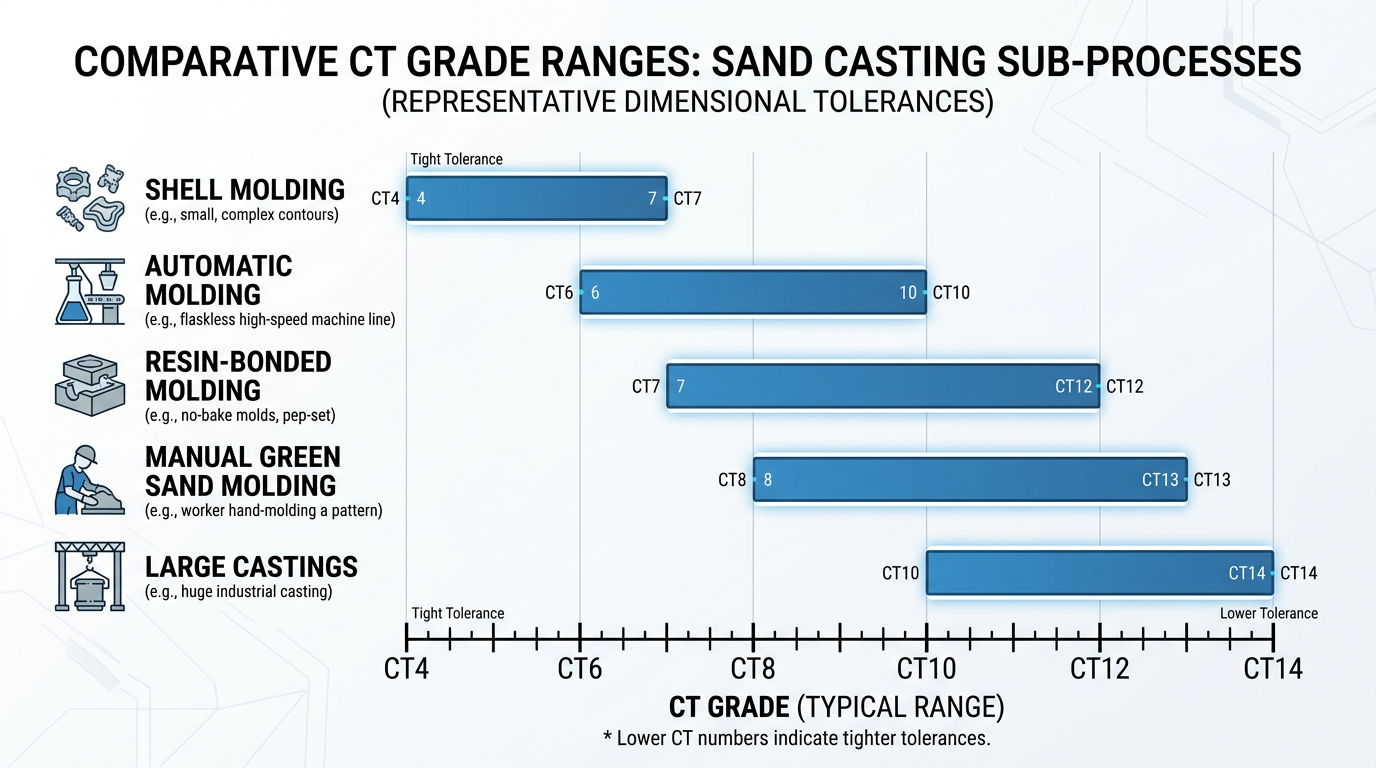
For a design engineer writing an RFQ, this hierarchy translates into a practical rule: specify the mold type alongside the tolerance class. A drawing that says “sand casting, CT10” without specifying no-bake or automatic green sand leaves the foundry guessing — and foundries price uncertainty conservatively.
What CT Grades Mean in Actual Dimensions
A CT10 rating means nothing until you attach it to a dimension length. At 25 mm, CT10 gives you +/-1.3 mm. At 100 mm, the same CT10 grade widens to +/-1.8 mm. At 1,000 mm, you are looking at +/-4.0 mm. The relationship is non-linear — tolerance grows with dimension length, but not proportionally.
Here is a practical reference for the grades most relevant to sand casting:
| Dimension Range | CT9 | CT10 | CT11 | CT12 |
|---|---|---|---|---|
| Up to 10 mm | +/-0.74 mm | +/-1.0 mm | +/-1.5 mm | +/-2.0 mm |
| 25-40 mm | +/-0.9 mm | +/-1.3 mm | +/-1.8 mm | +/-2.5 mm |
| 100-160 mm | +/-1.3 mm | +/-1.8 mm | +/-2.6 mm | +/-3.6 mm |
| 400-630 mm | +/-2.0 mm | +/-2.8 mm | +/-4.0 mm | +/-5.6 mm |
| 1000-1600 mm | +/-2.8 mm | +/-4.0 mm | +/-5.6 mm | +/-8.0 mm |
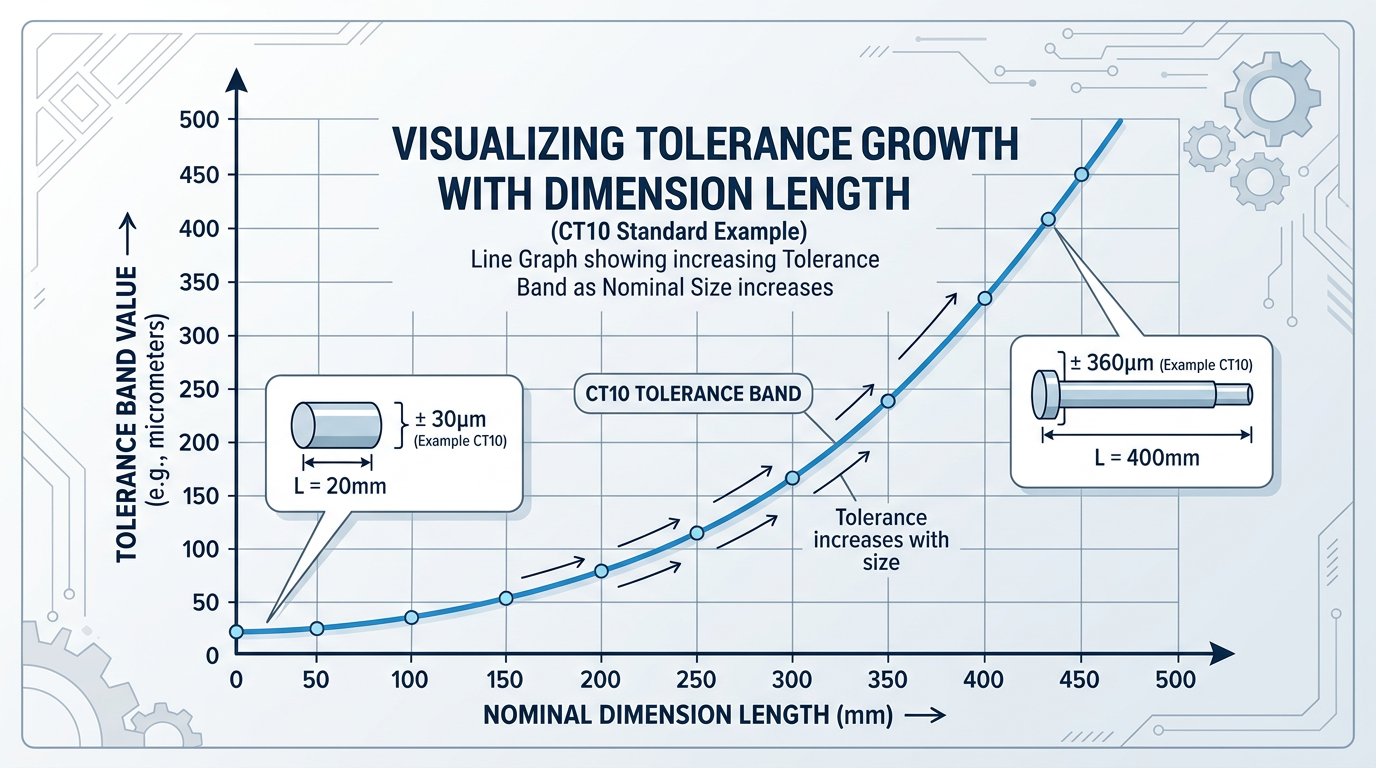
These values come from ISO 8062-3. Without this translation, “CT10” on a drawing is a label, not a specification.
The most common mistake I see in new patterns is assuming tolerance is a percentage of dimension. It is not. A +/-1.3 mm tolerance at 25 mm is 5.2% — but the same CT10 at 1,000 mm is only 0.4%. Engineers who apply a flat percentage overestimate tolerance on small features and underestimate it on large ones. Always reference the ISO table for the specific dimension range, not a rule of thumb.
Surface Finish by Sand Type
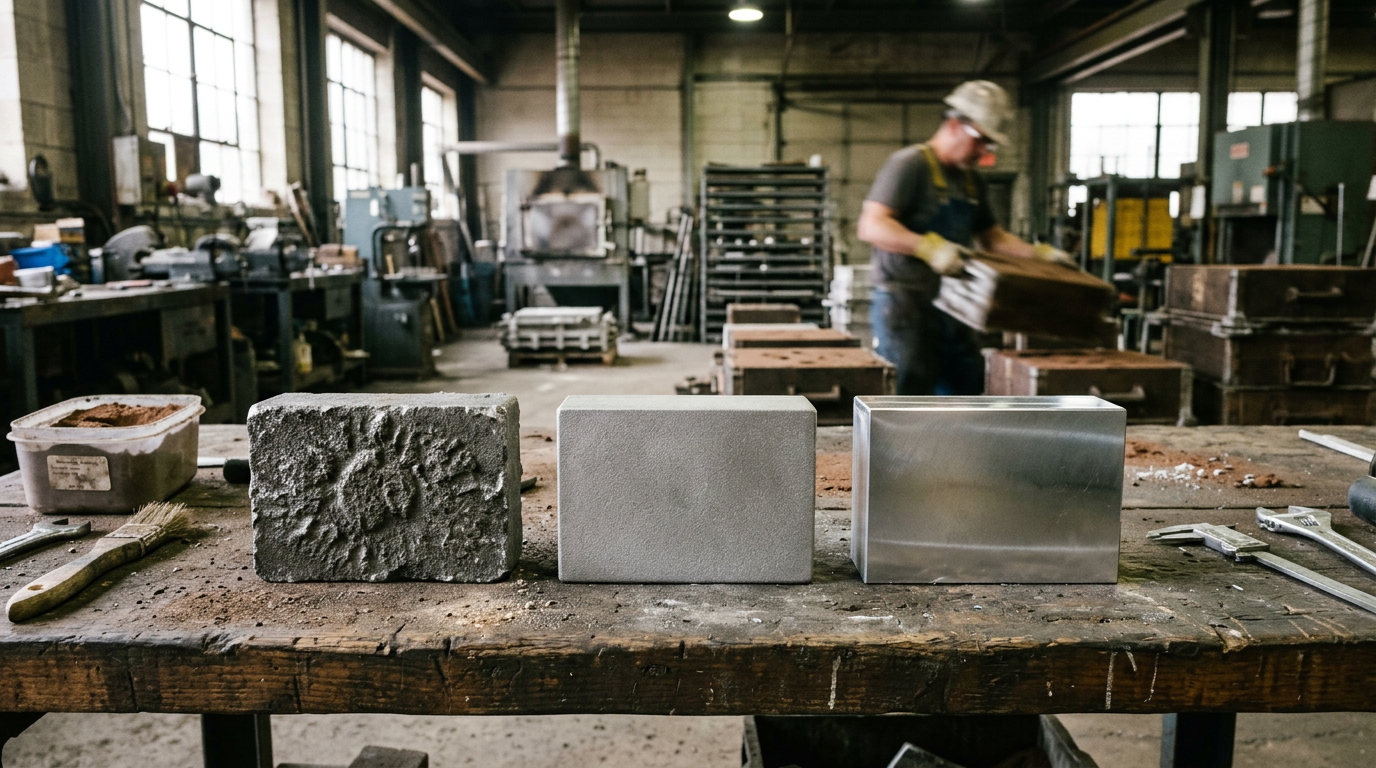
Green sand castings come off the line at Ra 25 um or rougher — shell-molded parts can hit Ra 1.6 um without any post-processing. That 15x range determines whether a surface can seal, bear load, or function as a mating face without machining.
Here is what each process delivers:
- Green sand (manual): Ra greater than 25 um (500-900 RMS). Visible sand grain texture. Acceptable for structural brackets, counterweights, non-contact surfaces.
- Green sand (automatic): Ra greater than 25 um (250-500 RMS). Tighter compaction improves consistency but does not fundamentally change surface character.
- Resin-bonded (no-bake, fine sand): Ra 3-6 um (75-150 RMS). Suitable for gasket faces with soft gaskets, low-pressure sealing.
- Shell molding: Ra 1.6-3.2 um (63-125 RMS). Approaches investment casting quality without the tooling cost premium.
Moving from green sand to resin-bonded sand delivers roughly 75% surface finish improvement — often enough to eliminate a machining operation on non-critical sealing surfaces. Before specifying a surface finish number, ask the functional question: what does this surface need to do? Bearing surfaces and valve seats require machining regardless of sand type (Ra 0.8-3.2 um). Structural brackets and covers function perfectly with as-cast finish.
One practical optimization: sand grain fineness hits a ceiling around AFS GFN 67. Finer sand beyond that threshold costs more without meaningfully improving surface quality. If your foundry quotes premium sand charges to chase a smoother finish, check whether you have already passed the point of diminishing returns.
Factors That Shift Tolerance in Practice
Pattern Quality
Before you pour, check the pattern. I have seen more tolerance problems from worn patterns than from any process variable. A wood pattern with 5,000 cycles of wear introduces dimensional drift that accumulates invisibly. Metal patterns hold tighter, longer — but even aluminum patterns degrade at the parting surfaces. The pattern is the master reference for every casting dimension. If the master is off, no amount of process control fixes the result.
Non-Uniform Shrinkage
Applying a single shrinkage percentage — 1% for gray iron, 2% for steel — works on simple geometries. On complex parts, it fails. Thick sections connected to thin ribs cool and contract at different rates, causing geometry-dependent distortion. I once pulled a ductile iron gearbox housing where the engineer applied a uniform 1%. The bearing bore pockets came out unmachinable because the thick bosses pulled the thin walls inward during cooling. A 0.5% pattern error combined with that shrinkage miscalculation scrapped the entire run.
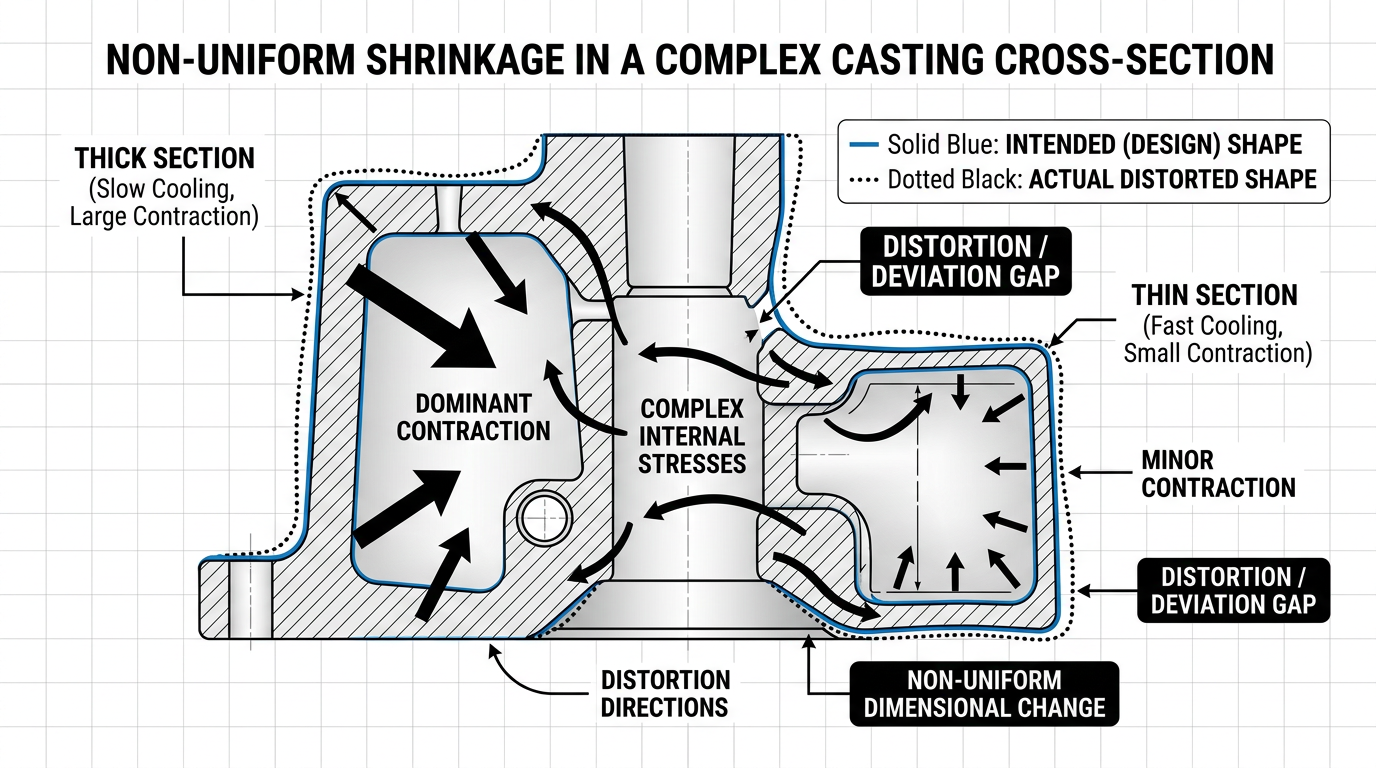
Shrinkage is not one number — it is three distinct phases (liquid contraction, solidification shrinkage, solid-state contraction) happening at different rates in different sections of the same casting.
Parting Line Location
Dimensions that cross the parting line are always less precise than dimensions contained in a single mold half. Cope-to-drag alignment introduces additional variation — typically +/-0.2 to 0.25 mm on top of the nominal tolerance. For critical dimensions, design them into one mold half whenever possible. If a feature must span the parting line, add machining stock and finish it.
When to Machine and When to Leave As-Cast
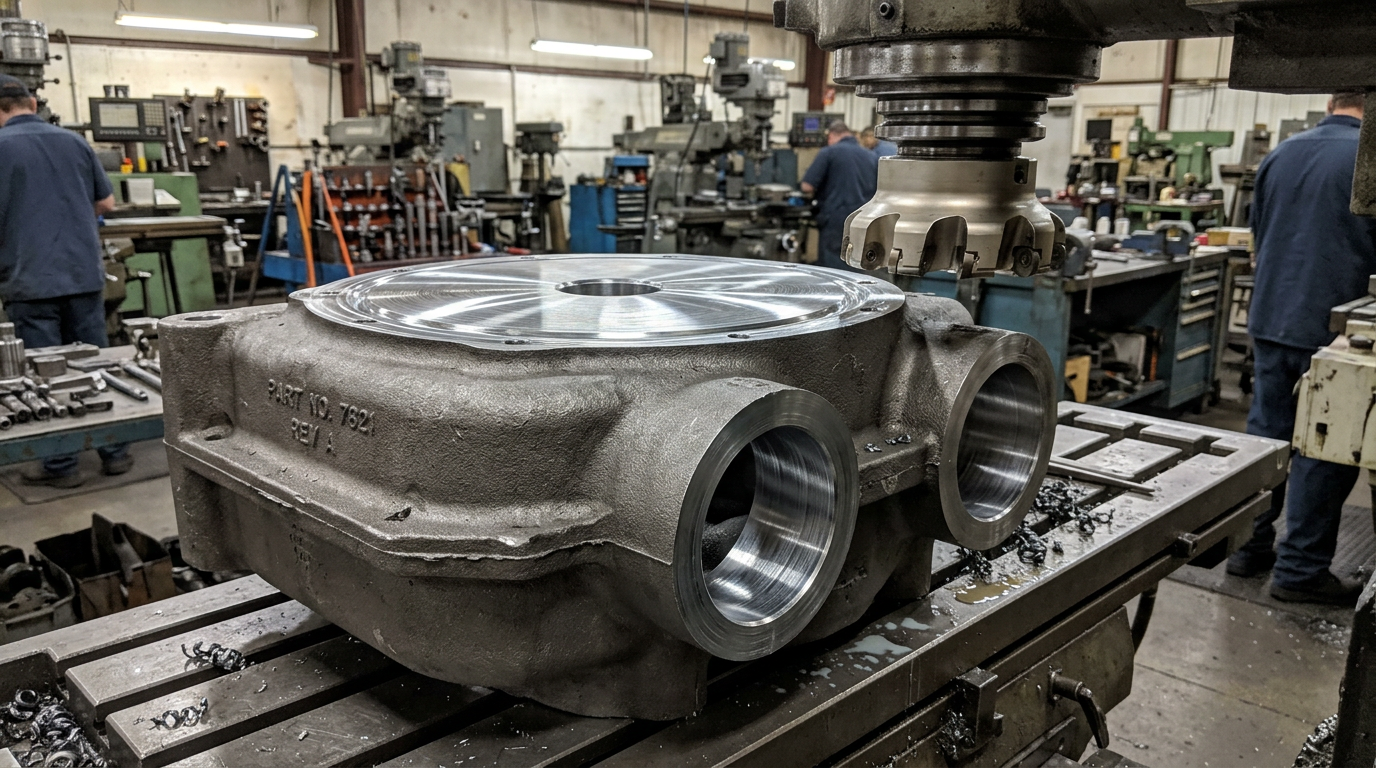
The decision is not binary. Most castings have a mix of as-cast and machined surfaces. Plan machining stock of 3-4 mm (roughly 1/8 inch minimum) on any surface requiring tighter tolerance or smoother finish than the as-cast process delivers.
Leave As-Cast
Non-contact structural surfaces. Cosmetic surfaces that will be painted or coated. Features where the as-cast tolerance (referenced from the CT grade table above) meets or exceeds the drawing requirement. Internal passages where machining access is impractical.
Machine After Casting
Mating surfaces and bearing bores — these almost always need machining. Sealing faces that contact O-rings or gaskets (Ra below 3.2 um). Threaded holes. Any dimension tighter than the achievable CT grade for your process and part size. Foundries with in-house CNC machining capability can deliver finished, ready-to-install components without the coordination overhead of a separate machine shop.
The practical test: overlay your drawing tolerances on the CT grade table for your dimension lengths. Every dimension that falls outside the achievable range gets machining stock. Everything inside the range stays as-cast. This five-minute exercise during DFM review prevents expensive surprises at first article inspection.
Specifying Tolerances on Your Next RFQ
Stop specifying a single tolerance for the entire casting. Call out the sand process (green sand, no-bake, shell) alongside the CT grade. Reference the ISO 8062-3 table for the specific dimension ranges on your part — a 50 mm bore and a 600 mm overall length have different achievable tolerances even at the same CT grade.
Identify which surfaces are functional and which are structural. Functional surfaces get machining stock and finish callouts. Structural surfaces get as-cast tolerance with the appropriate CT grade. Surface finish specs belong on the drawing too — foundries that quote without Ra requirements are guessing at your needs, and guesses cost money in both directions. The RFQ that separates as-cast from machined dimensions, names the process, and references the standard gets the most accurate quote and the fewest first-article surprises.