
A ferrous investment casting still needs machining, but only on the minority of features whose print callouts exceed what any shell can hold. Threaded holes, bearing bores, seal seats, and bolt-circle locations always get cut. Most of the part’s remaining geometry arrives at print from the die.
Once the wax die is committed, the question is what lands on your dock. If you are still weighing investment casting against a sand-cast or bar-stock route, settle that first.
What Gets Machined on an Investment Casting
Four feature classes always get cut, regardless of die quality or shell system:
- Threaded holes. Thread form and pitch diameter are geometry the shell cannot produce. On a converted 8620 low-alloy steel engine component, Hayes Manufacturing and Eagle Precision Cast Parts reported that threads were the only machined feature class that survived the bar-stock conversion. The threads were cut after heat treatment, not before, because the thermal cycle can distort slender sections.
- Bearing bores and seal seats. Roundness, cylindricity, and the Ra the application demands require a cutter. No shell holds the combination of form tolerance and finish a rotating shaft needs.
- Sealing and gasket faces. Flatness plus finish.
- Mating flanges with bolt-hole patterns. Positional tolerance accumulates across a bolt circle and the die cannot hold that accumulation below assembly limits.
Alloy changes the cost of each cut. ASTM A48 Appendix X1.3 places gray iron Classes 20 through 35 in the “excellent machinability” group. X1.3.1 moves Classes 40 through 60 into “more difficult to machine.”
Cast CF8M is roughly 10 to 15 percent harder to machine than CF8, so each setup on a CF8M valve body takes longer than the same feature on an A216 WCB pump housing.
Which Features Can Ship As-Cast
Three feature classes need no cutter:
- External surfaces that carry no mating, sealing, or bearing function ship at the as-cast finish. Webs, ribs, and walls with generous clearance on an A536 ductile iron bracket need no cutter.
- Cored internal passages ship as-cast because no cutter ever enters them. Cores are blasted out or dissolved in a molten caustic bath. The passage must be dimensioned generously at DFM, because nothing corrects it after the fact.
- Cosmetic faces with no functional callout also ship as-cast, provided the gate was not placed on them.
Gate location is chosen at DFM so the stub lands on a surface that gets machined anyway, or on one that does not affect fit, form, or function.
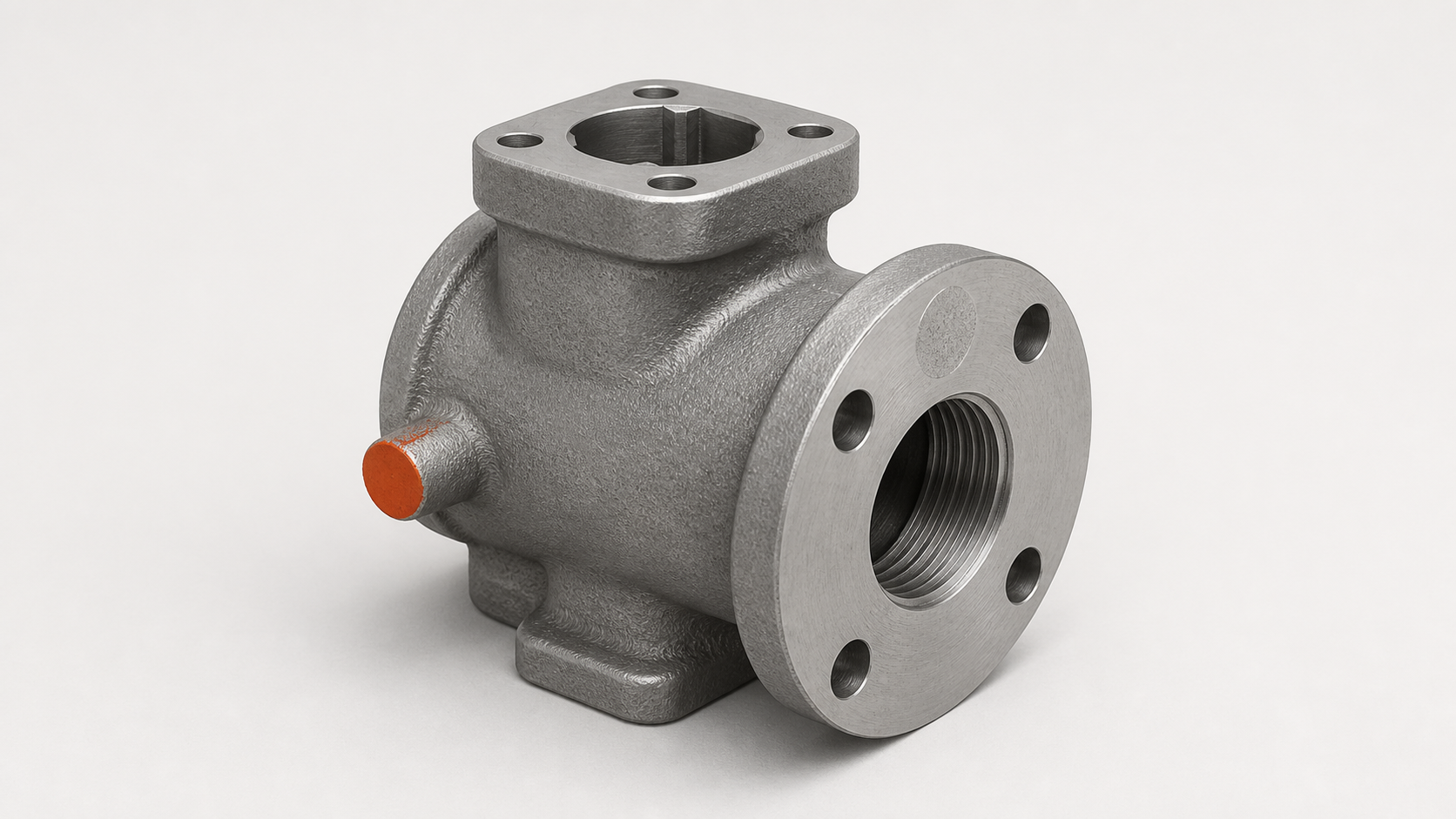
A gate stub on a functional face is a design outcome to negotiate before the die is cut, not a defect to reject on arrival. The stub is ground flush with abrasive wheels, blended rather than cut to a dimension, so that region must not carry a print callout.
What Machining Does Investment Casting Eliminate
Milling, turning, drilling, and grinding on bar or plate disappear when the die delivers near-net geometry. The honest baseline is a part hogged out of bar stock, not a forging. On a converted weldment, the largest removed operation is often the joining and its fixturing, not a milling pass.
On the Hayes Manufacturing 8620 conversion, every milling and turning operation the bar-stock route required came off the list. One feature class remained: threads. The redesigned casting came in roughly 25 percent lighter than the machined bar-stock design, with scrap largely eliminated.
No published ferrous source gives a setup count. What is verifiable is the operations list that disappears. Against a sand-cast blank, the investment shell removes the roughing passes that sand’s larger stock demands and the fixturing the coarser geometry requires.
What the First Article Should Tell You Beyond Dimensions
Straightening of investment castings, heated, on a hydraulic press with fixtures, is a routine step. Heat treatment can introduce growth, shrinkage, or distortion, particularly in long or slender sections.
Before you release the machining program, measure the cast datums. A cast datum the foundry gauged is not automatically the datum the machine shop can pick up. If the two do not agree, the first operation introduces an offset every subsequent cut inherits.
The Investment Casting Institute (ICI) convened a fourteen-panelist consensus in 2024 that framed the first article as more than a dimensional check. It is also an approval of metallurgical soundness. Failing to correct the drawing at that stage can cost hundreds of thousands of dollars.
Fluorescent penetrant inspection looks for cracks whose origins include knockout, grinding, heat treatment, and straightening. Bad casting quality produces bad finish even on machined faces. A cut face is not a clean slate.
Should the Foundry or a Separate Shop Cut the Part
The datum scheme on the drawing must match the GD&T protocol regardless of who holds the cutter. A machined casting drawing helps even when the foundry does no machining, because the datum structure is the buyer’s drawing obligation.
When an outside shop receives the casting, inspection coverage splits. Machine shops typically run NDT only on the areas they machined. A partial x-ray sampling plan can still surface a latent defect after machining.
When a bore opens into subsurface porosity on the second operation, one party owns it or two parties argue about it. A foundry that both pours and machines the casting holds one datum scheme, one inspection record, and one owner when the bore comes back out of round.
That continuity can be addressed by a single-source casting and machining operation. An RFQ that includes machining should carry a machined casting drawing and indicate preferred or designated machining locating areas.
Put the question to any foundry whose quote does not say: which faces will you machine, off which datums, and in how many setups.
Where Over-Specifying Sends the Part Back to Bar Stock
The most expensive mistake on a machined investment casting is specifying tight tolerance on a feature that was always going to be cut. The ICI consensus panel has seen parts revert to bar stock for no other reason, undoing the conversion the buyer chose investment casting to achieve.
Before you sign off the first article, flag the features that get machined. Ask whether the tolerance on each is achievable from the shell plus a finish pass, or whether it demands the stock and setups that push the part back toward bar-stock economics.
A machining drawing also tells the foundry which areas do not matter, because they are about to become chips.