Are you comparing casting prices — or total landed costs? The answer determines whether your cost analysis is worth the spreadsheet it lives on. I’ve reviewed hundreds of casting RFQs where procurement teams picked the process with the lower per-part quote and ended up paying 30-40% more once machining, scrap, and logistics hit the invoice. One gearbox housing project ran a 50% scrap rate after machining because porosity defects hid inside the casting walls — and every scrapped part carried the full machining cost with it.
Per-part casting price is not a cost comparison. Total landed cost — tooling, secondary operations, scrap, lead time, and supply chain markup — is the only metric that tells you which process actually saves money. At volumes under 5,000-10,000 units, that number typically favors sand casting by a wider margin than the casting quote alone suggests.
Tooling Cost
Sand casting patterns run $500 to $7,500 depending on size and complexity. Die casting molds start at $5,000 for small zinc parts and climb to $75,000 or more for large aluminum dies. That 10x-to-50x difference in upfront tooling cost is where most comparisons begin — and where too many end.
The real value of cheap tooling goes beyond the purchase order. A $1,500 sand casting pattern lets you validate geometry, test fit, and confirm machining approaches before you commit capital. If the design changes — and in my experience, first-run designs change more often than not — you’ve lost $1,500, not $22,000. That’s not just a cost difference. It’s risk mitigation. Treating tooling cost as an option value rather than a line item changes how you evaluate early-stage projects.
Die casting molds last 100,000 to 1,000,000 shots, which matters at high volume. But a well-made aluminum sand casting pattern produces 10,000+ molds before refurbishment. For annual volumes under a few thousand parts, pattern longevity is rarely the constraint.
Where the Per-Part Crossover Actually Falls
Sand casting at $21 per part raw plus $11 machining gives $32 per finished part with a $1,500 pattern. Die casting at $8.20 per part plus $3 in machining savings brings finished cost to roughly $16.20 per part — but with a $22,000 mold. Run the arithmetic: break-even falls at about 1,298 parts.
At 1,000 parts, sand casting saves roughly $4,700. At 5,000 parts, die casting saves $58,500. At 10,000 parts, the die casting advantage hits $139,000. The per-part math is clear — and it’s also incomplete.
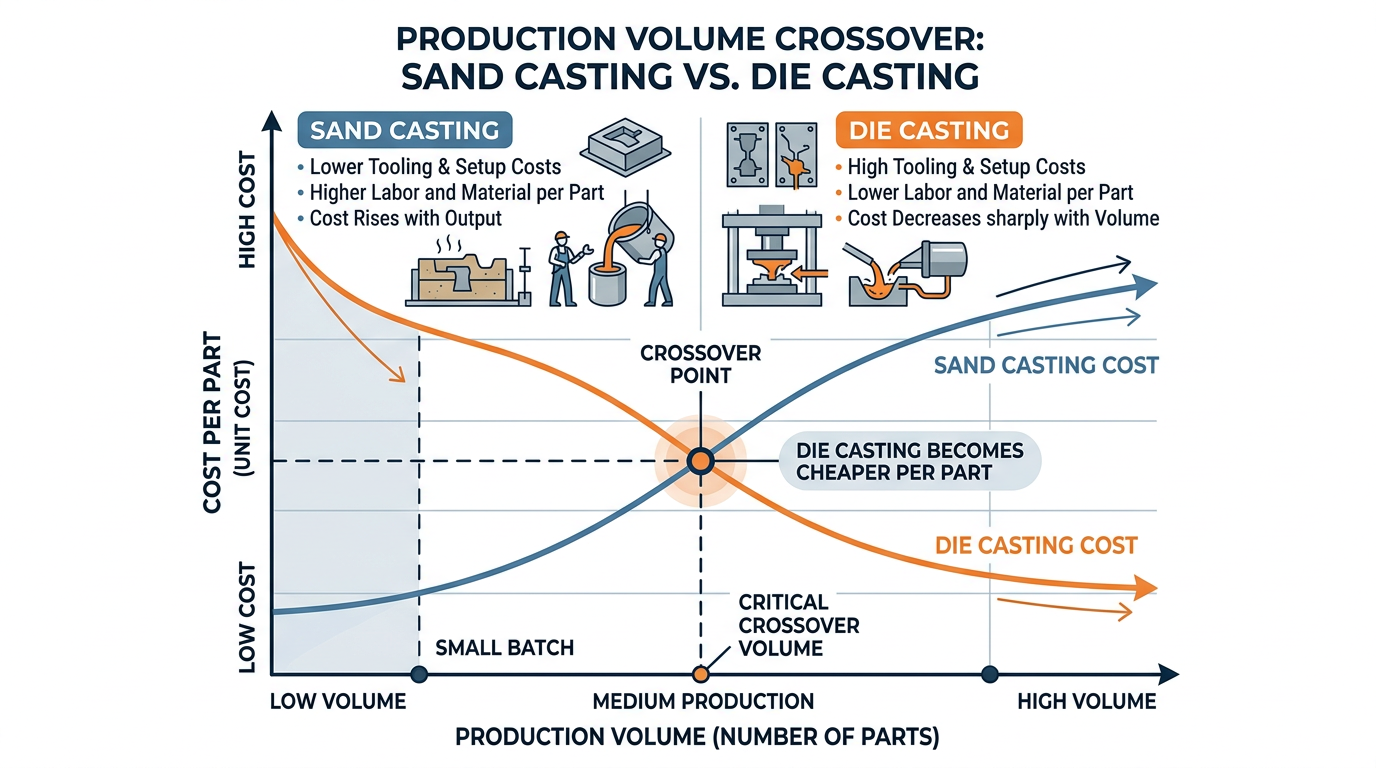
That 1,298-part crossover only holds when you compare casting price plus tooling in isolation. The moment you add below-the-quote costs — secondary machining, scrap, lead time, supply chain markup — the crossover moves much higher. The realistic break-even falls between 5,000 and 50,000 parts for typical industrial applications, depending on geometry and finish requirements. The low estimate works only when both processes deliver near-net-shape parts with minimal post-processing — a scenario that rarely describes real production.
Below-the-Quote Costs That Shift the Break-Even
Secondary Machining
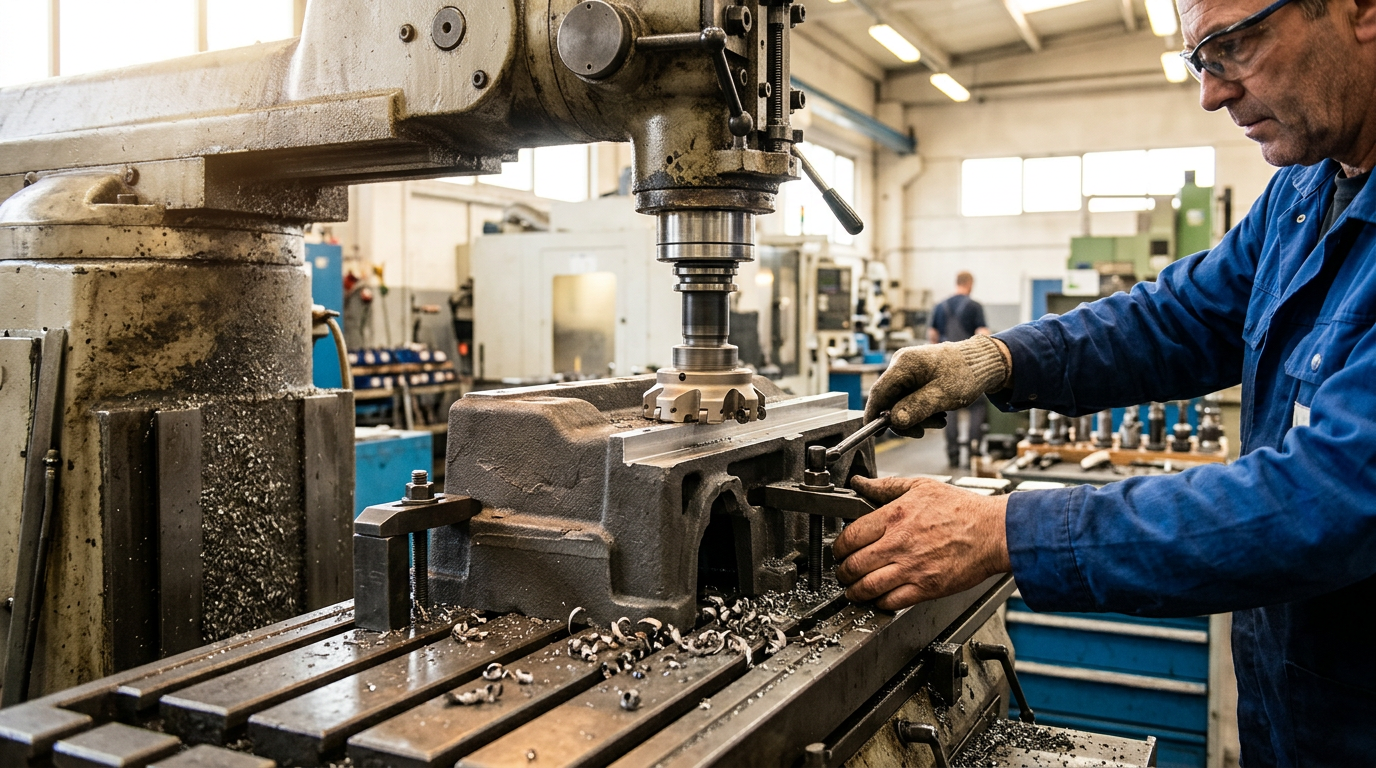
Sand castings hold tolerances of +/-0.5 to +/-2.0 mm with surface finish of 6.3-25 um Ra. Die castings achieve +/-0.1 to +/-0.5 mm with 1-2 um Ra. That precision gap means sand castings almost always need more machining.
Machining typically adds 20-60% to the raw casting price on sand cast parts. Die castings often need only deburring. This is die casting’s strongest cost advantage — when it applies. But many industrial parts only need tight tolerances on a few mating surfaces, not everywhere. Sand casting plus targeted CNC on critical features frequently beats die casting’s all-over precision at a fraction of the tooling investment.
Scrap and Rework
Scrap discovered after machining is the most expensive kind. You’ve already paid for the raw casting, the setup, and the machining time — then the part goes in the bin. One foundry reduced scrap from 13.8% to 2.7% on a single 5-lb pattern and saved an estimated $24,420 on that one part number. Across 28 patterns, a 2.65% average scrap reduction saved $514,000 annually.
Both processes generate scrap, but the financial impact differs by volume. At low volumes, each scrapped sand casting costs the full per-part price. At high die casting volumes, scrap rates of 2-4% are absorbed across a larger run. The question is whether your scrap rate multiplied by your per-part-plus-machining cost has actually been calculated — or just assumed.
Lead Time and Supply Chain
Die casting mold lead time runs 8-16 weeks. A sand casting pattern ships in 3-4 weeks — sometimes faster with 3D-printed tooling. That gap is not just a scheduling issue. It represents cost of capital tied up in waiting, delayed revenue from products not yet in market, and the competitive exposure of arriving late.
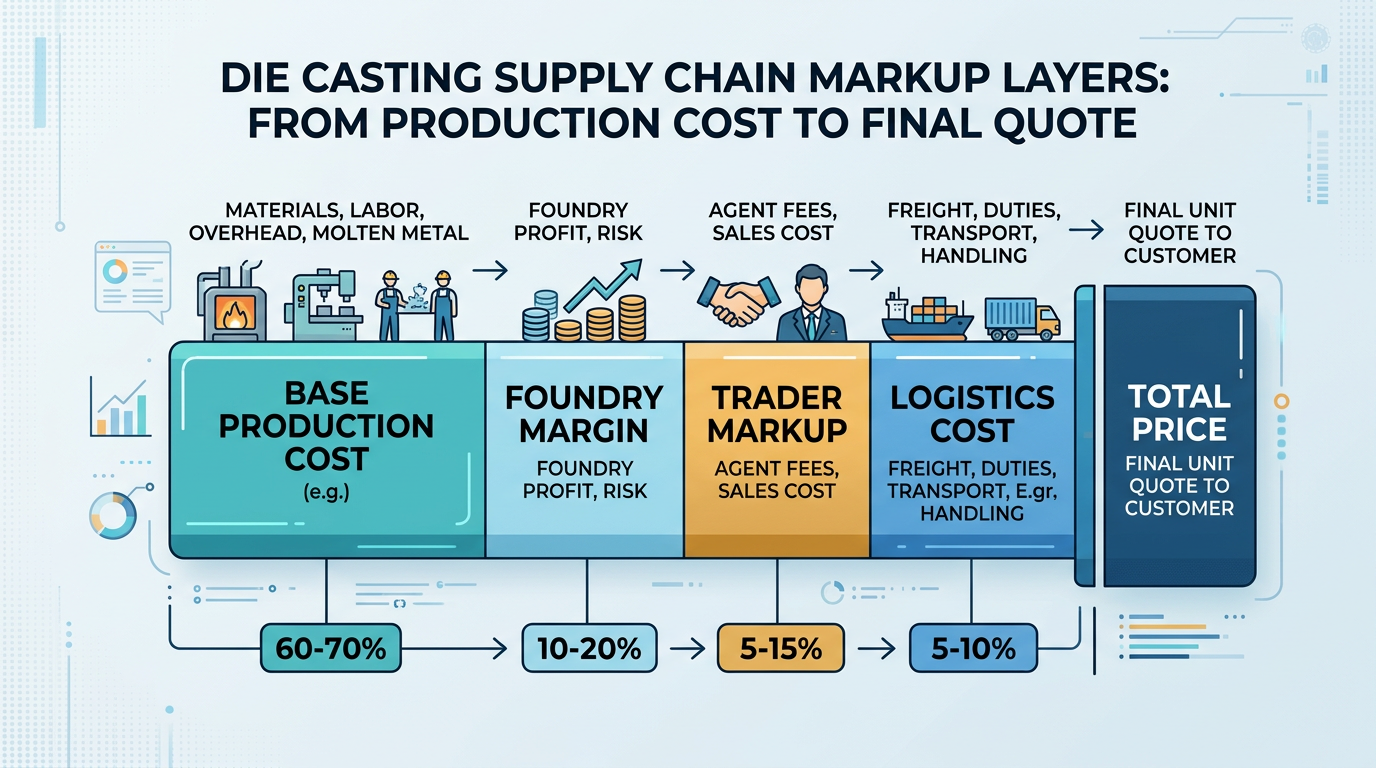
Supply chain markup compounds the problem. Aluminum die casting base production cost can run around $8.38/kg, but by the time quotes pass through foundry margins, traders, and logistics, final pricing lands near $24.20/kg — a nearly 3x markup. When you compare per-part quotes between sand casting and die casting, you’re often comparing two opaque numbers that obscure very different supply chain structures.
When Material Eliminates the Comparison
Before you build any cost spreadsheet, answer one question: what alloy does your part require?
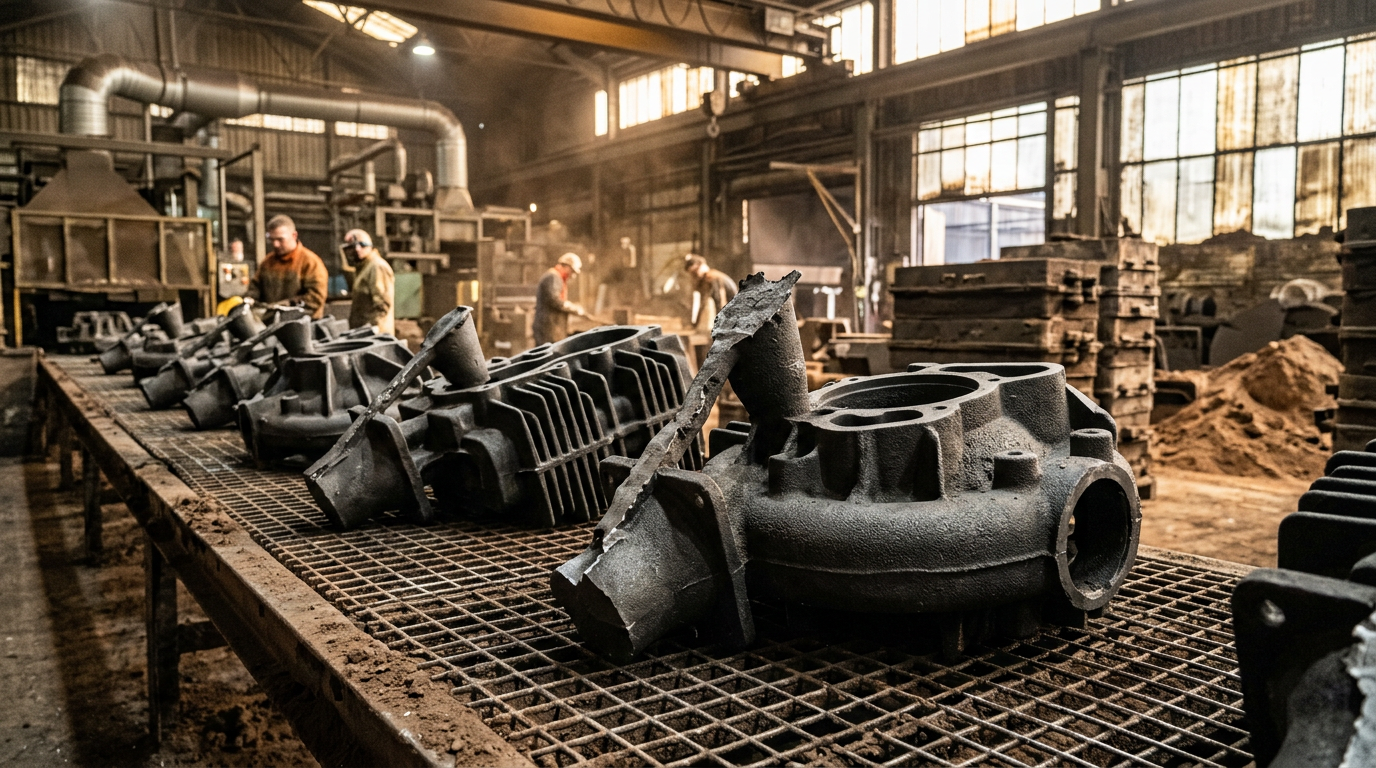
Die casting works with aluminum, zinc, magnesium, and some copper-based alloys. If your application calls for carbon steel, stainless steel, ductile iron, or gray iron, die casting is not an option at any volume. The ferrous metal melting temperatures destroy steel dies through thermal cycling and chemical attack. Kurt Foundry’s carbon steel and ductile iron castings serve exactly these applications where die casting cannot compete.
This eliminates a massive portion of industrial casting applications from the die casting column entirely. I’ve seen procurement teams spend weeks building detailed cost comparisons for steel parts, only to discover at the RFQ stage that no die caster will quote the job. Start with material. If your alloy is ferrous, sand casting is not the cheaper option — it is the only option.
For aluminum and zinc parts where both processes are viable, the cost comparison framework above applies in full. When investment casting enters the comparison, tooling costs run $6,000-$15,000 and per-part economics shift again — apply the same total landed cost framework, but with different inputs.
How to Build Your Cost Comparison
Stop comparing casting quotes. Start comparing landed costs. Here is the five-variable framework:
- Material filter. If your alloy is ferrous, stop here. Sand casting. If non-ferrous, continue.
- Tooling risk. Is this a proven design or a first iteration? Unproven designs get sand cast first. The $1,500 pattern is insurance against the $22,000 die that needs revision.
- Volume crossover. Calculate your break-even using actual per-part quotes plus tooling amortization. Then adjust: add secondary machining cost per part for each process. Add your historical scrap rate multiplied by per-part-plus-machining cost. The crossover shifts higher — often into the 5,000-10,000 range for parts needing any significant post-processing.
- Lead time cost. What does an extra 6-12 weeks cost your program? If you are launching a new product, the revenue delay alone can exceed the tooling savings.
- Supply chain transparency. Get quotes that break out casting cost, machining cost, and finishing separately. If a die casting supplier quotes a single number, you cannot validate the comparison.
When you factor in the total landed cost, the process that looks expensive on the casting quote frequently delivers the lower total. Before you RFQ, define your quality requirements on paper — then run the numbers with all five variables, not just the first two.