
CF8, CF8M, and CF3M share nearly the same 18% chromium base and strength minimums within a few ksi of each other. Yet the wrong pick among them can perforate a pump housing in months or sensitize a valve body at its first weld pass.
Most engineers reach these ASTM A351 codes holding a wrought grade they already trust — 304, 316, or 316L — and expect a clean one-for-one swap.
The equivalency map fixes the starting composition: 304 to CF8, 316 to CF8M, 304L to CF3, 316L to CF3M. Three service variables then decide which code belongs on the drawing — chloride exposure, welding without a post-weld solution anneal, and minimum service temperature. Get those three right and the composition takes care of itself.
What CF8, CF8M, CF3M, and CF3 Equal in Wrought Grades
CF8 is cast 304, CF8M is cast 316, CF3 is cast 304L, and CF3M is cast 316L. Each ASTM A351 code swaps the wrought designation for a foundry one while holding chromium, nickel, and molybdenum within a hair of its wrought twin.
One translation trips people up. CF8M is the cast equivalent of standard 316, not 316L. The true low-carbon version of 316L is CF3M — the drop from an 8 to a 3 marks the 0.03% carbon ceiling, not the molybdenum.
| Grade | Wrought equivalent | Carbon max | Molybdenum | Yield / tensile (min) |
|---|---|---|---|---|
| CF8 | 304 | 0.08% | none | 30 / 70 ksi |
| CF8M | 316 | 0.08% | 2–3% | 30 / 70 ksi |
| CF3 | 304L | 0.03% | none | 30 / 70 ksi |
| CF3M | 316L | 0.03% | 2–3% | 30 / 70 ksi |
Molybdenum is the only meaningful composition lever in that table, and the carbon ceiling is the only other. Chromium sits at 18–21% and nickel at 8–12% across all four grades, so strength and general corrosion resistance barely move between them.
Near-identical spec sheets are exactly why the grade call is a service-condition decision, not a spec-sheet lookup.
When Does Chloride Service Require CF8M or CF3M?
Molybdenum-bearing CF8M and CF3M earn their premium once chloride is a routine part of the service — seawater, brackish water, or chloride-bearing process streams. The 2–3% molybdenum resists the pitting and crevice attack that eats plain CF8 and CF3. In general industrial water or oxidizing service, CF8 or CF3 holds up just as well at lower cost.
Before you specify the grade, understand the service conditions — and the trap is defining chloride exposure by the steady-state number.
A set of 316L plate heat exchangers at a coastal hydroelectric plant ran on raw water at about 60 ppm chloride, comfortably inside the grade’s tolerance, and still perforated within months. During shutdowns, a water-inlet flaw let seawater at up to 30,000 ppm back into the system, concentrating in the crevices between the plates.
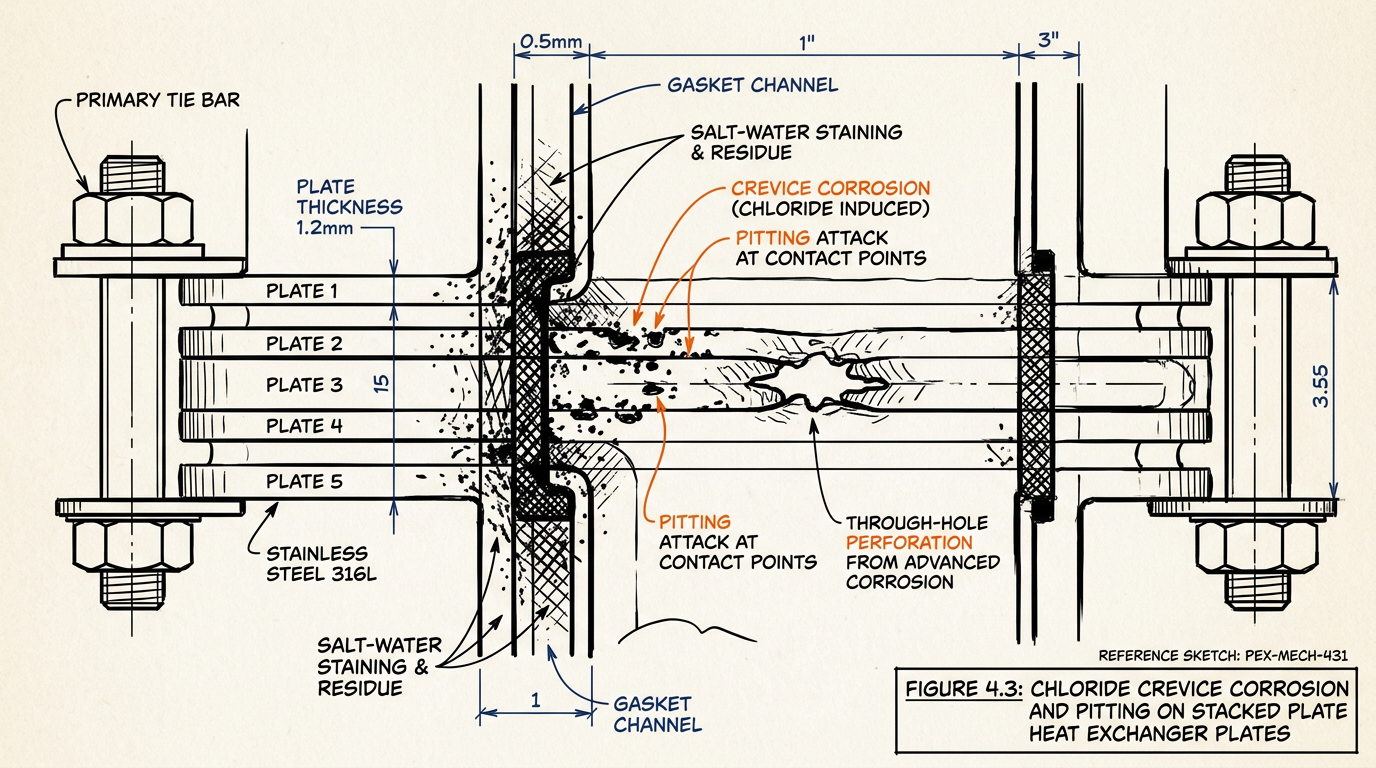
The grade was never wrong for its design condition; the design condition was wrong for the service.
Chloride is the dominant reason a pump or valve moves to molybdenum, but not the only one. Reducing acids — sulfur compounds, dilute acetic — call for CF8M or CF3M regardless of chloride. Oxidizing nitric-acid service gains nothing from molybdenum, making CF8 or CF3 the correct choice rather than the cheap one.
For genuinely chloride-driven duty, specifying CF8M or CF3M is the standard call — a duty Kurt Foundry pours to order as stainless steel castings.
Why Welded Service Favors CF3M Over CF8M
A cast part that will be welded and run in service without a post-weld solution anneal is where CF3 and CF3M become the safer default, not an optional upgrade.
Weld cooling holds the heat-affected zone in the 450–900°C range, and in that window chromium carbides precipitate along the grain boundaries of a higher-carbon grade. That strips chromium from the metal beside them and leaves a sensitized path for intergranular corrosion.
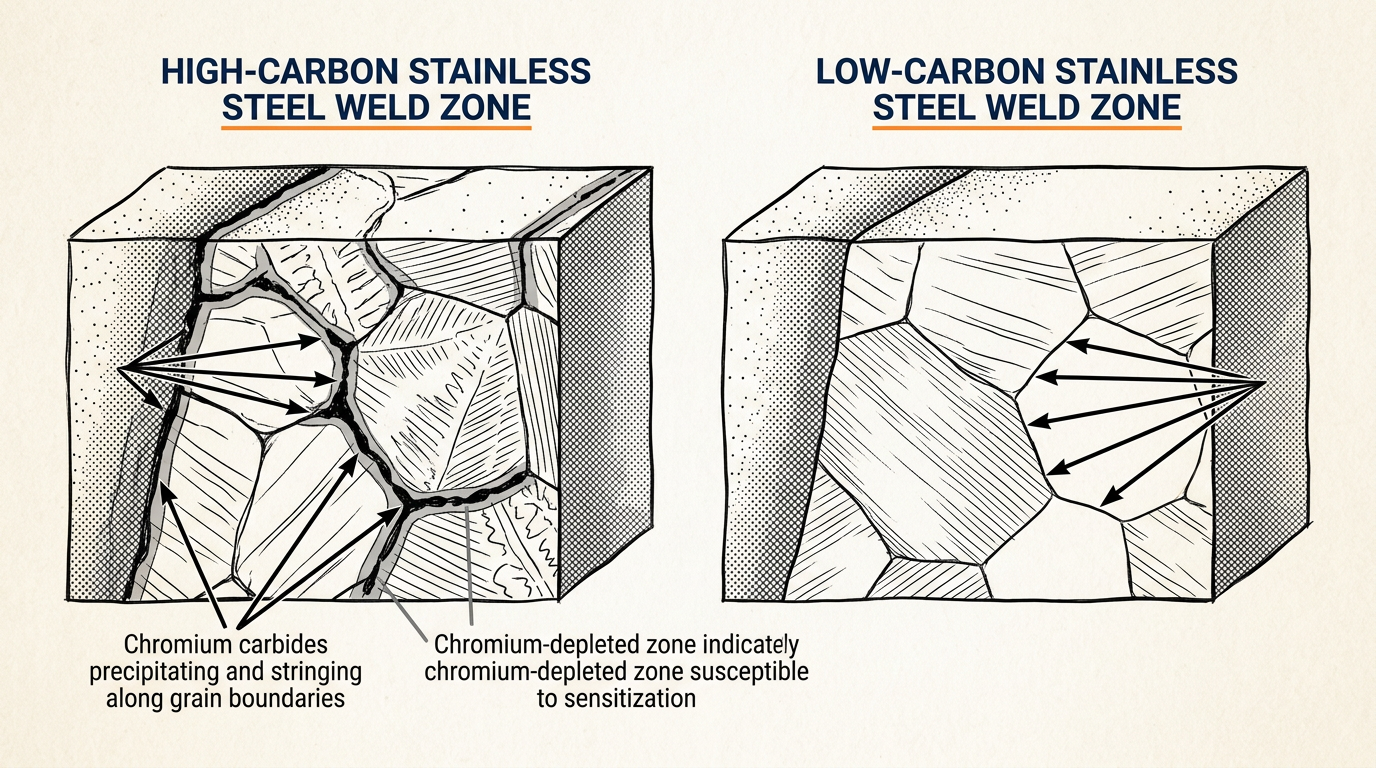
The 0.03% carbon ceiling on CF3 and CF3M exists for exactly this. Hold carbon low enough and there is not enough of it to build those grain-boundary carbides during welding.
The microstructure tells the whole story here: sensitization is a grain-boundary chemistry problem, and the defenses are starving it of carbon or dissolving the carbides back into solution.
That leaves two clean paths for a welded casting. Specify CF3M from the start and the low carbon does the work, or pour CF8M and follow with a full post-weld solution anneal to put the carbides back in. What you cannot do is weld a CF8M casting, skip the anneal, and expect 316-grade corrosion life.
I’ve seen this failure trace back to shops that welded a CF8M casting into service and skipped the anneal to save a furnace cycle. Re-pouring a welded wrought assembly as a single casting sidesteps the question entirely — no weld, no sensitization.
Minimum Service Temperature for CF8, CF8M, and CF3M
Cast 304 and 316 stay tough far below zero, so at low temperature the deciding factor is usually which specification governs the order, not which grade you picked. CF8 impact energy falls gradually from 125–215 ft-lb at room temperature to 37–70 ft-lb at −325°F, with no abrupt ductile-to-brittle transition.
ASTM A351 gives you minimums; what actually matters in the cold is that it requires no impact test on these grades at all, even at −325°F service. ASME SA351 takes the same position. The European EN 10213 does not — it mandates impact testing at ambient plus low-temperature qualification.
One North American supplier ran 69 production heats at liquid-nitrogen temperature; all but one cleared 20 ft-lb, and even that heat beat the 15/12 ft-lb minimum. The material is tough; whether you have to prove it on paper depends on the code stamped on the order.
So for a cryogenic valve body, the grade is rarely the constraint — the governing specification is. Pin down whether ASME or EN 10213 rules the order before anyone argues CF8 versus CF3.
Why CF8M and CF3M Are Not Literal Copies of 316 and 316L
Cast grades are not a one-for-one of their wrought twins, and two of the differences never appear on the equivalency table. Cast austenitic grades keep a few percent delta ferrite that wrought bar stock does not, and their solution anneal has to be matched to section thickness.
The ferrite is deliberate — it stops the casting from hot-cracking as it solidifies. Too much costs corrosion resistance and toughness, so corrosion-critical work caps it below 3% per ASTM A351. Wrought bar has no equivalent, which is why a 316L data sheet cannot fully describe a CF3M casting.
The heat treatment carries the same catch. The solution anneal — roughly 1,900–2,100°F followed by a water quench — has to cool the whole cross-section fast enough to hold carbides in solution. A thick valve body does not quench like a thin impeller vane, so section thickness, not grade alone, decides whether the anneal actually lands.
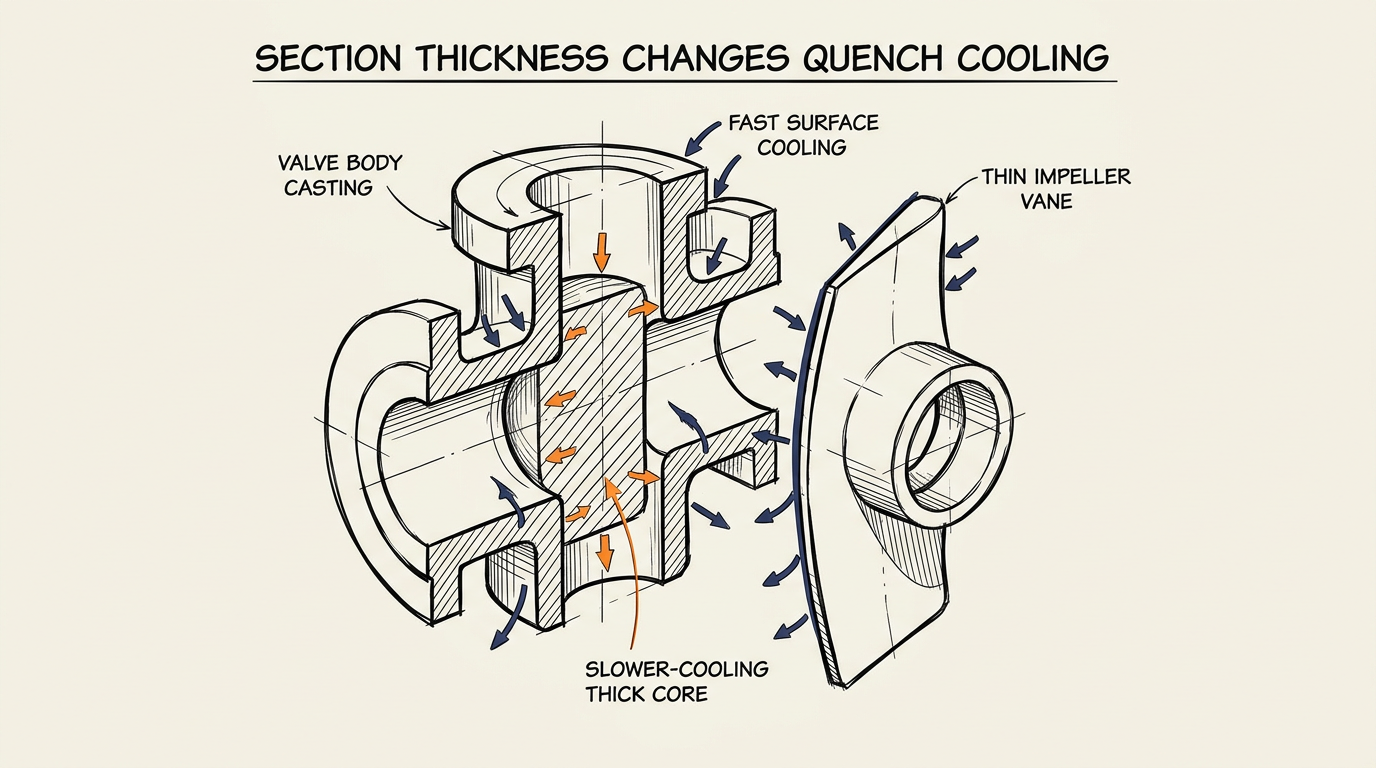
A wrought-to-cast substitution quietly drifts off spec right here — worth checking against your service conditions with the foundry before the drawing is released. Whether stainless is even the right material to cast for the part is a prior question that sits upstream of the CF8-versus-CF3M debate.
The same as-cast behavior — ferrite, section-driven heat treatment — runs through every cast alloy family a foundry pours.
The equivalency table gets the chromium, nickel, and molybdenum right. Ferrite and section thickness are the two things you still have to specify yourself.
Making the Right Grade Call
CF8 and CF3 remain the right default for general and cold-service parts — reaching for CF8M or CF3M by reflex just spends molybdenum the duty may never use. Move to the molybdenum grades only when chloride or reducing acids are genuinely in play.
Drop to the low-carbon CF3 or CF3M whenever the casting will be welded into service without a solution anneal. That call has nothing to do with corrosion — it is about what happens in the weld’s heat-affected zone.
The code on the drawing is a service-condition decision wearing a composition label. The equivalency table gets you to the right neighborhood; chloride exposure, weld plan, and minimum temperature get you to the right door.